For years, students at a high school near the Colosseum in Rome whispered about strange spaces under the gym floor. Now those rumors have led archaeologists to a richly decorated Roman home buried beneath the school, a 1,800-year-old discovery that turns an ordinary gym into a doorway to imperial Rome.
The site is now known as Domus Liceo Cavour. Students first brought the underground rooms to attention after exploring beneath Liceo Scientifico Cavour and telling a teacher, who alerted the authorities. The spaces have since been identified as part of a large second-century Roman house with painted walls, stuccoed ceilings, and more still hidden from view.
A school rumor becomes archaeology
The discovery was presented to the public on May 28, 2026, in the school’s main hall. Claudia Marino introduced the event, while Filippo Coarelli of the University of Perugia opened the presentation, and specialists from the Special Superintendency of Rome described the excavation campaign.
The school reports that remains under the gym were found by chance and were later reported to archaeological officials. In January 2026, crews began removing recently dumped material from the underground rooms, a first step before deeper archaeological work could begin.
What exactly is a domus
A “domus” was a private Roman house, usually linked to a wealthy family rather than ordinary renters. Think of it less like a modern apartment and more like a large home with decorated rooms, service spaces, and areas meant to impress visitors.
This one dates to the middle of the second century CE, when Rome was ruled by emperors and elite families were still building homes near the city’s political and social center. That date matters because taste, money, and status were often written directly onto the walls.
Paint on the vaults
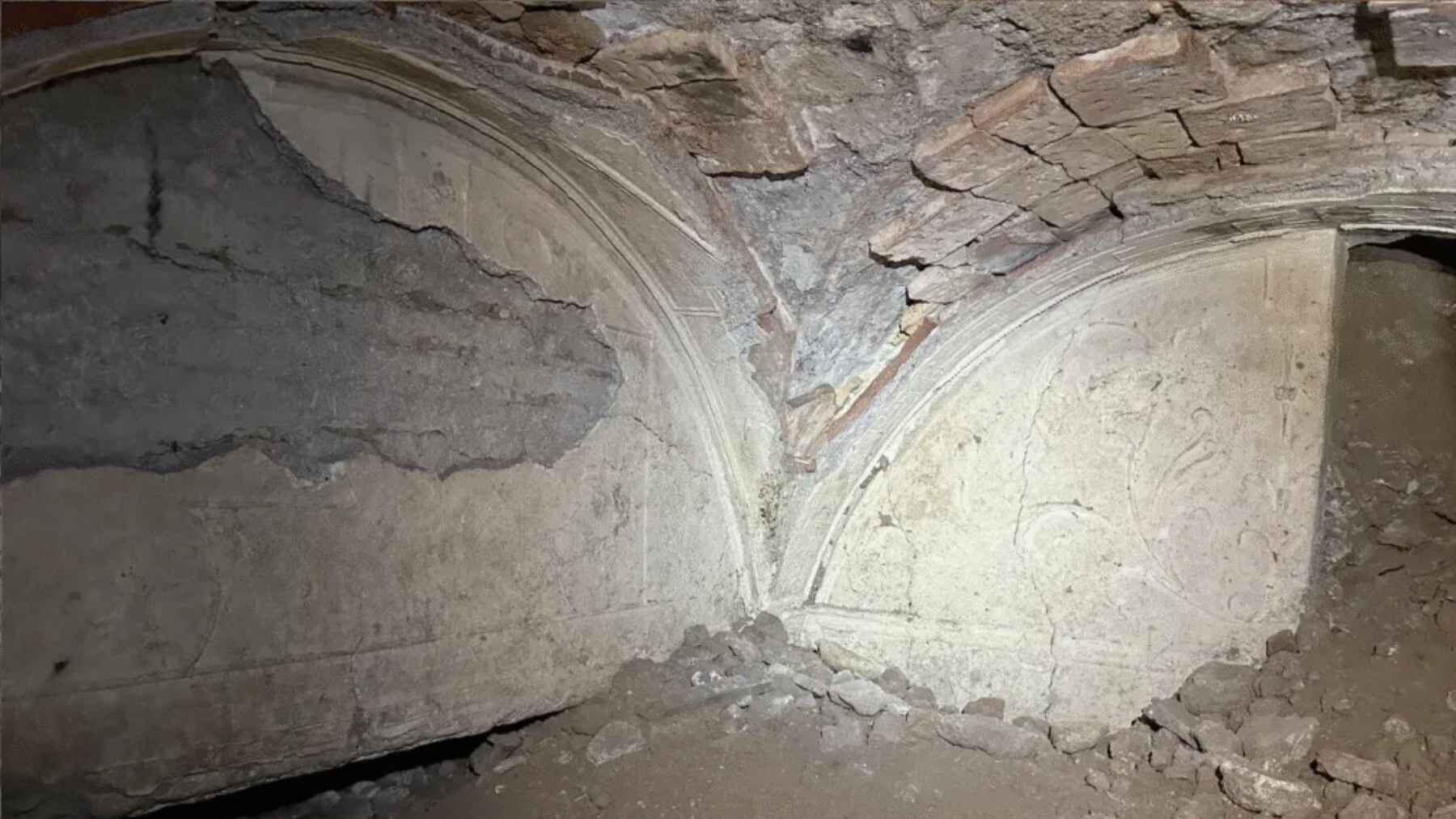
Official descriptions say the visible part of the home included five vaulted and decorated rooms before the recent work began. The walls and ceiling surfaces still preserve painted plaster, floral designs, human figures, and monochrome stucco, although the site also shows cracks, detachment, and vandalism.
That mix tells a very human story. The ancient residents wanted beauty above their heads and around their guests, but later visitors left marks in rooms that had slipped out of public memory.
In one room, archaeologists also found a mosaic made with large, irregular tiles, a style associated with elite taste in the second century. A lead water pipe found in earlier work carried the names Umbria Albina and L. Fabius Gallus, offering a clue to the home’s social world, though not yet a complete answer about ownership.
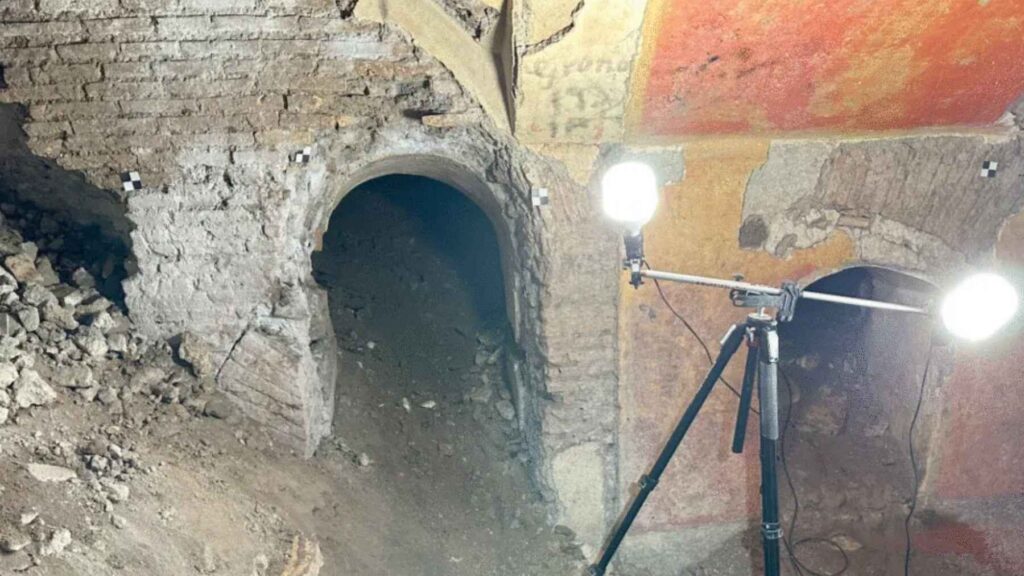
Archaeologists document the underground chambers of the Domus Liceo Cavour, a 1,800-year-old Roman house uncovered beneath a school gym near the Colosseum.
Why this corner of Rome matters
The house sits in Rione Monti, in a central area between the ancient Carinae and Esquiline districts, not far from the Colosseum. The official project page notes that this part of Rome was connected with major figures such as Cicero, Pompey, and Octavian, later known as Augustus, but modern construction has made the ancient layers hard to study.
That is the catch with Rome. The city is packed with history, but much of it lies under roads, schools, apartment blocks, and daily life, which means archaeologists often work around buildings that cannot simply be removed.
Earlier excavations in 1895 revealed part of the residence during work linked to Via degli Annibaldi, but that eastern sector was later lost. The rediscovery beneath the school gives researchers a rare chance to study another surviving portion of the same high-status home.
Students may become guides
The plan is not only to dig and then close the doors again. Official project documents describe conservation work, safer access, a visitor route, educational material, and digital tools that could help make the site understandable to the public.
In the future, it could mean students eventually explaining the ancient rooms to visitors standing below their own school. The project page lists roughly $400,000 in funding and about $240,000 in work costs according to recent exchange rates.
For teenagers used to bells, backpacks, and gym class, that is a strange kind of field trip. The past is not across town in a museum case; it is under the floor, waiting for someone curious enough to ask what is behind the door.
A buried lesson in plain sight
What makes the find so striking is not only the frescoes or the possible names on a pipe. It is the way a school rumor, the kind students pass around between classes, ended up pointing toward a real piece of Roman domestic life.
There is a lesson here, and it is not buried very deep. Archaeology does not always begin in a remote desert or on a planned dig; sometimes it begins under a gym floor, where curiosity bumps into history.
The official project has been published by Cantieri Narranti.