Britain’s legendary summer of 1976 has long been remembered as the heat wave by which all others are judged. It brought dry reservoirs, wildfires, water shortages, and 15 straight days when temperatures somewhere in the U.K. climbed above 90°F.
Now scientists have asked a more unsettling question. What would that same weather pattern look like in today’s warmer climate? Their answer is clear enough to make the old benchmark feel less like history and more like a warning.
The old benchmark has shifted
In 1976, the U.K. heat wave peaked at 96.6°F in Cheltenham on July 3, and it became part of national memory through images of parched lawns and standpipes in the streets. The Met Office says the broader summer is still one of the most iconic weather events in U.K. history, but it happened in a much cooler world.
That matters because the U.K. is no longer comparing today’s heat with the same baseline. In late June 2026, provisional Met Office observations recorded 99.9°F at Lingwood in Norfolk, a new U.K. June daily maximum temperature record.
A few decades ago, 90°F felt exceptional in Britain. Today, it can feel like the edge of a new normal, especially when the heat lingers through the night and pushes into homes that were never designed for this.
What 1976 would feel like now
According to the analysis, a heat wave comparable to 1976 would already be about 5.4°F hotter in today’s climate. This means the famous 15 days above 90°F could become 15 days above 95°F.
Peak temperatures in a present-day version of the 1976 event would likely sit around 100°F to 102°F. That might not beat the U.K.’s all-time heat record of 104°F, reached in July 2022, but it would still be far beyond the conditions most schools, hospitals, railways, and homes were built to handle.
Professor Ed Hawkins of the University of Reading put the change plainly, saying 1976 happened in “a much cooler climate.” His warning is not just about one hot week, but about how quickly the yardstick for extreme heat is moving.
Heat does not stop at sunset
The trouble is, heat is not only a daytime story. When nights stay hot, buildings cannot cool down, sleep gets harder, and the body has fewer hours to recover.
The Met Office noted that warm nights are now a key part of the danger, especially because most U.K. homes do not have air conditioning. During the recent 2026 heat wave, four nights stayed above 71.6°F somewhere in the U.K., compared with three such nights during the entire 1976 event.
Anyone who has tried to sleep in a stuffy bedroom during that sticky summer heat knows the problem. For older adults, babies, people recovering from surgery, and workers in hot indoor spaces, it is not just uncomfortable. It can become dangerous.
Roads, rails, and daily life
Britain’s infrastructure was largely built for a milder climate. Roads soften, rail tracks buckle, power demand rises, and water supplies come under pressure right when people need them most.
That is why extreme heat is now treated as more than a beach-weather headline. The Met Office says heat warnings reflect risks to health, infrastructure, and essential services, not just the number on a thermometer.
Think about a school exam hall with no cooling, a packed commuter train stopped on overheated tracks, or a hospital ward trying to care for vulnerable patients in high temperatures. This is where climate science stops feeling abstract.
The 2056 scenario
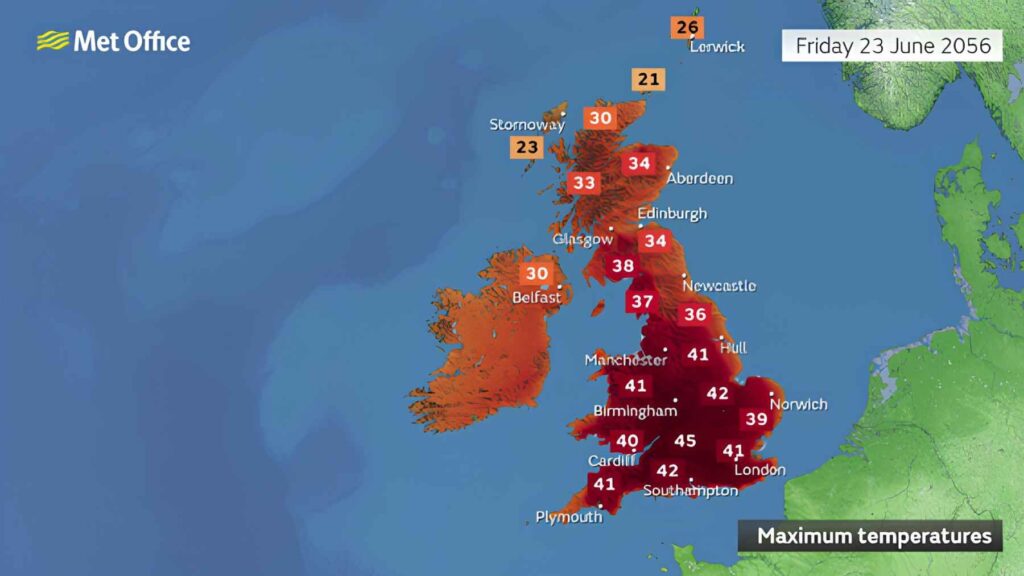
The Met Office also developed a plausible 2056 heat wave scenario based on a world around 4.5°F warmer than preindustrial levels. It is not a forecast for a specific future day, but it shows how risks could change if warming continues.
In that scenario, temperatures could peak at 113°F in England, 106°F in Wales, 100°F in Scotland, and 86°F in Northern Ireland. The same scenario includes about two weeks of extreme heat, with nine consecutive days above 104°F somewhere in the U.K.
That kind of heat would reshape ordinary life. Outdoor sports, crowded buses, classrooms, construction sites, and even the weekly electric bill would all become part of the climate story.
Why the future is not fixed
The scientists are not saying Britain is helpless. They are saying that every extra year of greenhouse gas emissions makes future heat waves more frequent, more intense, and harder to manage.
Most of the warming is tied to greenhouse gases released by burning fossil fuels, according to the official research summary. Cutting those emissions, restoring nature, reducing deforestation, and preparing cities for heat would not bring back the climate of 1976, yet it could still limit how severe the future becomes.
At the end of the day, adaptation and prevention have to move together. Shadier streets, cooler homes, stronger water systems, and cleaner energy are not luxuries when summers keep breaking records.
The lesson from 1976
The summer of 1976 is still remembered because it lasted so long. What has changed is that today’s atmosphere can turn a similar weather pattern into something hotter and more hazardous.
That is the real message from recreating the old heat wave in the present climate. The past has not disappeared, but the conditions around it have changed, and the next version may be much harder to live through.
The official statement was published on the Met Office’s website.