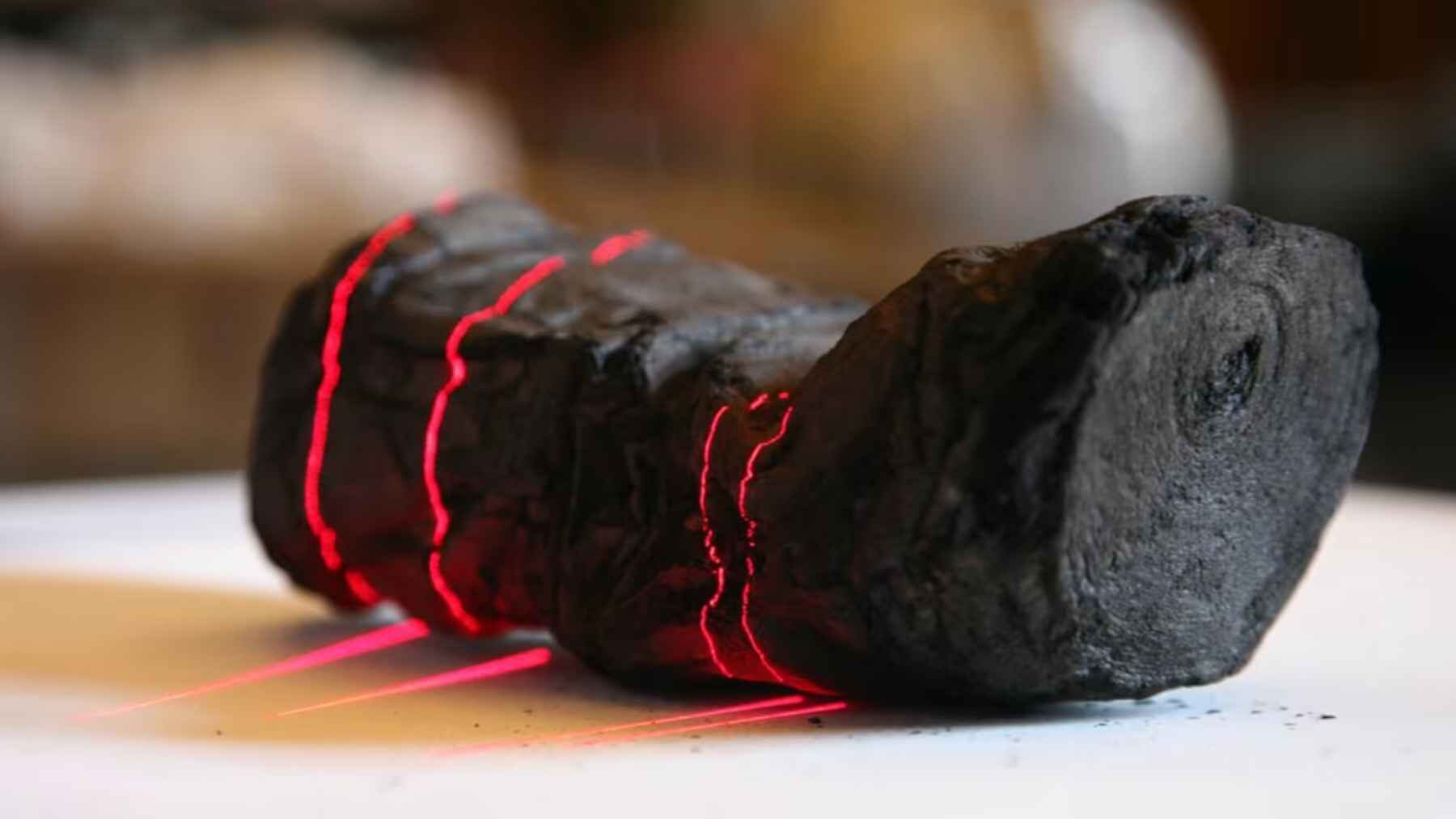
A blackened papyrus roll buried in the eruption of Mount Vesuvius has been read from beginning to end without being opened by hand, a feat that would have sounded almost impossible just a few years ago. The scroll, known as PHerc. 1667, was carbonized in 79 AD and later became part of the famous Herculaneum collection, whose sealed rolls are too fragile to unroll safely.
The breakthrough matters because this is not just one old document coming back into view. It shows that advanced X-ray imaging, virtual unwrapping, and machine learning can recover hidden writing from a library that has been physically preserved but intellectually locked away for almost 2,000 years. For classicists, it is a little like finding a sealed room in history and realizing the key actually works.
A library trapped by a volcano
The Herculaneum papyri were discovered in the 18th century in the Villa of the Papyri, an elite Roman residence buried during the same volcanic disaster that destroyed Pompeii. The eruption charred the scrolls, but it also preserved them in a strange, cruel way. They survived, yet touching them could destroy the very words scholars wanted to save.
The arXiv preprint describes the Herculaneum papyri as the only large-scale library to survive from classical antiquity. Hundreds of unopened rolls still remain unread, and earlier efforts to open some of them mechanically revealed texts at a steep cost. Imagine trying to read a book made of ash.
How AI read the burned papyrus
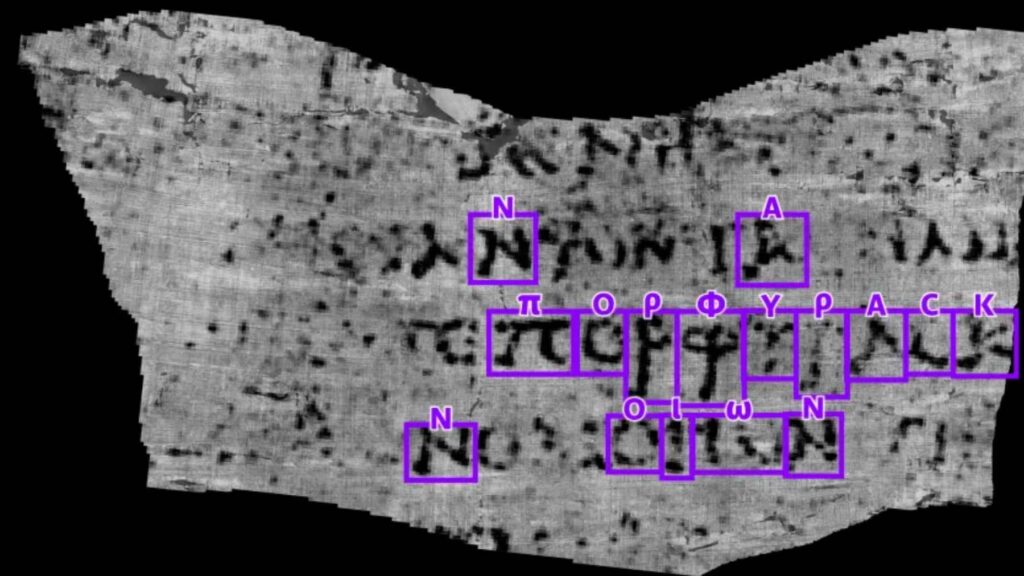
The team did not crack open PHerc. 1667. Instead, researchers used high-resolution phase-contrast X-ray microtomography at the European Synchrotron Radiation Facility, then reconstructed the curled sheet inside the roll, flattened it digitally, and used machine-learning tools to make faint ink signals visible.
That may sound simple on paper, but the challenge is brutal. Carbon-based ink can look almost the same as carbonized papyrus in X-ray scans, so the system has to catch tiny differences in texture, surface shape, and contrast. Then papyrologists still have to inspect the results, letter by letter.
Why PHerc. 1667 is different
PHerc. 1667 had been considered effectively unreadable after earlier physical handling in the 20th century. What remains is only the compact inner core, about 3” tall, from an original scroll height of roughly 7.5” to 9.4”. The object is only about 0.8” wide, small enough to disappear in your palm, but it carried a long-hidden argument inside.
The study reports a reconstructed writing surface with 22 columns or column-equivalents across almost 1 ft.² of preserved papyrus. Vesuvius Challenge says the complete surface is roughly 4.6 ft. of papyrus, read continuously rather than as scattered words or lucky fragments. That is the leap.
A lost Stoic voice emerges
The newly recovered text appears to be a philosophical treatise about ethics, human nature, impulse, and moral progress. The evidence points to a Stoic context, and the final preserved column names Aristocreon, the nephew and pupil of Chrysippus, one of the most important early Stoic thinkers.
So what was the writer worried about? The text discusses “hormē,” or impulse, a drive to act that humans and animals share. The author appears to warn that when reason fails to regulate behavior, impulse can become harmful passion or pull a person away from their goals.
Another idea is “phronēsis,” often translated as practical wisdom. This is the ability to choose well, not just to know impressive things. The recovered passage includes the line, “we will inquire into something, but we will not grasp it, if in some way we depart from ourselves and from our own nature.”
Why one title changes the library
The same project also recovered title and author evidence from another sealed scroll, PHerc. 139. Researchers identified it as “Philodemus, On Gods, Book 8,” a finding that shows the work extended to at least eight books. Until now, only the first book was known.
That may seem like a tiny library label, but labels matter. A title can tell scholars what a sealed roll contains before they have fully read its running text. It is the ancient equivalent of finally seeing the spine of a book that has been locked shut for two millennia.
The human work is just beginning
The Vesuvius Challenge began in 2023 as an open effort built around imaging, computer vision, and machine learning. But the newest results suggest the project is moving into a different phase–the machines can help reveal the marks, but people still have to decide what they mean.
Brent Seales, co-founder of the Vesuvius Challenge and a University of Kentucky computer scientist, put it plainly. “Now we need experts who can read, edit and understand what they are saying,” he said. That is a good problem to have.
After centuries in which the scrolls could either stay unread or be damaged by opening, researchers now face a new task: turning digital recovery into cultural recovery. The clock is no longer beating against fragile papyrus in quite the same way.
What could come next
The method does not mean every Herculaneum roll will suddenly become readable. The arXiv study warns that results still depend on preservation, scan quality, layer separation, deformation, local ink contrast, and the condition of the surface. In other words, some scrolls may speak clearly, while others may whisper.
Still, this is a major change in the archaeology of ancient knowledge. The Vesuvius Challenge says hundreds more scrolls remain sealed, and the method is designed to scale as data, code, and transcriptions are made openly available. For the first time in a very long time, the lost library of Herculaneum feels less like a ruin and more like a reading list.
The full preprint was published on arXiv.