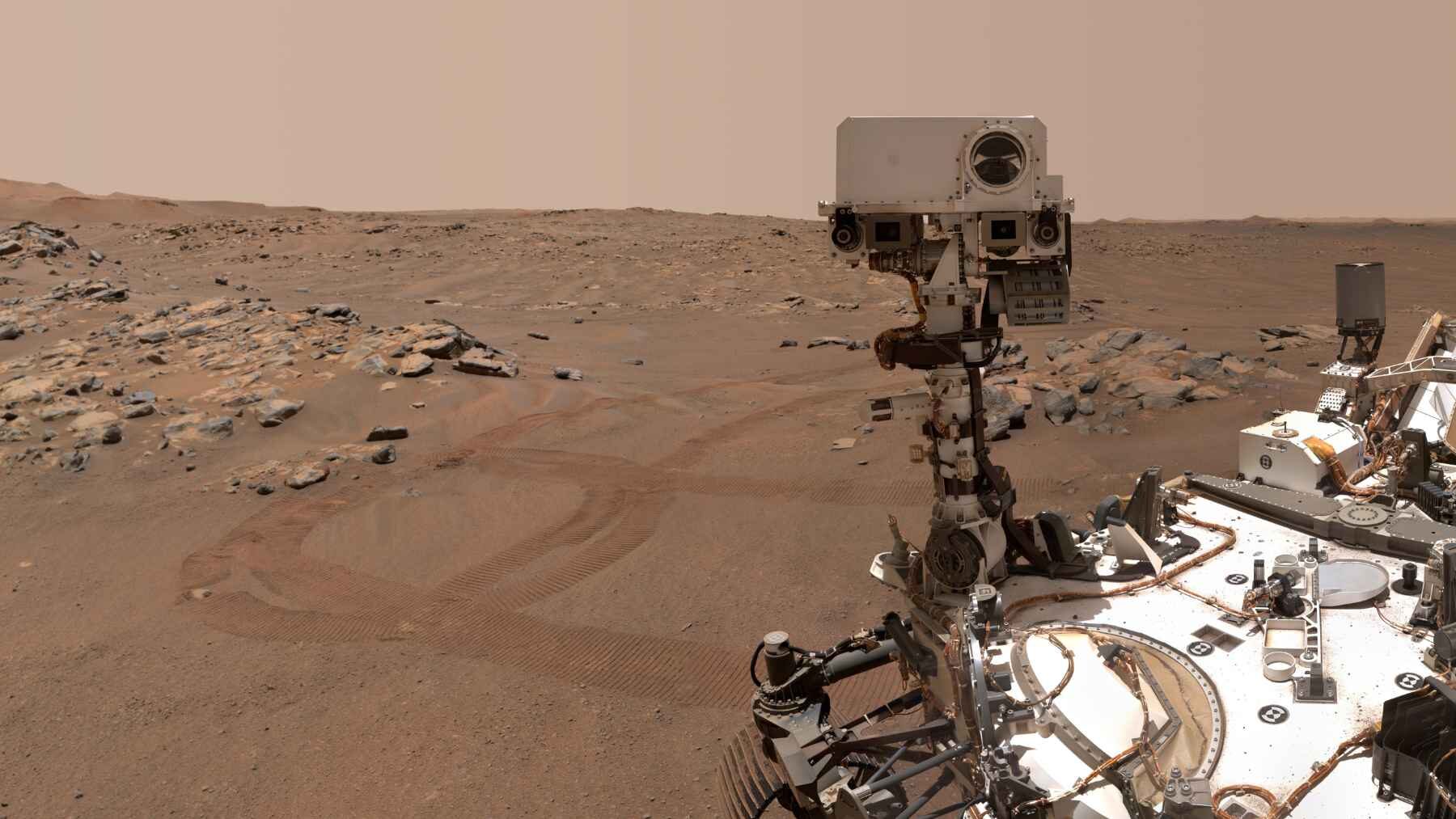
NASA’s Perseverance rover has crossed a symbolic finish line on Mars. On June 14, 2026, the six-wheeled robot reached 26.2 miles of driving across the Red Planet, the same distance as a marathon here on Earth.
That number may sound ordinary if you are picturing a Sunday race through city streets. On Mars, however, where every move is planned from millions of miles away, the milestone says something bigger about how fast robotic exploration is changing.
A marathon without a crowd
Perseverance reached the marathon mark after five years and four months of driving on Mars. NASA’s Opportunity rover also reached that same distance, but it took 11 years and two months to get there, according to the official image release from the Jet Propulsion Laboratory.
That comparison is striking. Perseverance is not racing on smooth pavement, and nobody is standing beside the route with water cups or cheering signs. It is crossing loose dust, rocks, slopes, and rough ground while its team carefully decides where it can go next.
The rover’s top speed is only about 0.06 mph in ideal conditions. That is slower than a person strolling through a grocery store aisle, but speed is not really the point. On Mars, safe progress matters more than quick progress.
Spotted from orbit
The moment was documented from above, not from the rover’s own cameras. NASA’s Mars Reconnaissance Orbiter photographed Perseverance on June 13, 2026, one day before the rover passed the marathon distance.
In the image, Perseverance appears as a tiny green speck west of Jezero Crater in an area the science team calls “Arbot.” Its tracks stretch across the surface like a faint line in the dust, showing the turns, detours, and course corrections made along the way.
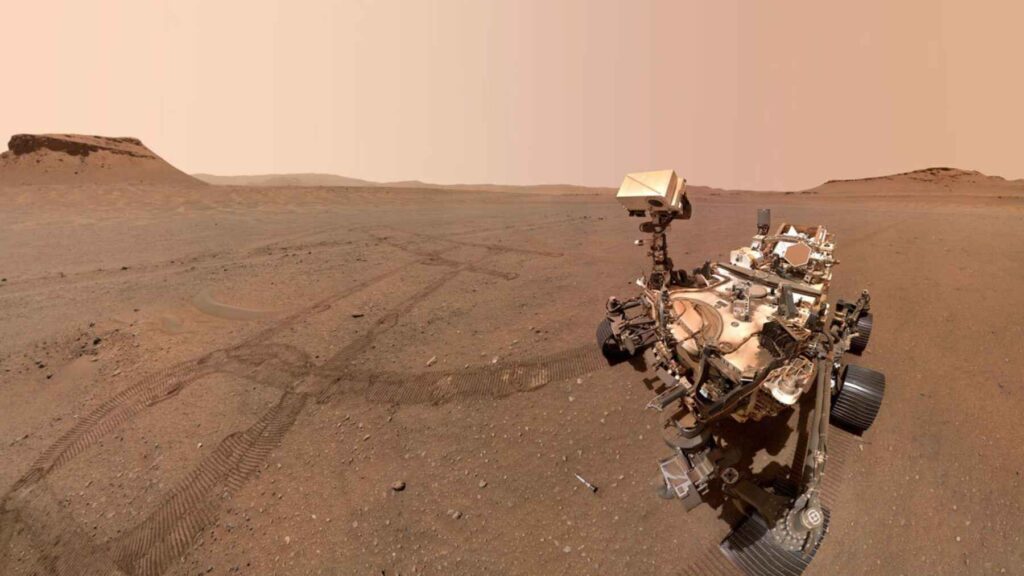
That overhead view tells a different story than a selfie or a close-up of a rock. It shows the route as a physical mark on another planet. Every bend in that line hints at a decision made to avoid danger or reach a better scientific target.
Why the miles matter
Perseverance is part of the Mars 2020 mission, which is searching for signs of ancient microbial life. In simple terms, that means scientists are looking for clues that tiny life forms may have existed when Mars was wetter and warmer.
The rover also collects rock and regolith, which is broken rock and soil, for possible return to Earth by a future mission. NASA describes Perseverance as the first step in a proposed round trip to bring Martian samples home for more detailed study.
That is why distance matters. Each mile gives the rover access to new layers of rock, new landscapes, and new clues. The goal is not just to drive far, but to read Mars like an old book with missing pages.
Jezero’s ancient story
Jezero Crater was chosen because scientists believe it once held a lake and an ancient river delta. A delta forms where flowing water slows down and drops mud, sand, and minerals, sometimes preserving signs of past environments.
Could traces of ancient life be hidden there? That is the big question. No confirmed evidence of life has been found on Mars, but some rocks can still carry chemical or structural hints worth studying.
In 2025, NASA reported that a Perseverance sample from a rock called “Cheyava Falls” contained potential biosignatures. A potential biosignature is not proof of life, it is a clue that could have a biological origin; but it needs more testing before scientists can draw that conclusion.
Driving is science
A rover drive is not just a commute from point A to point B. In practical terms, every move must fit into a daily plan that balances science, safety, power, time, and communication with Earth.
The team has to decide which paths are worth the risk. A tempting rock outcrop may hold useful information, but a bad route can threaten the rover’s wheels or slow the mission. That is where patience becomes part of the science.
Think of it like walking across a messy construction site in the dark, except the construction site is another planet. You do not step anywhere without thinking first. Perseverance does that kind of careful work every time it rolls forward.
Two rovers, one planet
Perseverance is not working alone. NASA’s Curiosity rover is exploring a different region of Mars about 2,300 miles away, and together the two missions are helping scientists compare very different chapters of Martian history.
Curiosity is studying Gale Crater and Mount Sharp, while Perseverance is focused on Jezero Crater and its ancient watery environments. One rover cannot tell the whole story of a planet. Two rovers, working in different places, give researchers a broader view.
That wider view matters because Mars changed dramatically over time. It went from a planet with evidence of water activity to the dry, cold world we see today. The trouble is, the details of that transition are still not fully understood.
The orbiter’s role
The Mars Reconnaissance Orbiter is more than a camera platform. It has been studying Mars since entering orbit in 2006, looking for evidence that water persisted on the surface long enough to create possible habitats.
Its HiRISE camera, operated by the University of Arizona, can spot small details on the Martian surface. That ability helps scientists track rover routes, inspect terrain, and choose safer or more useful targets for future exploration.
From the ground, Perseverance sees Mars like a traveler standing among rocks. From orbit, the spacecraft sees the map. Put those views together, and the mission becomes much stronger.
What comes next
Perseverance’s marathon is not the end of the story. It is a checkpoint in a mission built around patience, precise engineering, and the search for ancient life.
For most of us, 26.2 miles means sore legs and a finish-line photo. On Mars, it means years of careful driving, thousands of decisions, and a growing trail across a crater that may once have held the ingredients for life.
The official image release has been published by NASA’s Jet Propulsion Laboratory.