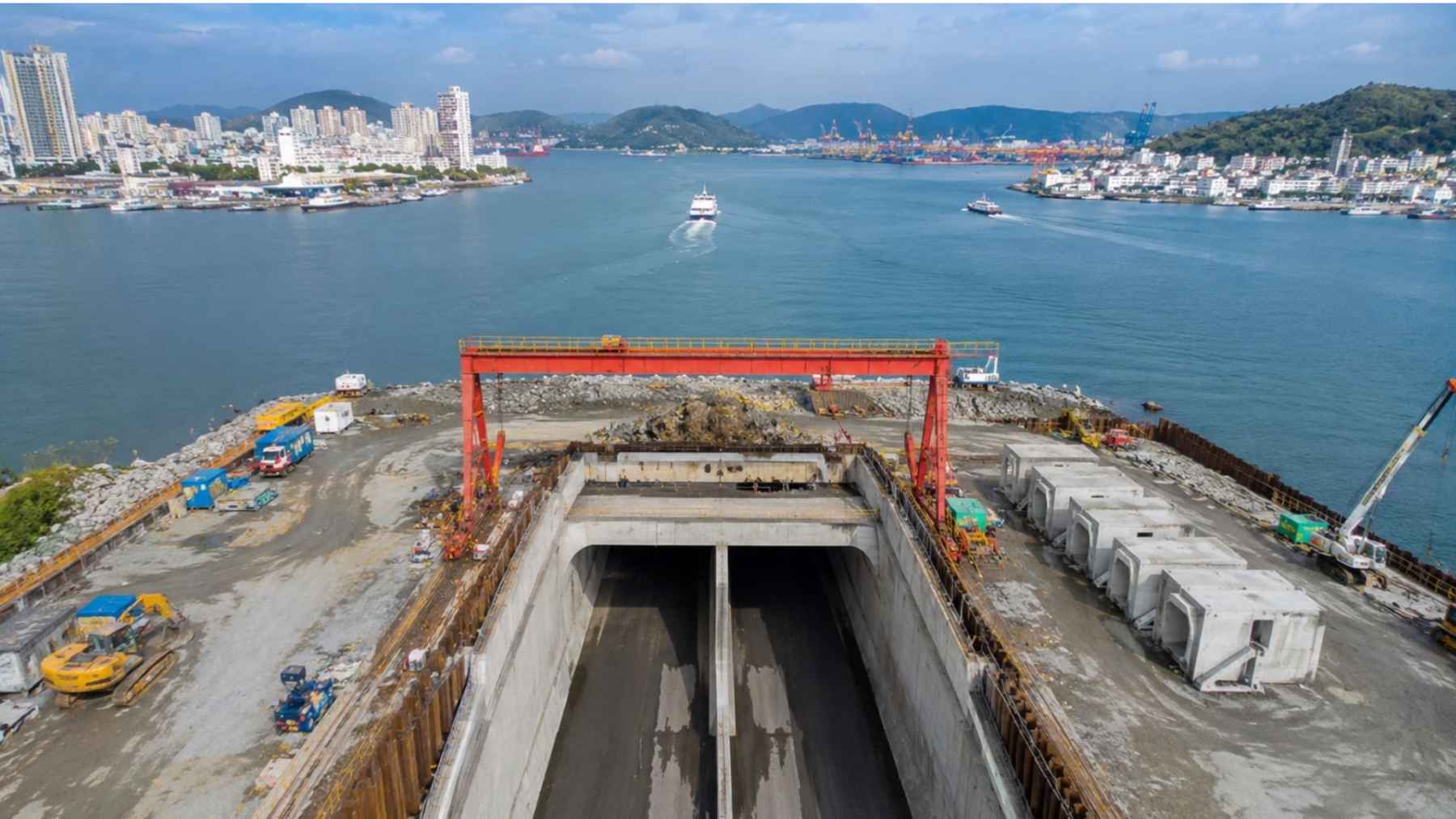
Brazil is getting ready for a piece of infrastructure it has talked about for more than a century. The Santos-Guarujá Tunnel, planned for the coast of São Paulo state, would become the country’s first immersed tunnel, creating a permanent dry link below the Port of Santos channel instead of relying so heavily on ferries and long road detours.
The latest step is not concrete or machinery, but money control. The Santos Port Authority has authorized an exclusive escrow account for federal resources tied to the project, a move meant to answer oversight demands and keep public funds connected only to the tunnel. For a project now listed at R$6.8 billion, or roughly $1.35 billion, that matters. A lot.
A historic dry link
The tunnel is designed to connect Santos and Guarujá across a total length of about 0.93 miles, including a submerged stretch of roughly 2,854 feet under the port channel. That may sound modest on a map, but for residents stuck between ferry lines, port traffic, noise, and exhaust fumes, it could change the rhythm of daily life.
Official project information says the crossing could fall from about 50 minutes to less than five minutes. Other state information notes that a road trip between the two cities can take around an hour today, while ferry crossings are affected by weather and ship traffic. Who would not want a more predictable commute?
Built for more than cars
The project is not being sold as just another road tunnel. It is planned with three lanes in each direction, space prepared for the VLT light rail system, pedestrian access, bicycle passage, and a service gallery. In practical terms, that means the tunnel is supposed to serve commuters, port workers, cyclists, and future public transit riders, not only drivers.
That multimodal design is the environmental piece worth watching. A tunnel that simply attracts more car traffic would not be the same as one that also supports light rail, bikes, and walking. The difference may show up in traffic jams, local air quality, and the small everyday choices people make when crossing the channel.
Ferries still matter
Today, the Santos-Guarujá crossing is a busy system. According to São Paulo state information, boats in the Baixada Santista region carry more than 21,000 vehicles, 7,700 cyclists, and 7,600 pedestrians a day, operating around the clock.
The tunnel is expected to reduce dependence on ferries, but officials have not described the boats as disappearing overnight. That is an important detail. For many people, the best mobility system is not one single option, but several reliable ways to get across when the weather turns, traffic builds up, or a work shift ends late.
The money question
Older references to the project placed the investment near R$4.2 billion, or about $831 million. The official project website now lists R$6.8 billion, or about $1.35 billion, while the public contribution schedule shows R$5.13 billion, or about $1.02 billion, split between São Paulo state and Brazil’s federal government.
That is why the escrow account has become more than a financial footnote. Anderson Pomini, president of the Santos Port Authority, said the measure aims to ensure “transparency and proper governance” for the money intended to build the dry connection. In plain English, the public needs to know where the money is, what it is paying for, and who can touch it.
The environmental test
Big infrastructure can solve one problem while creating others. In this case, the main environmental watchpoints include dredging, sediment handling, impacts on mangroves, noise, conservation areas, local fauna and flora, and possible displacement effects near the route.
São Paulo’s environmental agency, Cetesb, has already issued a preliminary environmental license, but that does not mean the ecological work is finished. The winning concessionaire must still present detailed mitigation and compensation plans, along with communication programs for local residents, before the next licensing stages can move ahead.
How it will be built
The tunnel is planned as an immersed structure, using prefabricated concrete modules made outside the channel and later placed into a trench in the port bed. It is a technique already used in other parts of the world, but this would be Brazil’s first project of its kind.
The public schedule points to project preparation in 2026, initial works in 2027, concrete module production in 2028, immersion and assembly in 2029, final systems and testing in 2030, and commercial operation in 2031. That is the plan, at least. With projects this large, the clock often depends on engineering, licenses, money, and politics moving in the same direction.
What happens next
Mota-Engil won the public-private partnership auction and is set to handle construction, operation, and maintenance under a 30-year contract. The state says the project could generate about 9,000 direct and indirect jobs, another reason local expectations are running high.
Still, the most important promise is not only speed. It is whether the tunnel can improve mobility without treating the Santos estuary as an afterthought. At the end of the day, the real test will be simple enough for anyone waiting in ferry traffic to understand. Faster crossings are useful, but cleaner, safer, and better-governed crossings are what make a project last.
The press release was published on the Santos Port Authority’s website.