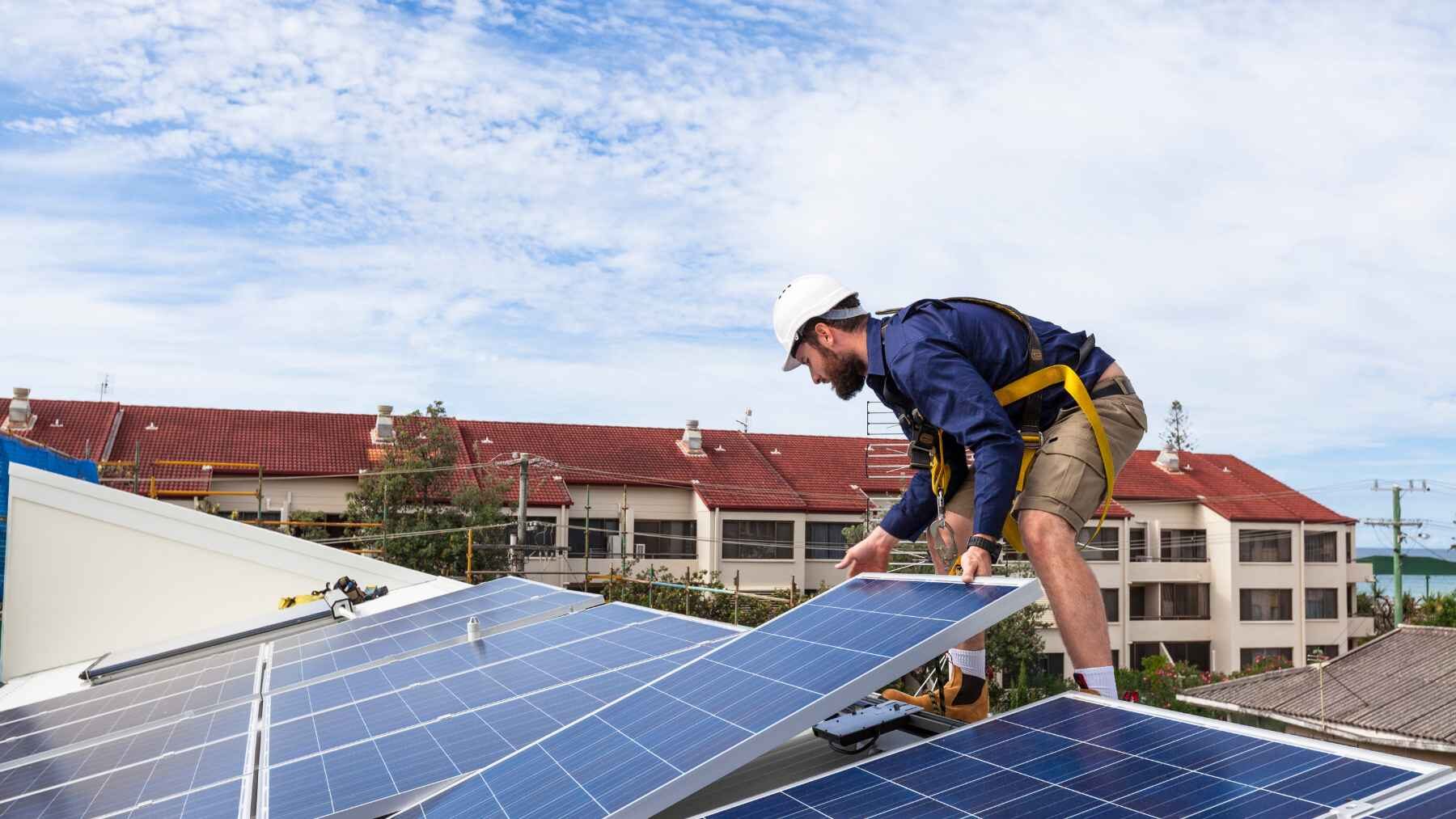
People with solar panels at home may soon notice that the story on their electric bill is no longer just about how much power their roof produces. The bigger change is about when that power is used, how much is stored, and what utilities decide it is worth when it flows back to the grid.
New data from the International Renewable Energy Agency (IRENA) shows that solar power is no longer a niche technology trying to catch up. In 2025, utility-scale solar photovoltaic power held at about $44 per megawatt-hour, or roughly 4.4 cents per kilowatt-hour, while onshore wind fell to about $33 per megawatt-hour, or 3.3 cents per kilowatt-hour. IRENA says renewables are now “the cheapest source of new electricity in most markets.”
Falling costs are changing solar
The long fall in clean energy costs has been dramatic. Since 2010, IRENA says the cost of solar photovoltaic power has dropped 89%, onshore wind has fallen 71%, and offshore wind has declined 63%. More than 90% of new utility-scale renewable capacity commissioned in 2025 produced electricity at a lower cost than the cheapest new fossil fuel alternative.
For homeowners, that does not mean every rooftop system suddenly becomes cheap overnight. It does mean the wider market is moving in their direction, especially as cheaper panels, inverters, and batteries filter into residential offers over time.
And then there is storage. IRENA reports that four-hour utility-scale battery costs fell close to 30% in 2025 alone, reaching about $140 per kilowatt-hour of storage, about 95% below their 2010 level. That is not a rooftop battery quote, but it is a strong signal of where the market is heading.
What changes on the electric bill
A home solar system usually cuts the amount of electricity bought from the grid during sunny hours. Simple enough. But the bill itself can still include fixed charges, grid fees, minimum payments, and different prices depending on the hour.
That is why some solar owners may see the value of their system shift from exporting electricity to using more of it at home. In practical terms, running the dishwasher, charging an electric car, or cooling the house during peak sunlight can matter more than it used to.
The same goes for batteries. If a household can store midday solar power and use it during the evening, especially when air conditioning kicks in during that sticky summer heat we all know, the savings can look very different from a solar-only setup.
Batteries move from bonus to backbone
For years, home batteries sounded like an expensive extra. Now they are becoming part of the larger clean energy equation, especially because solar production peaks during the day while household demand often rises after sunset.
IRENA’s latest cost comparisons show that solar-plus-battery systems designed for 95% reliability fell from more than $100 per megawatt-hour in 2020 to below $85 per megawatt-hour in 2025 at high-quality sites. That is below about 8.5 cents per kilowatt-hour. The agency also projects further reductions of around 30% by 2030 and 40% by 2035.
There is another clue in the utility market. Around one quarter of newly commissioned utility-scale solar capacity in 2025 was paired with battery storage, according to IRENA. Once big projects normalize storage, residential products, financing, and installer experience usually start to follow.
Cheap panels do not guarantee cheap power
Here is the catch. The cost of the technology is only part of the final price. Permits, grid connection delays, financing costs, interest rates, and local rules can all change the economics.
IRENA warns that where a project is built now matters a great deal. Its cost-of-capital model suggests that country-level economic conditions such as sovereign risk, interest rates, and inflation explain about 56% of the variation in financing costs, far more than technology alone.
That same idea applies at the household level, just in a more familiar way. A solar loan with a high interest rate, a roof that needs repairs, or a long interconnection wait can eat into savings even when panels themselves are cheaper.
Brazil shows the opportunity
The original market discussion pointed to Brazil as one of the places where cheaper clean energy can support microgeneration and ease household budgets. That makes sense, for the most part, because Brazil is already one of the lower-cost solar markets in IRENA’s comparison.
In 2025, IRENA estimated solar photovoltaic electricity at about $37 per megawatt-hour in Brazil, or 3.7 cents per kilowatt-hour. That was close to China at $36 and India at $35, while Germany stood much higher at $65.
Still, local rules will decide how much of that global cost drop reaches families. Net metering policies, taxes, utility compensation for exported power, and distribution fees can turn the same rooftop system into a great deal in one city and a slower payoff in another.
The next solar question is timing
So, what should solar owners watch now? Not just the panel price. The more important questions are how their utility values exported electricity, whether time-of-use rates apply, and whether a battery can shift solar power into the hours when electricity is most expensive.
At the end of the day, the grid still has to work when clouds roll in and lights come on. Solar can help, but storage and smarter rate plans are what turn daytime sunshine into evening savings.
The climate case is also getting stronger. IRENA estimates that renewables avoided about $480 billion in fossil fuel costs in 2025 and prevented about 9.3 billion U.S. tons of carbon dioxide emissions. That turns clean energy into something more practical than a distant environmental goal. It becomes protection against fuel price shocks, and yes, against painful electric bills.
For home solar owners, the message is clear but not simplistic. The panels on the roof are still the star, but the next big change may come from the battery in the garage, the rate plan from the utility, and the hour when electricity is used.
The report was published on IRENA.