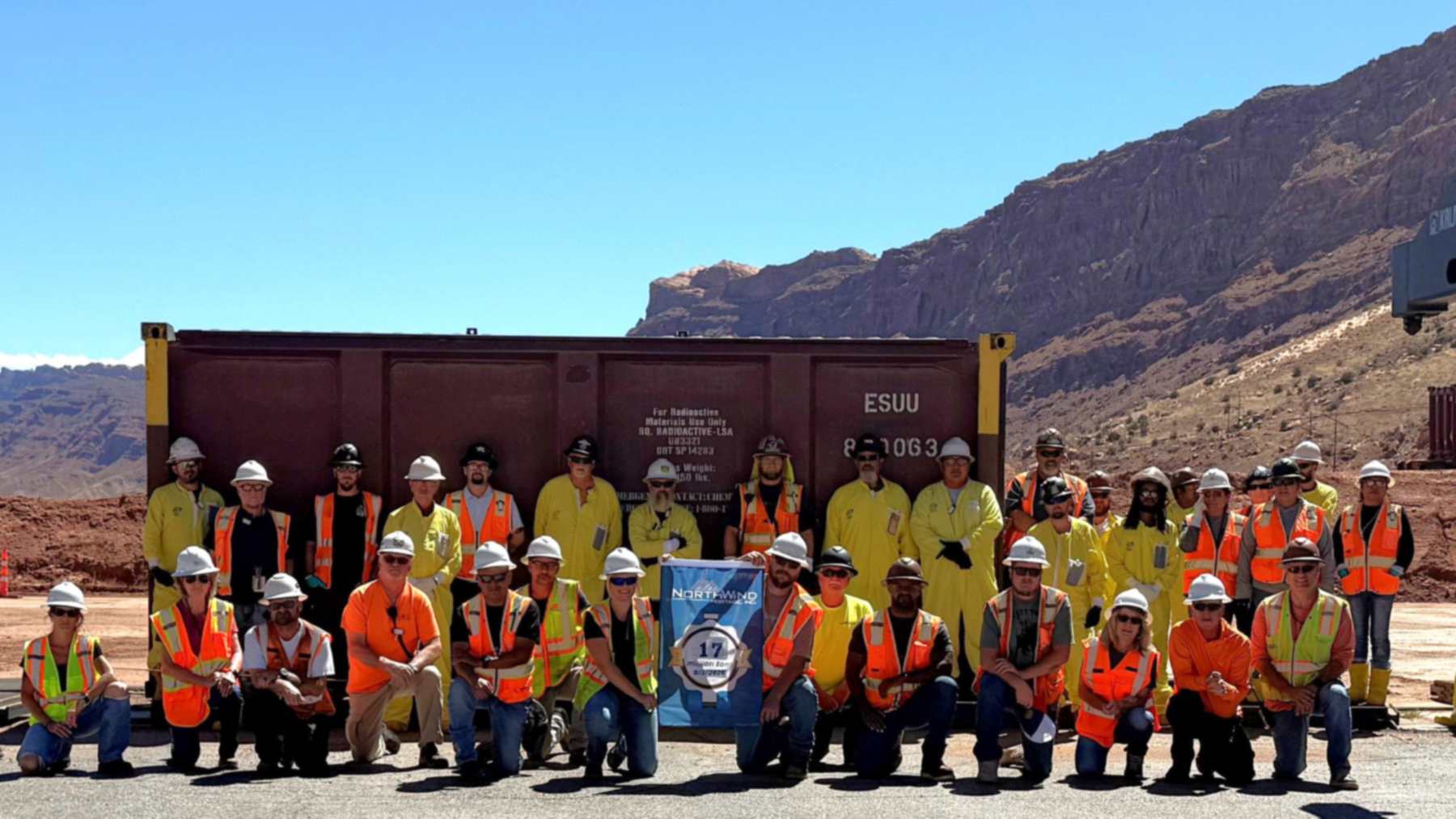
Drive into Moab, Utah, from the north on Highway 191 and you still see trucks and heavy equipment moving red dirt by the Colorado River, where the Moab uranium tailings sat for decades and where the Department of Energy says crews have now shipped 17 million tons (about 15.4 million metric tons) of waste out by train since 2009.
“Over the course of 30 years or so of processing that uranium ore, just a huge tailings pile built up, and it’s literally on the Colorado River, just north of Moab,” Grand County Commissioner Jacques Hadler told KUER 90.1. “And it’s been amazing in my time here watching that pile dwindle.”
DOE posted the number on September 29, 2026. Its crews “have transported the tailings by rail from the Moab Site to an engineered disposal cell about 30 miles away in Crescent Junction,” the agency wrote, a distance of about 48 kilometers.
Where the pile came from
Tailings are what’s left of the rock after the uranium is taken out. In Moab they piled up next to a processing plant that ran under private owners from 1956 to 1984, on a site of 480 acres (194 hectares).
Mary McGann watched it grow. Her father was a superintendent at the old Atlas Minerals mill, and at an April ceremony she told the crowd, “We lived here in the ’50s. We drove into this town and there wasn’t a pile, and we had the misfortune, or the fortune, because it was our economy to watch it grow to 90 feet high.”
“I’ve always said my dad built the pile, and I’m tearing it down,” said McGann, now a Grand County commissioner and chair of the Moab Tailings Project Steering Committee, as reported by The Times-Independent.
Meg Bigler got to town in 1990. “I came in at night, so I couldn’t see what I was coming into, but when I woke up and saw the red rocks against the blue sky, it meant home to me,” she told KUER.
The pile was part of that view. “I knew what it was, sort of, that it was a pile left over from the uranium mining, and I didn’t know what tailings were at the time, but I knew that it was creepy seeing dust come off of the tailings pile in a stiff wind,” Bigler said.
Forty million people downstream
The bigger fear was water. In a July 2026 review the Government Accountability Office wrote that “The surrounding groundwater was contaminated and flowed into the Colorado River, posing environmental risks.”
Moab Mayor Joette Langianese has worked on the cleanup for more than 25 years, and she remembers what she was told. “A town of 10,000 people is never going to move the needle of commerce,” she recalled being told. “Forty million water users downstream, California, Arizona, Nevada, they’re going to move the deal. And they did. Here we are today.”
She also remembered what U.S. Sen. Mike Lee used to say about it. “You know what? The federal government created this problem,” Langianese recalled. “They need to fix it. They need to take care of it.”
“Finally, finally this project is almost completed,” she said in April. “There was a time when we never thought this project would end.”
Sixteen tiles, then one more million
Back in 2009 the pile was estimated at about 16 million tons. The project made a plaque with 16 movable tiles, one per million tons, and moved them one at a time to a second plaque showing the Crescent Junction cell, with the last one going across on April 9, 2026.
“It’s such a huge, historic milestone,” Matt Udovitsch, the federal cleanup director, said that day, according to The Times-Independent. “What once was a longstanding environmental liability is now a meaningful opportunity for reuse.”
Jeff Scott, president of the contractor North Wind Portage, said many workers had been on the project since its early years. “We have a truly amazing team, and it takes a truly amazing team to do something like this,” he said.
Digging went on after the ceremony, and DOE says the work now includes “removing remaining contaminated soil beneath and adjacent to the surface tailings pile,” and by late September the running total had reached 17 million tons.
Crescent Junction keeps it for good
The cell up at Crescent Junction is meant to hold the waste “for 1,000 years, to the extent reasonably achievable, and, in any case, for at least 200 years,” under the federal standards laid out in the GAO report.
The cell still needs its top layer, which DOE calls an evapotranspiration cover, a soil-and-plant “cap” that soaks up rain and gives it back to the air so very little water gets down into the waste.
Hauling radioactive loads a long way has been done before, for example when the Trojan reactor vessel went 300 miles from Oregon by barge and trailer in 1999, about 480 kilometers.
The bill and the 2029 finish line
The cleanup cost about $970 million through fiscal year 2025 and should end up around $1.16 billion, all of it federal money, the GAO says.
Officials once talked about finishing around 2034, KUER reported. Now the target is 2029, and after that DOE’s Office of Legacy Management looks after both sites.
“We are the enduring responsibility for the Department of Energy and the U.S. government’s impact on your land,” Lara Beasley, deputy director of that office, said in April. “We’re here to partner with everyone in this room until the very end.”
A park, a stage or a giant oops
DOE expects to give most of the mill site to Grand County, though it has not made a final decision, according to the GAO, and it would rather the community pick what goes there. Hadler already has ideas for it. “What we’d like is for the land to be conveyed to the county to use as a park of some sort, maybe with a musical venue, with some, with maybe a boat ramp,” he said.
He likes what Grand Junction, Colorado, did with Las Colonias, another old tailings site. “They’ve turned it into like a national-level musical venue with some other really cool amenities for Grand Junction,” Hadler said, “so we’d love to do something similar down here.”
“We’re not just getting 480 acres of land back,” said Melodie McCandless, who chairs the Grand County Commission. “We are looking at a community vision for enhanced recreation, community assets and economic diversification.”
Bigler is less sure about the government’s motives. “They realized that Moab was now a town geared toward another business,” she told KUER. “That’s tourism, and they didn’t want the big ugly pile there to deter visiting.”
Her plan for the land is simpler. “In big red letters that can be seen from the air, just ‘oops,'” she said. “Because it was an oops, and it still is an oops, and a town that can say, ‘Oops, we blew it,’ that’s a good town, that’s a decent town to come to.”
What is still unresolved
Groundwater is the big unknown. DOE expects to send a final groundwater remedy design to the Nuclear Regulatory Commission in 2027, and the GAO says cleanup and monitoring of the groundwater may go on for decades.
Because of that, KUER reported, the land probably won’t be safe for housing or lodging. DOE’s September update also doesn’t say how much of the 17 million tons came from the original pile and how much from the dirt under it.
The health question is murky too. Bigler’s best friend got lung cancer and lived in the path of those winds, but Bigler said it was never confirmed that the pile was to blame. “She kind of just gave up and said, ‘It doesn’t matter why I have it, you can be angry about the tailings pile, Meg, but I can’t waste my precious time being angry,'” Bigler said.
Old uranium sites tend to stick around, from the flooded German mine whose bacteria locked up uranium in lab tests to the Pinyon Plain uranium mine near the Grand Canyon.
The Department of Energy’s milestone update was published on September 29, 2026, by its Office of Environmental Management.
“The community has waited a long time for this day,” Udovitsch said in April.
Photo: U.S. Department of Energy