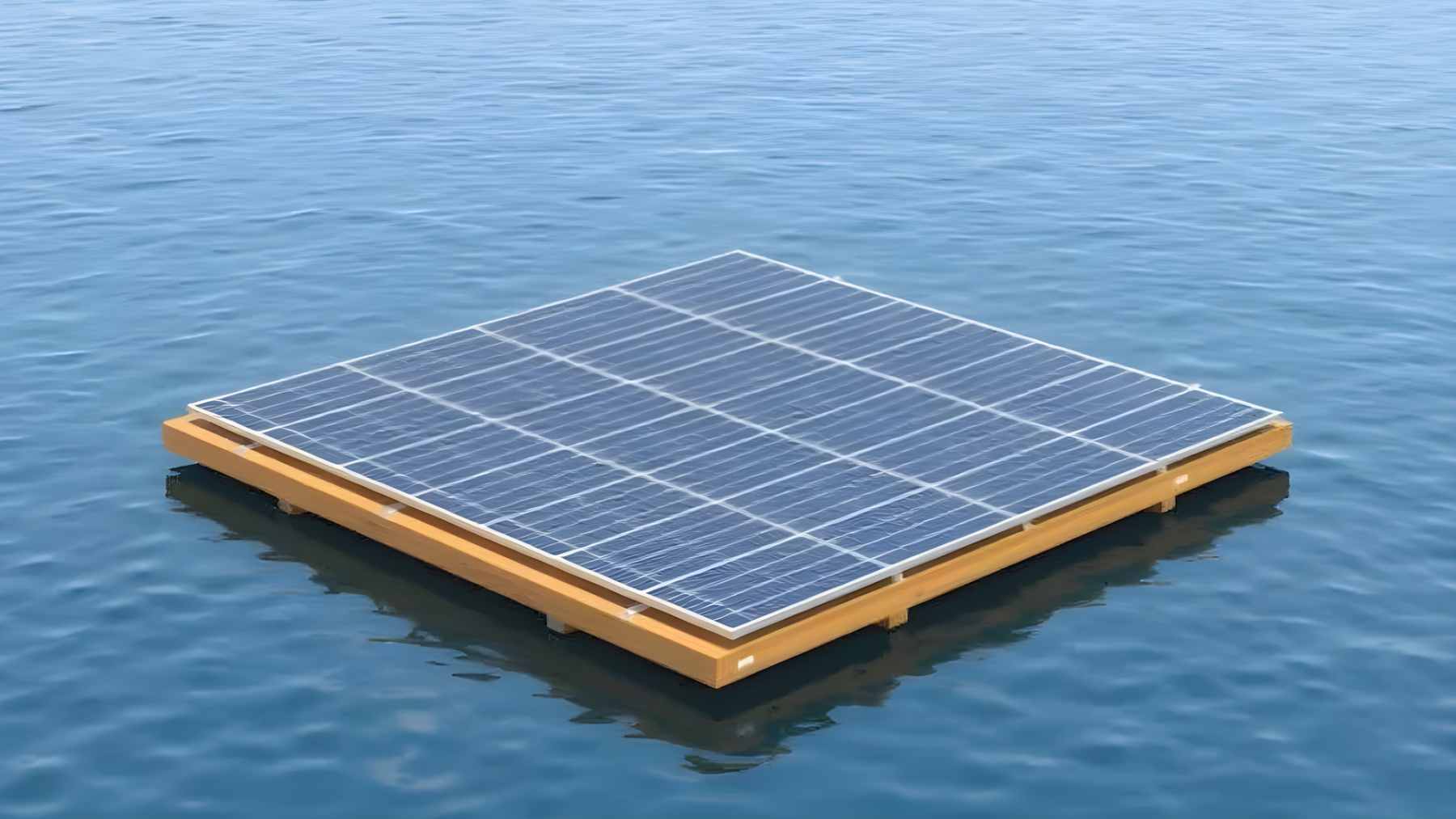
Rain is great for gardens, but could it also help keep the lights on? A research team in China demonstrated a floating device that can turn raindrop impacts into electricity and light 50 LEDs in controlled tests.
The main point is not that rain power will replace solar or wind. It is that a lightweight add-on like this could help run low-power electronics such as water-quality sensors, especially where wet weather is common, the sky turns gray, and the electric bill keeps ticking.
A doormat-sized prototype with a striking demo
The system is called the Water-integrated Droplet Electricity Generator, or W-DEG. It was developed at Nanjing University of Aeronautics and Astronautics and published in National Science Review, with an online publication date of August 4, 2025.
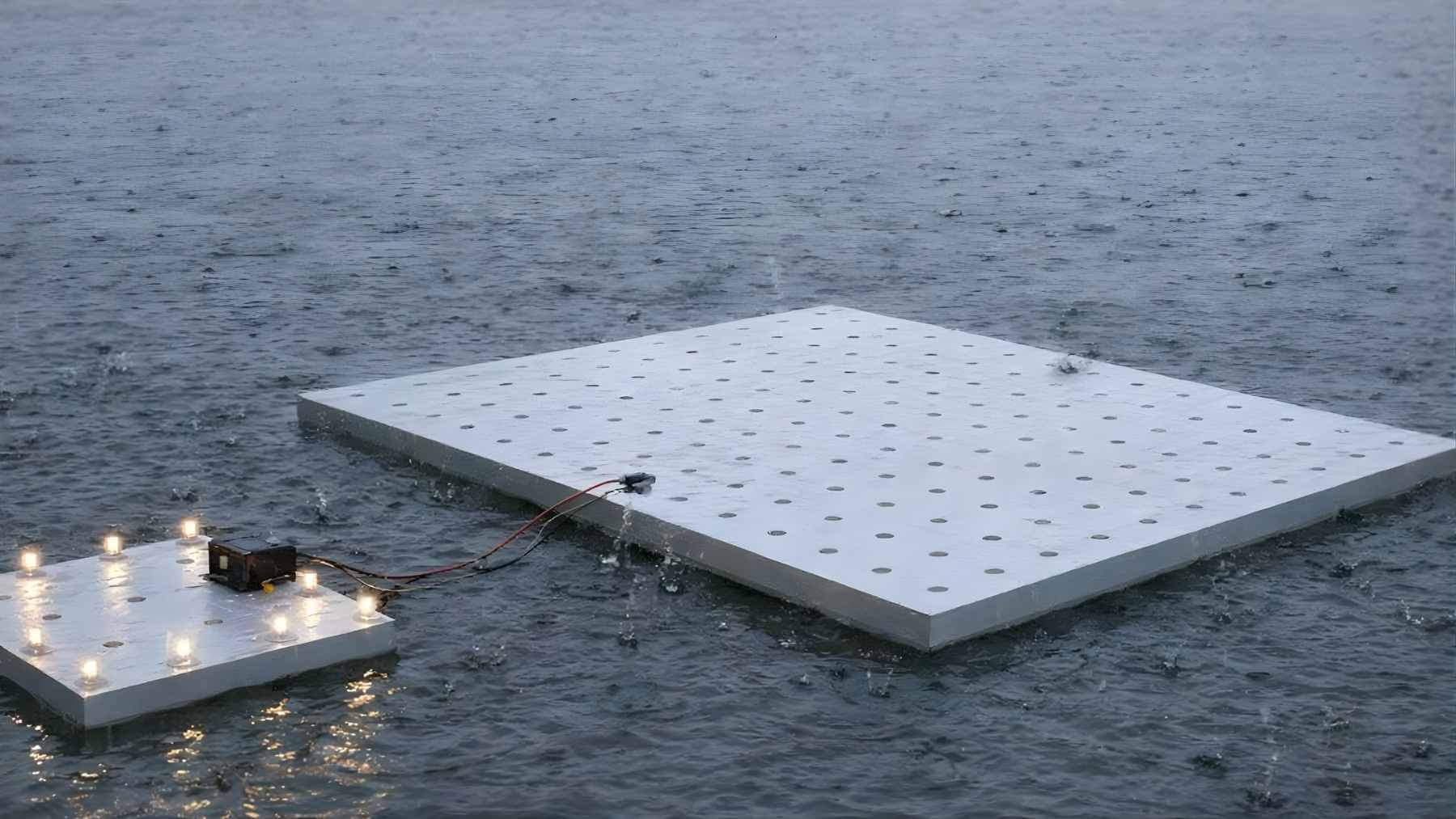
To show it can scale, the researchers assembled an integrated device covering about 3.2 square feet (0.3 square meters) by combining 10 units. They also report that a single unit could keep 50 commercial LEDs illuminated under repeated droplet impacts.
The headline number is voltage, not continuous power. The study reports peak output around 250 volts under certain test conditions, but useful energy still depends on rainfall and storage electronics that can smooth those quick pulses.
How a raindrop becomes a pulse of electricity
W-DEG uses a thin dielectric film that floats on water, with a wire electrode above it and another wire contacting the water below. When a droplet hits, charges shift at the water-solid interface, and the circuit can briefly close as the droplet spreads and touches the top electrode.
The researchers describe the process as driven by contact electrification and electrostatic induction. In plain language, each droplet creates a short electrical pulse rather than a steady stream of power.
There is also a constraint that matters outside the lab. The paper notes that high output depends on droplets contacting the electrode at maximum spreading, which is harder when natural rain arrives with mixed sizes, speeds, and landing positions.
The design choice that cuts weight and cost
Traditional droplet electricity generators often rely on rigid platforms and metal-bottom electrodes, which add bulk and limit where they can go. W-DEG replaces that hardware with the water itself, which the authors describe as a “nature-integrated” approach.
That swap shows up in the materials bill. The study estimates costs of about 9.9 yuan (roughly $14) per square foot, compared with about 19.5 yuan per square foot, for a conventional version, based on retail material prices.
Weight drops sharply as well. The authors report about 0.5 kilograms per square meter, roughly 0.10 pounds per square foot, versus about 4.14 kilograms per square meter, roughly 0.85 pounds per square foot, and summarize the shift as about an 87% material weight reduction.
Why floating matters for the environment
The floating setup changes the map. Instead of competing for rooftops or land, W-DEG is designed for “land-free” applications on water surfaces where the water acts as both support and electrode.
What if a reservoir could power the sensors that watch over it, tracking water quality without frequent battery swaps? The researchers point to powering wireless sensors for water-quality monitoring as a practical use case.
There is also the weather angle that everyone recognizes. As one corresponding author, Professor Wanlin Guo, put it, “By letting water itself play both structural and electrical roles, we’ve unlocked a new strategy for droplet electricity generation,” aiming to complement other renewables rather than replace them.
Drainage and durability are not side details
Pooling water on the top surface can reduce output, so drainage becomes essential for scaling up. The paper shows voltage dropping when water accumulates, and it argues that prompt drainage is crucial in larger installations.
To deal with that, the team designed drain holes that allow water to move downward after impact while resisting unwanted upward flow. Their experiments describe a drain opening around 3 millimeters wide, about 0.12 inches, tuned to water surface tension and the hydrophobic film so the system can self-regulate during heavy rainfall.
They also tested performance under conditions that mimic messy reality. The device maintained output across temperatures from about 50 degrees Fahrenheit to 122 degrees Fahrenheit (10 C to 50 C) and across a wide range of salt levels, and it continued working after exposure to outdoor lake water where biofouling occurred.
What to watch next before this leaves the lab
The study is candid about what still needs work. The authors highlight the challenge of diverse raindrops, along with the need to improve film uniformity and integrity for practical deployment.
They also show what “useful” could look like at small scales. With a power management circuit, the integrated device charged a 220 microfarad capacitor to 3 volts within a few minutes, and it brought larger capacitors up as well, which is the kind of output that can support sensors.
Clean energy is not one single machine. Sometimes it is a patchwork, and tiny technologies like this can help fill the small gaps that big infrastructure often misses.
The study was published in National Science Review.