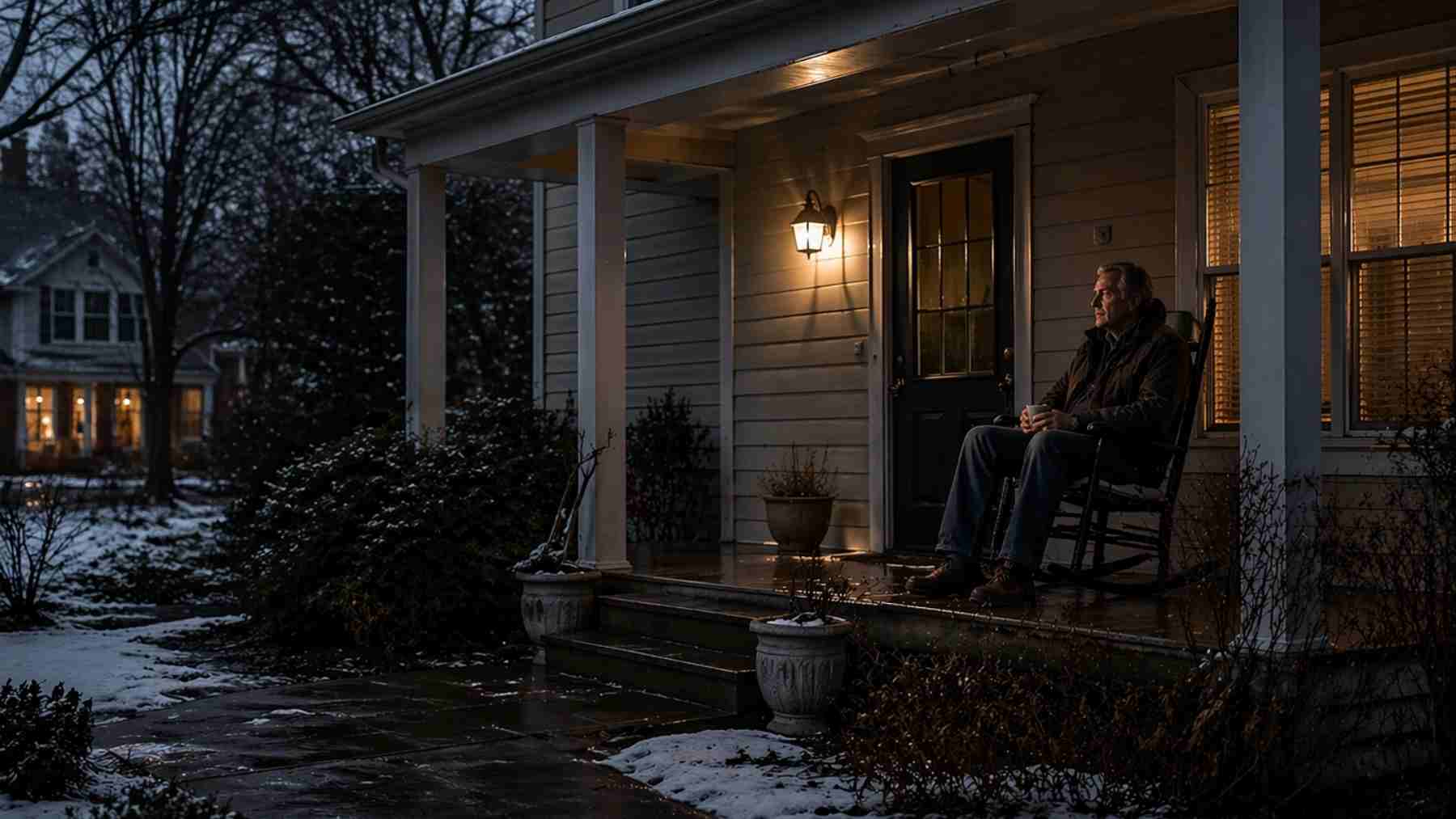
What does a dark front porch in December really mean? To a neighbor, it can look like indifference, especially because holiday decorations have long worked as a quick social signal of warmth and neighborhood spirit. But first impressions are only part of the story.
The research is more layered than a viral list of “nine quiet values.” What psychologists have actually studied are things like financial self-direction, authenticity, clutter, time pressure, minimalism, and the way people get more lasting enjoyment from experiences than from possessions.
Put together, those studies suggest that people who skip holiday decorations may often be protecting money, time, calm, and personal choice more than rejecting celebration itself.
First impressions
An older study in the Journal of Environmental Psychology found that strangers looking only at photos of homes used Christmas decorations as a cue that the residents were friendlier and more connected to neighbors. In other words, lights, wreaths, and lawn displays can act like social shorthand before anyone even knocks on the door.
But signals are not motives. A house without lights may read as distant from the sidewalk, yet the psychology research that exists points more toward personal priorities than personality flaws. That is a big difference, and it matters when people jump from “they do not decorate” to “they must be cold.”
Choosing on their own
One of the clearest themes is autonomy. In a Frontiers in Psychology paper, Stefano Di Domenico, Richard Ryan, Emma Bradshaw, and Jasper Duineveld found in two studies of American adults that “autonomous” motivation, meaning choices made because they fit your own values rather than outside pressure, was linked to better financial knowledge and financial well-being even after accounting for income, wealth, age, gender, and education.
That helps explain why some people leave the attic bins untouched every year. If decorating feels like an obligation, not a genuine desire, skipping it can be a form of authenticity. Another Frontiers in Psychology study described self-authenticity in simple terms as behavior that matches a person’s values and beliefs, and linked that state to healthier psychological functioning and well-being.
Less stuff less strain
Then there is the home itself. Research tied to UCLA’s Center on Everyday Lives of Families, including work by Darby Saxbe at the University of Southern California and UCLA psychologist Rena Repetti, found that in dual-income families, the way mothers described their homes as “mess,” “not fun,” or “very chaotic” tracked with higher stress markers across the day. That does not prove decorations are harmful, of course, but it does show how quickly extra visual clutter can pile onto mental load.
More recent minimalism research points in a similar direction. A 2025 study of 444 people found that stronger minimalist habits were linked to a smaller ecological footprint, less negative emotion, and more positive emotion, while a 2021 study described minimalism as a sustainable lifestyle that can support emotional well-being. For some non-decorators, that likely translates into a very ordinary choice. Fewer purchases, fewer boxes in the garage, and less to manage when January rolls around.
Time over display
Time may be the most practical factor of all. A University of British Columbia research release on work led by Ashley Whillans with Elizabeth Dunn reported that more than 6,000 adults across four countries showed greater life satisfaction when they spent money to save time, and a field experiment found people felt happier after spending $40 on a time-saving purchase rather than on a material one. Put simply, hours matter, especially during a month that already feels packed.
That same pattern shows up in consumer psychology. Cornell University research associated with Thomas Gilovich found that people tend to get more enduring happiness from experiences than from possessions, in part because experiences are less vulnerable to deflating social comparison. So for some families, the better holiday investment may be a meal together, a long walk, or a movie night on the couch, not another glowing reindeer on the lawn.
What it really means
For the most part, that is the real takeaway. The evidence does not support a neat personality test where every non-decorator shares the same nine hidden traits. What it does support is a loose cluster of values that can overlap, including self-direction, authenticity, simplicity, lower-stress surroundings, environmental concern, and a preference for time and experiences over visible display.
So, does skipping holiday decorations mean someone has less spirit? Not necessarily. To a large extent, psychology suggests it may mean they are choosing calm over clutter, priorities over pressure, and real connection over performance. A bare porch can still belong to a warm house.
The main studies and official research notes cited in this article were published in Frontiers in Psychology, the Journal of Environmental Psychology, Proceedings of the National Academy of Sciences, and Sustainable Production and Consumption, with supporting official research releases from Cornell University, UCLA, and the University of British Columbia.