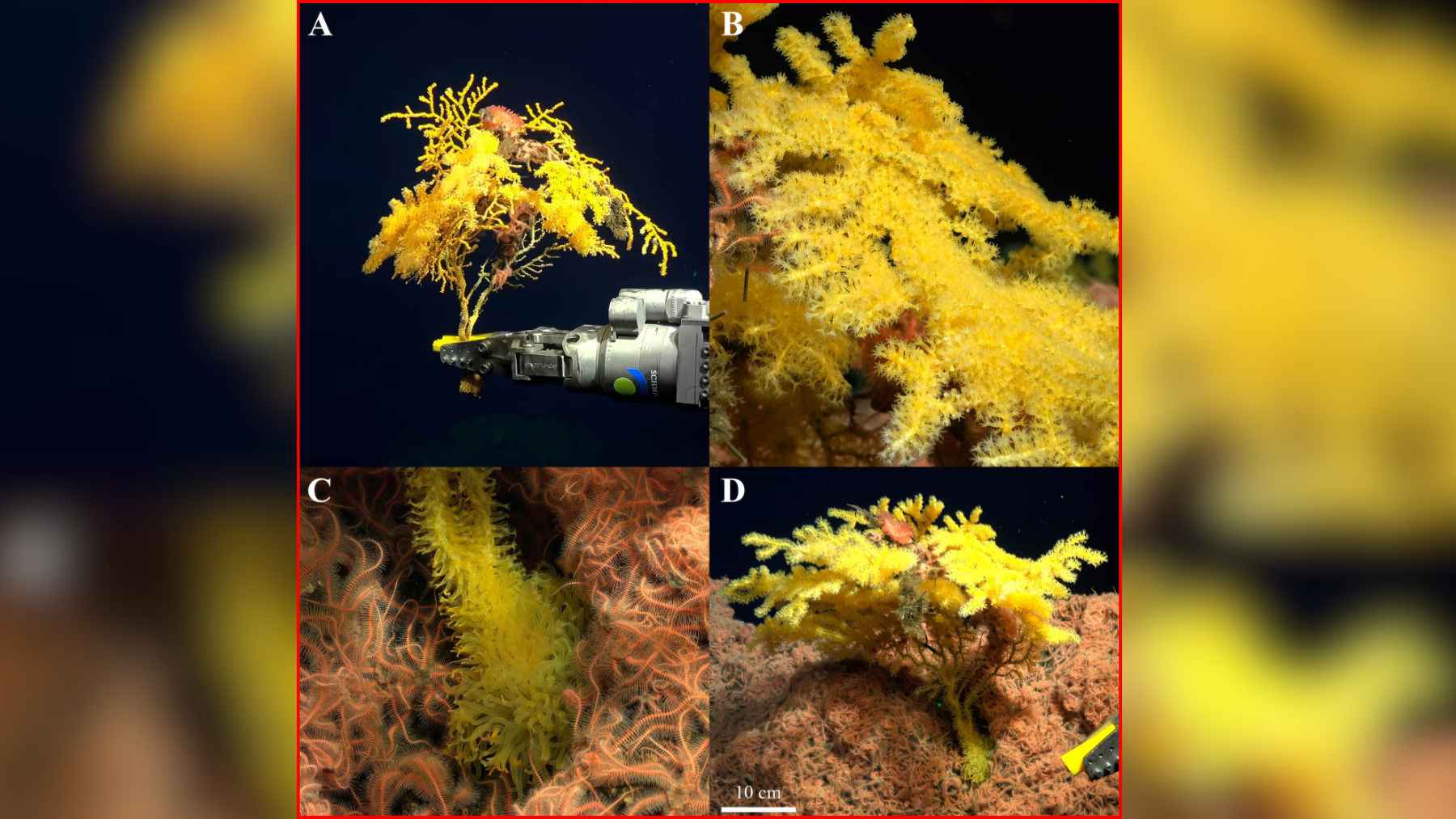
Scientists discovered a new coral species in the depths of the Pacific in Costa Rica that is so surprisingly different (anatomically and genetically speaking), that obliged the scientific community to create a complete new family in the tree of life: Laurinqueidae. This amazing Laurinque elenya, created extensive golden forests at depths between 360 and 529 meters. and they tend to grow on top of rocks that are covered by millions of brittle stars.
A golden forest hidden in the Pacific
The coral was found by researchers during Schmidt Ocean Institute expeditions in 2019 and 2023. The remotely operated vehicle SuBastian could take some amazing pictures and could collect information about specimens in Las Gemelas I and II near Isla del Coco, as well as Seamount 6 along Costa Rica’s Pacific margin.
At Las Gemelas II, large colonies created big gardens over the rocks almost completely covered by brittle stars. Even their stems and bases were mostly buried under the living mat of slender arms, leaving the yellow branches to rise above it.
This tree is actually a colony of animals
L. elenya can really look like a plant, but you know what? It is an octocoral made up of many small polyps. It has its beautiful branches and some elongated tubular polyps that cover the colony, and if something disturbs them, they retract in small protuberances.
Scientists tried to check for other similar skeletal structures, but really they could not locate this one in any specific gender or existing family. This coral simply did not fit, so that is why scientists had no option but to add a new branch to the scientific family tree.
Its DNA kept giving scientists different answers
After many genetic tests, they definitely discovered that this living thing was not only anatomically different from others—genetically speaking, it was too.
All the physical traits and genomic scale supported the creation of Laurinqueidae, with Laurinque as its only known genus and L. elenya as its only formally described species. That is why there was no way to find similarities with the Eunicellidae.
A Tolkien language gave the coral its name
The story of how the name started is actually pretty nice. It was the seafloor that shaped the name. Laurinque comes from “Laurinquë,” which in Quenya means “golden tree.” And then elenya means “stellar” or “of the stars.”
And yes, the name can sound a bit fancy, but it really reflects and transmits pretty well what it is: the brilliant shape of the coral tree and the brittle-starts habitat where its largest gardens were found.
Life thrives in cold water with very little oxygen
If we think about the ocean, the “deep” part starts below 200 meters and it covers around 66 percent of the planet’s surface. So imagine at that depth how difficult it is to investigate those areas.
These golden colonies live there, in a cold, oxygen and very poor environment that does not like warmth at all. The study reports say that the water temperature there is between 46.6 to 51.4 degrees Fahrenheit. And with all that information, still, the gardens were extensive and they are recognized, in general, as vulnerable marine ecosystems.
Specifically, octocorals are tridimensional colonies that can create a structure for another life, as other shrubs and trees do on land.
Why one new coral family matters
“I was impressed by the beauty of the landscape,” Odalisca Breedy of the University of Costa Rica said and yes, the landscape with this new discovery is amazing.
But still this discovery is not an isolated surprise. During an expedition in 2019, they could find at least four deep coral species and other six animals that looked new to science. This allows us to see that there is still a lot of biodiversity that has not been documented yet.
This is only the first step… mapping and naming the species. For now the only verified location is in Costa Rica, and some possible observations could include Panama and the Galapagos Island but still is not confirmed.