Have you ever looked at the leftovers after a family barbecue and thought about what they might tell someone 3,000 years from now? In southern Britain, ancient piles of discarded bones are doing exactly that, only on a much larger scale.
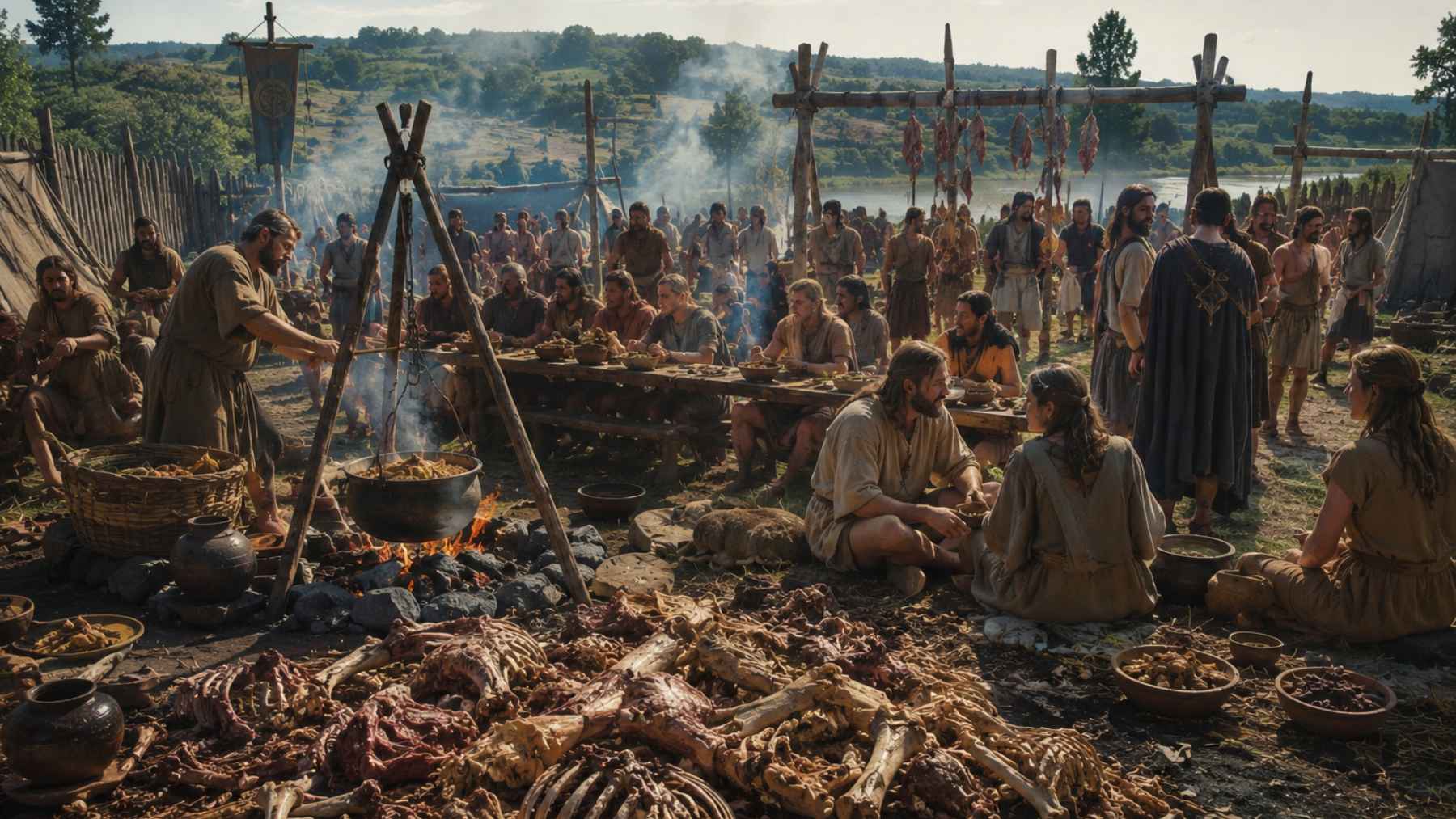
A new study suggests that people living near the end of the Bronze Age gathered for huge meat-centered feasts between about 900 and 500 BCE. These were not simple village meals. They were repeated events that drew people, pigs, cattle, and sheep from near and far, leaving behind enormous middens that now act like archaeological maps of food, movement, and community life.
Feasts hidden in ancient trash
Ancient celebrations often leave behind pottery, beads, and other small clues. Feasts are a little easier to spot because they leave bones–lots of them.
At Potterne in Wiltshire, researchers described a midden covering roughly eight acres, about the size of several large sports fields. It may contain as many as 15 million bone fragments, a number that points to organized and repeated gatherings rather than a few big dinners.
That scale matters. When people return to the same place again and again to share food, the site becomes more than a dump, it becomes a landmark.
What the bones revealed
The research was led by Dr. Carmen Esposito, now at the University of Bologna, and examined animal remains from six middens in Wiltshire and the Thames Valley. The study used multi-isotope analysis, a method that reads chemical traces locked inside bones and teeth.
Those traces come from the water animals drank, the plants they ate, and the geology beneath their grazing land. In practical terms, the chemistry can tell researchers whether an animal was raised nearby or brought in from somewhere else.
The team analyzed 254 animals, which the paper describes as the largest multi-isotope dataset of faunal remains yet generated in archaeology. That is a lot of ancient livestock stories packed into bone.
Pigs, cattle, and sheep
Each midden had its own menu. Potterne was strongly associated with pork, and many of its pigs appear to have come from a wide catchment, including areas as far away as northern England.
Runnymede in Surrey told a different story. There, cattle were the main attraction, and the animals also seem to have been drawn from varied and distant places. East Chisenbury, about 10 miles from Stonehenge, was different again, with sheep dominating the remains.
Why does that matter? Because it shows that these communities were not all doing the same thing. Some sites acted like regional hubs, while others leaned into local production and specialist economies.
A chemical travel diary
The team looked at signals from strontium, oxygen, and sulfur. Strontium can reflect the type of bedrock in an area, oxygen can point to climate and drinking water, and sulfur can help identify coastal or wetland grazing.
Put together, these signals helped researchers trace animal movement with more confidence. One chemical clue alone can mislead, but several together make the picture sharper.
This is where the bones become a kind of travel diary. They show animals moving across landscapes before ending up at major gathering places, where people likely shared food, labor, news, and identity.
A difficult time in Britain
The feasts took place during the transition from the Bronze Age to the Iron Age, a period linked with climate change, economic disruption, and shifting trade networks. The official study notes that climatic change and economic upheaval were part of the wider social background across Europe.
That makes the feasts more than a culinary curiosity. When life gets uncertain, people often lean harder on shared rituals. Even today, meals can steady a community during stressful times.
Professor Richard Madgwick of Cardiff University put it plainly, saying that people in southern Britain turned to feasting during “climatic and economic instability.” He also noted that such events can build and strengthen relationships within and between communities.
Not just garbage
It would be easy to dismiss these middens as prehistoric trash heaps, but the study suggests they were much more important than that.
Dr. Esposito said the findings show that each midden had a distinct makeup of animal remains, with some full of locally raised sheep and others containing pigs or cattle from much farther away. She added that each midden may have been a “lynchpin in the landscape,” helping sustain regional economies and relationships during a turbulent period.
That image is powerful. A pile of discarded bones becomes a record of cooperation, pressure, and adaptation.
What these feasts tell us now
The findings also offer a wider lesson about food systems. Ancient communities did not respond to stress in one single way. Some widened their networks, bringing animals from far away, while others stayed closer to home and relied on local herds.
There is something familiar in that. When supply chains wobble or prices rise, people still rethink where food comes from and who they can count on.
These Bronze Age feasts remind us that food has always been about more than calories. It carries status, trust, memory, and survival. Sometimes, it even leaves enough evidence for archaeologists to reconstruct a whole social world from the leftovers.
The study was published in the journal iScience.