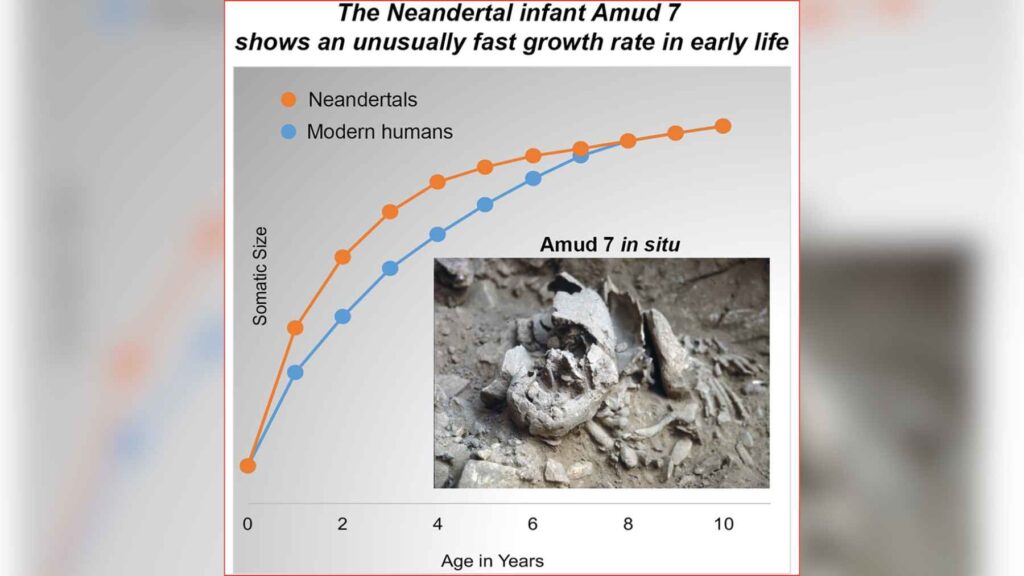
A Neanderthal baby who died roughly 55,000 years ago appears to have been only about six months old. Yet the infant’s limbs and brain were already comparable to those of a modern child close to one year old, creating a striking mismatch between the age recorded in the teeth and the age suggested by the rest of the skeleton.
The child, known as Amud 7, offers a rare look at how Neanderthals grew before their adult features were fully formed. The findings suggest that their bodies and brains sped through early development, a costly strategy that may have helped young children cope with demanding environments but would have required a dependable flow of food.
The age puzzle
Amud 7 was recovered from Amud Cave in northern Israel and dates to between 51,000 and 56,000 years ago. Researchers digitally rebuilt the child from 111 skeletal pieces in a project led by Ella Been of Ono Academic College and Alon Barash of Bar-Ilan University.
Microscopic growth lines in the tooth enamel placed the baby at between 5.5 to 6.8 months, with only the two lower front teeth beginning to emerge. The arm and leg bones resembled those of a modern child around 14 months old, while a brain volume of 54 inches³ matched a modern infant of roughly 11 to 13 months.
Built differently early
Even at this young age, Amud 7 had thick limb bones, no chin, a strongly curved collarbone, a distinctive shoulder joint, and a relatively short shin. These are features of morphology, the term scientists use for the shape and structure of a body.
“Every bone we examined, from the clavicle to the tibia, carries a Neanderthal signature,” Been said. That suggests the familiar Neanderthal body plan was already present in infancy, rather than being produced only by years of cold weather, heavy activity, or learned behavior.
A costly growth spurt
Why grow so quickly? The study cannot prove the evolutionary reason, but the researchers say faster development may have helped children build sturdy bodies sooner in the harsh and unpredictable environments of Ice Age Eurasia.
There was a tradeoff, though. Building robust bones while rapidly expanding a large brain would have demanded a great deal of energy, meaning mothers and other group members likely needed to provide nutritious food with unusual consistency. There was no pantry safety net when hunting or gathering went badly.
Food had to keep up
A 2020 study of Neanderthal baby teeth found that three children from northeastern Italy began eating solid foods at about five or six months. Alessia Nava of the University of Kent said the timing was linked more closely to infant physiology than culture, while Federico Lugli of the University of Bologna connected it to the growing brain’s high energy needs.
One detail is easy to miss. In this research, the start of weaning means adding complementary foods alongside breast milk, not ending breastfeeding overnight. The teeth cannot reveal Amud 7’s exact menu, but they show that Neanderthal families could introduce extra calories just when rapid growth made them especially valuable.
More than one large baby
Could Amud 7 simply have been an unusually large infant? The researchers compared the skeleton with Dederiyeh 1 from Syria and Roc de Marsal from France, and both showed a similar pattern of body and brain development running ahead of dental age.
Other work adds useful context. A 2020 rib cage study found that the short, deep, robust Neanderthal chest was present early in life, while a 2017 study of a child from El Sidrón found a broadly modern pattern with some developmental differences. Neanderthal growth was not simply faster at every age.
Different biological clocks
The new study proposes three broad stages of early Neanderthal growth. Teeth and body size began largely in step, then body and brain growth moved ahead during infancy, before dental and skeletal development drew closer again later in childhood.
Simply put, the finding is not that Neanderthals became giant adults. It is that they appear to have spent their early growth budget differently, accelerating some systems while the dental clock kept a more familiar pace. The route was different.
Were Neanderthals fast or are we slow?
There is another way to frame the discovery. Perhaps Neanderthal babies did not grow abnormally fast, and modern human children are the unusual ones because we remain physically dependent for so long. Researchers still debate that question, and one fossil cannot settle it.
Amud 7 cannot tell scientists when the child would have walked, how the group divided childcare, or which foods powered the growth spurt. However, the skeleton does show that teeth and bones can tell different stories when modern growth charts are applied to an extinct human relative. That changes the question from “Were they like us?” to “How many ways can a human childhood work?”
The official study has been published in Current Biology.