A crocodile fossil collected near Cairo in the 1920s now has a genus of its own, Herugavialis. An international team led by Paul Burke of the Swedish Museum of Natural History reexamined its skull, about 45 million years old. The animal came out of the Mokattam Formation, the same limestone that gave Egypt the Great Sphinx of Giza.
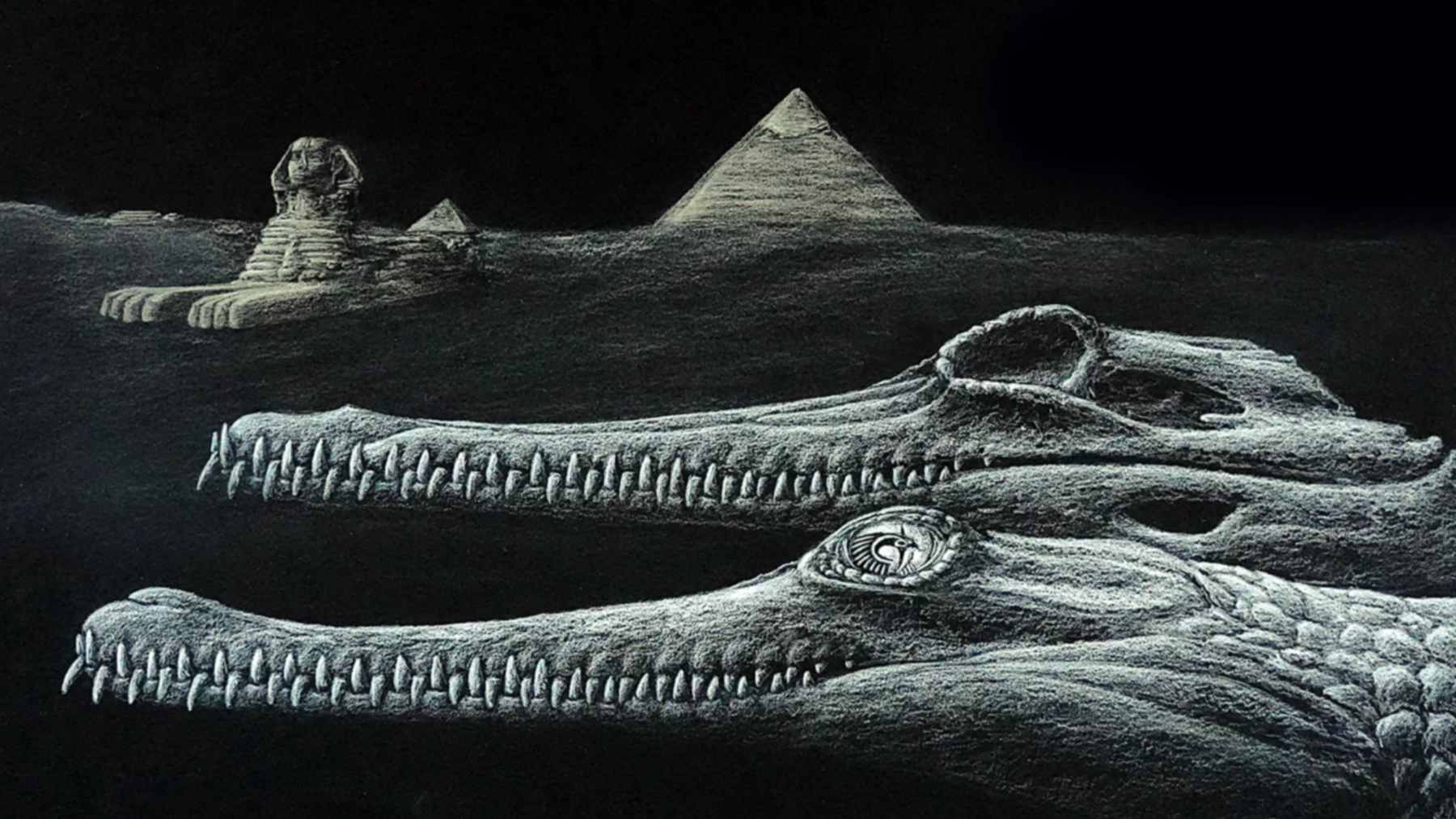
The authors describe the statue and the fossil as “both sharing the absence of the anterior tip of their nose/snout.” The redescription of the species, now called Herugavialis cairensis, appeared on October 7, 2026, in Royal Society Open Science.
Filed as Tomistoma since 1927
When the species was first described in 1927, it went into Tomistoma. That genus holds the living false gharial, a long-snouted crocodilian of Southeast Asian fresh water.
According to the new paper, nobody had redescribed the Egyptian skull in the century since. Recent family-tree studies kept placing it far from the false gharial.
Only two gavials survive today, and the IUCN Red List classifies the false gharial as Endangered.
Rock shared with the Sphinx
The holotype, the specimen that defines a species, came from Gebel Mokattam, east of Cairo. A second partial skull, pieces of snout and two partial lower jaws came from the same area. The paper calls the rock a Middle Eocene marine limestone full of nummulites, the coin-shaped shells of single-celled organisms.
The name grew out of the two missing noses. “Given this coincidence with the famously missing nose of the Great Sphinx, we decided to name the new crocodile after the Egyptian god Heru, who was possibly the inspiration for this iconic monument,” said Philip Mannion, a professor at University College London who co-led the study.
CT scans of a Stuttgart skull
The holotype skull, catalogued as SMNS 10575, belongs to the State Museum of Natural History Stuttgart. Co-author Stephan Spiekman works there.
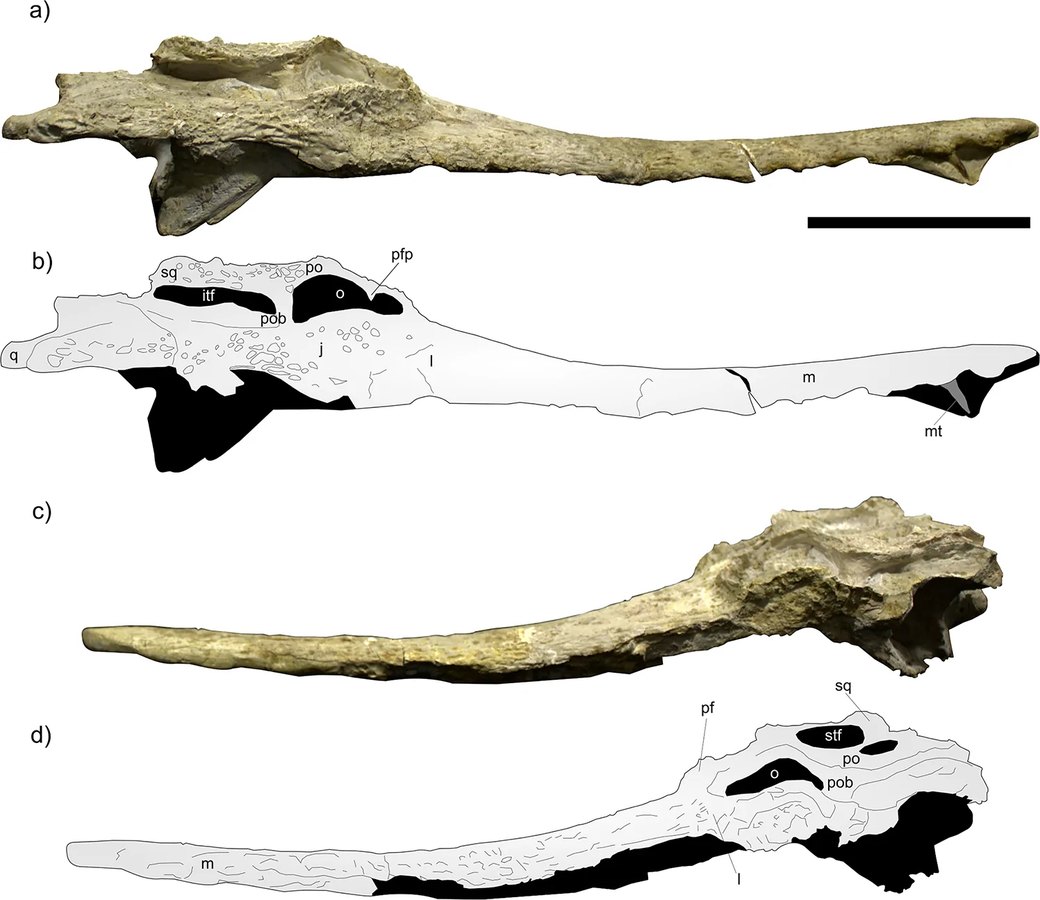
For the study, the skull went through X-ray micro-CT at Carl Zeiss IQS Deutschland. The team then rebuilt the brain cavity, the air sinuses and the nasal passages in 3D, and one surprise sat under the surface: the nasal bones keep their width where the upper jaw covers them, unlike in living gavials.
Scan data for both this skull and a related species, Paratomistoma courti, are openly available on MorphoSource.
Raised rims around each eye
The trait that best sets the animal apart is its telescoped orbits. In plain terms, raised bony margins ring each eye socket. The paper lists four more features, including a blunt peak on the brain cast.
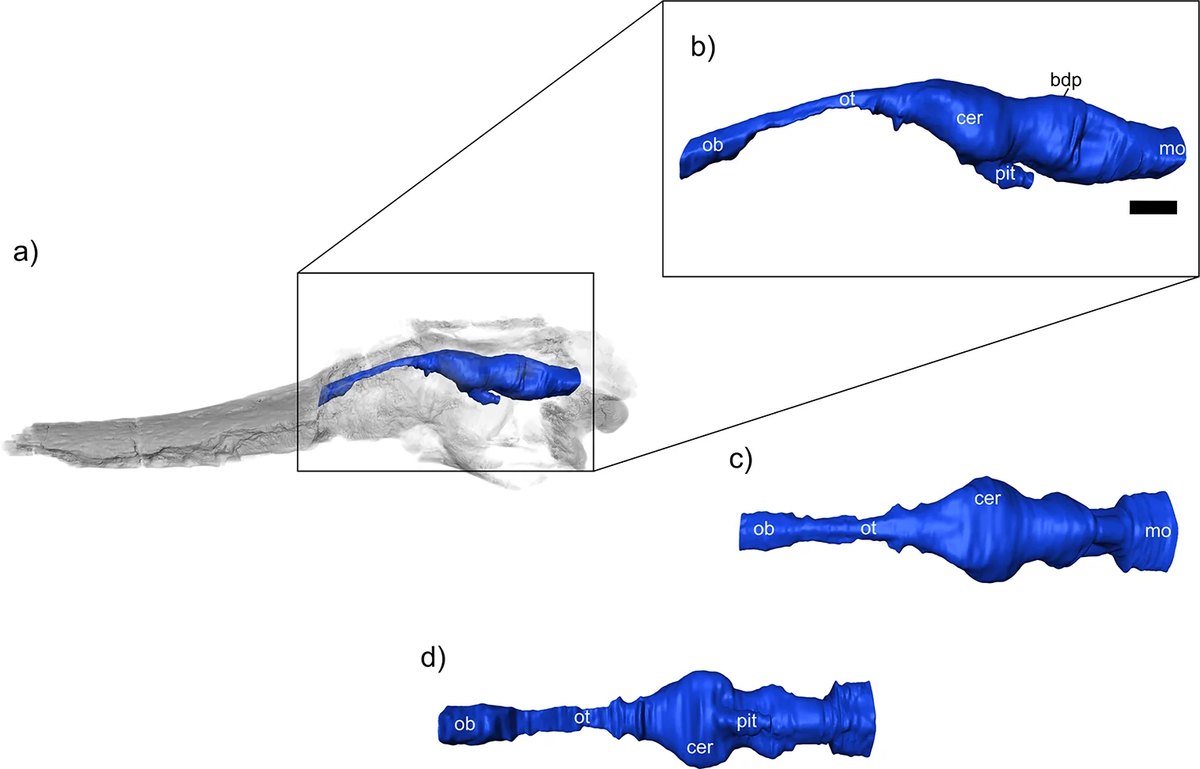
The snout made up about 64 percent of the skull’s length. From the surviving sockets, the authors estimate at least 15 teeth in each maxilla, the main bone of the upper jaw.
The researchers rescored 49 anatomical traits and placed the species among 152 crocodilians and their relatives, coded for 331 traits. Herugavialis came out as an early branch of the gharial line, apart from every other African or Mediterranean species.
Eocene Egypt’s other gavials
Two other gavials shared Eocene Egypt with Herugavialis. Paratomistoma courti comes from slightly younger rocks, and Eogavialis africanum from the Late Eocene. The study lists 24 features that differ among the three.
“Throughout much of the last 50 million years, the Mediterranean region hosted a high diversity of crocodiles, including gavials,” lead author Paul Burke said in the museum’s release. Unlike their living relatives, those species used coastal and shallow marine waters.
Egyptian rocks have reshaped other family trees too, as with the jaw of an unknown ape from 17 to 18 million years ago.
Cooling seas and a dried basin
The authors count at least six gavial species around the Mediterranean in the Paleogene and at least six more in the Miocene. In between lies a blank stretch.
No gavial fossils are known from the Mediterranean for most or possibly all of the Oligocene. The authors suggest that cooling and falling seas shrank the warm coastal habitat the animals needed.
“However, this diversity fluctuated over time, seemingly corresponding to changes in global temperature and sea level, before the loss of all crocodiles in this region as a result of the drying of the Mediterranean approximately 6 million years ago,” Burke said.
In the family tree, the Miocene species do not group with the older ones. If the later animals descended from the Eocene ones, the authors write, “then we would expect them to form a clade,” a single branch. On the final chapter, the paper is more careful than the release, saying only that the Messinian Salinity Crisis might have driven crocodiles out.
An inner ear the scans missed
Scan quality around the ear region was too low to rebuild the inner ear. The holotype also lacks the front of its upper jaw. One piece listed with the original material, the back of a skull, could not be found in the Stuttgart collection.
The other bones assigned to the species in 1927 are similar in size and came from the same area, so some may belong to the holotype animal. Reviews of ‘Tomistoma’ lusitanica, from Portugal, and Gavialosuchus eggenburgensis, from Austria, are still pending.
The full study was published in Royal Society Open Science.
Similar corrections have come out of other museum collections. In London, a skull fragment bought in 1924 sat in a museum drawer for nearly 100 years before it was named a new dinosaur. In Tübingen, a 12.7-inch giant isopod from Puerto Rico spent decades under the wrong name.
Image: Karim Zanaty / Burke et al., Royal Society Open Science (CC BY 4.0)