A broad current of iron-rich liquid deep inside Earth changed direction around 2010, shifting from a weak westward flow to a strong eastward flow beneath the equatorial Pacific. A new analysis of observations from 1997 through 2025 suggests that regional motion in the outer core can reorganize within about a decade.
One detail needs clearing up. Claims that iron erupted from the Pacific and altered Earth’s orbit are not supported by the paper. The event unfolded roughly 1,800 miles beneath the surface, and researchers say it poses no danger to people or the climate.
A hidden current changed course
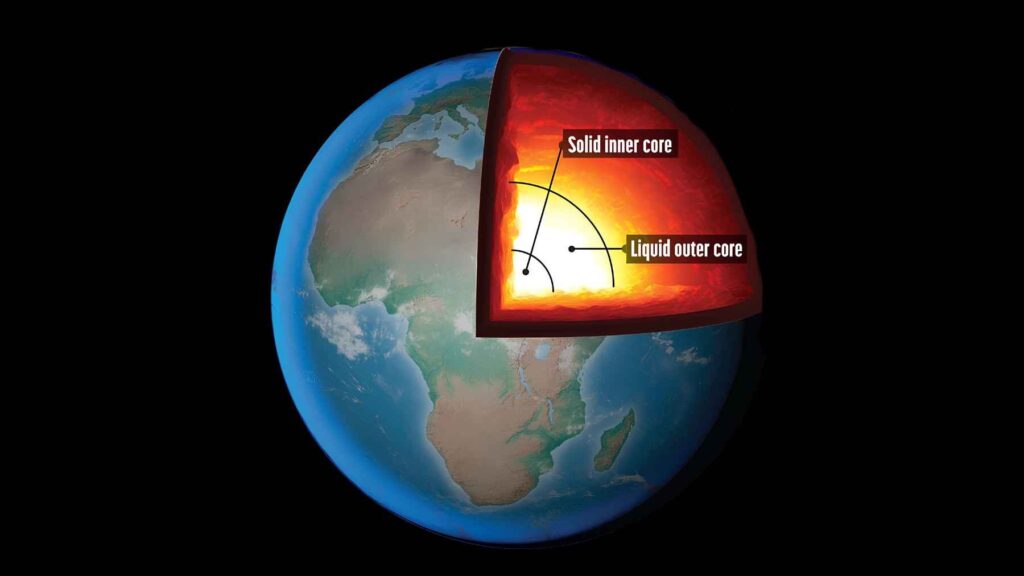
Earth’s outer core is a deep layer of mostly liquid iron and nickel wrapped around the solid inner core. As this electrically conducting metal moves, it creates currents that sustain the planet’s magnetic field, a process called the geodynamo. Picture boiling water inside a pot, except the moving material is metal under crushing pressure.
For decades, models showed a dominant westward circulation, including a huge loop known as a planetary gyre. The Pacific region was different and moved only weakly westward before the 2010s. Then the local current turned east, revealing a restless patch within a system known for long-lived global patterns.
How satellites saw through rock
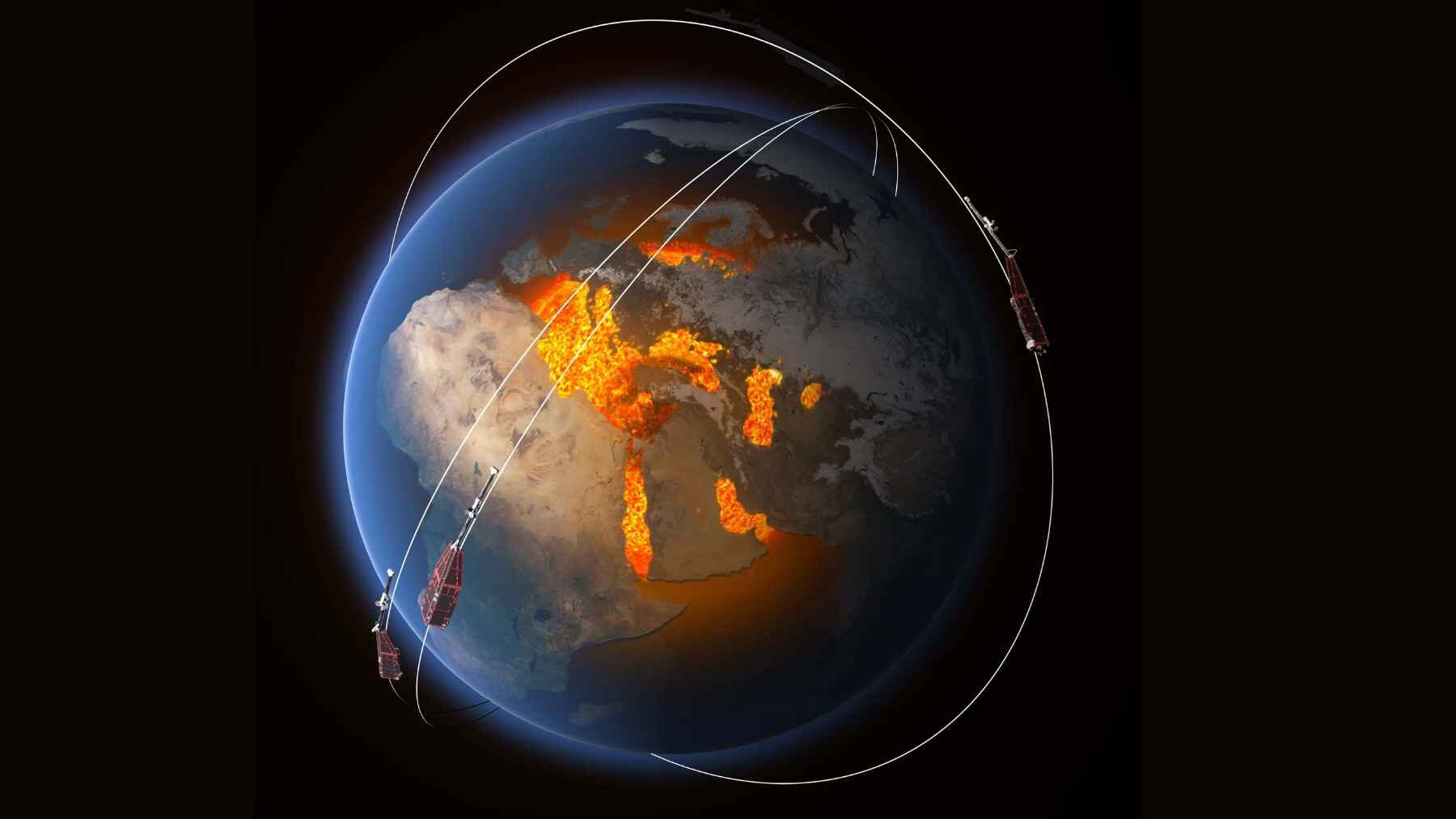
No satellite can photograph molten metal through thousands of miles of rock. Scientists instead measure small changes in Earth’s magnetic field and work backward to estimate how liquid metal is moving at the boundary between the core and mantle. It is like watching ripples to infer motion below a pond.
The research was led by Frederik Dahl Madsen with Isobel Howard, William J. Brown and Kathryn A. Whaler, whose affiliations included the University of Edinburgh and the British Geological Survey. The team combined ground observatories with measurements from the European Space Agency’s Swarm and CryoSat missions, Germany’s CHAMP satellite and Denmark’s Ørsted spacecraft.
What the models found
The team created three versions of the core-flow model, each using different limits on how the liquid could move. All three produced the same basic reversal beneath the Pacific. That consistency matters because the flow cannot be observed directly.
They also used principal component analysis, a method that separates a complicated dataset into its strongest patterns. The largest, relatively stable circulation explained about 95 percent of the modeled variation. The Pacific reversal accounted for roughly another 4 percent, while smaller waves and local structures made up most of the remainder.
The change weakened after 2020
The Pacific current appears to have crossed from westward to eastward around 2010 and became clearly strong after 2012. Its eastward motion continued building for years, but the model indicates that the increase stopped around 2020. Since then, the flow may have weakened.
What caused the turnaround? Scientists do not know whether it was a brief disturbance, one phase of a repeating cycle or a shift toward a new balance inside the core. The lead researcher said, “Continued monitoring will be essential to determine how the flow evolves over the coming years.”
A possible inner-core connection
The timing may offer a clue. The authors found that the Pacific reversal occurred near changes detected in the solid inner core through earthquake waves and precision measurements of Earth’s motion, but they call the connection a hypothesis, not a proven cause. Deep Earth is a set of coupled layers.
A 2024 Nature study built from 143 pairs of repeating earthquakes found that the inner core moved one way from 2003 to 2008, then slowly retraced that path through 2023. A separate 2025 analysis found that a roughly six-year rhythm in the length of Earth’s day was disrupted between 2010 and 2014. The timing is intriguing, but coincidence remains possible.
Rotation is not the same as orbit
Changes inside the core can exchange angular momentum with the mantle and produce tiny variations in how fast Earth spins. That affects the precise length of a day, not the planet’s path around the Sun. The new paper presents no evidence that Earth’s solar orbit changed.
This distinction matters. “Earth changed course” can suggest that the whole planet veered through space, while the real finding concerns a buried current of metal turning within Earth. Dramatic enough, but for a very different reason.
Why the magnetic field matters
Earth’s magnetic field slowly evolves as the outer core moves, which is why magnetic reference models must be updated. These models support navigation and heading systems, from aircraft and ships to the compass in a phone. Satellite measurements also help specialists track conditions in near-Earth space weather.
The study does not report a navigation failure, a climate threat or an imminent magnetic pole reversal. Better knowledge of rapid core changes could improve forecasts of the magnetic field and help spacecraft operators separate slow internal trends from disturbances driven by the Sun.
What comes next
Longer records will show whether the eastward Pacific flow continues to fade, swings west again or settles into a new pattern. The three-satellite constellation was launched after the 2010 transition, but its continuous global measurements captured the years that followed. The core keeps moving, so the scientific clock is still running.
At the end of the day, the discovery is not about iron pouring from the ocean or Earth leaving its lane around the Sun. It shows that the hidden engine behind our magnetic field can change regionally on a surprisingly short timeline.
The full study was published in the Journal of Studies of Earth’s Deep Interior.