A rocky planet 48 light-years from Earth has revealed something astronomers have spent years trying to confirm. A team led by the Center for Astrophysics, Harvard & Smithsonian found that LHS 1140 b still has an atmosphere by detecting helium slowly leaking into space.
The finding marks the first confirmed atmosphere around a rocky planet orbiting in another star’s habitable zone. It does not show that the world is inhabited, or even that its surface is comfortable, but it moves the search for potentially habitable planets from simply finding them toward testing what surrounds them.
The atmosphere showed itself by escaping
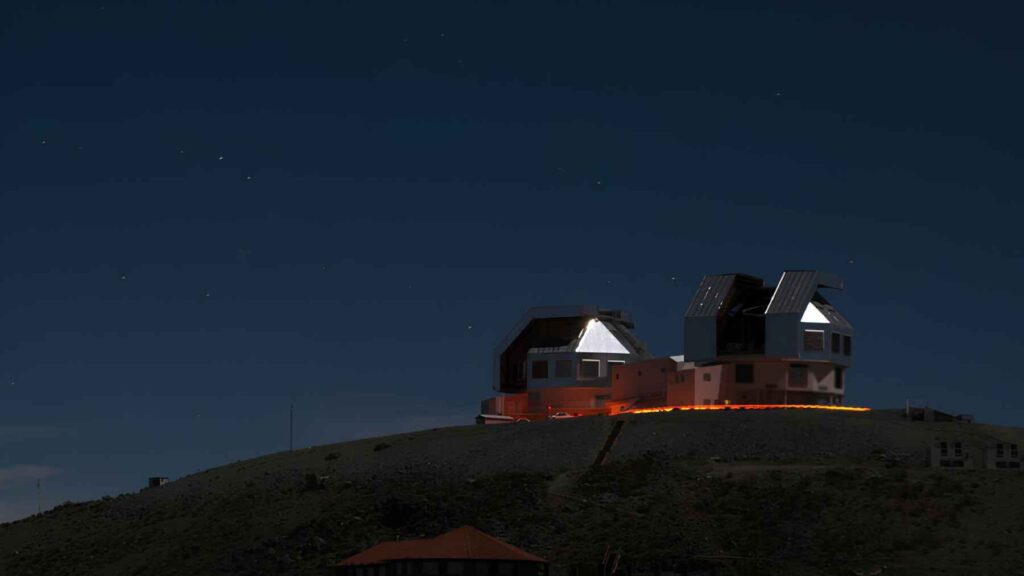
Lead author Collin Cherubim and his colleagues used the WINERED spectrograph on the Magellan Clay telescope at Las Campanas Observatory in Chile. On Sept. 23, 2024, they watched two planets cross their star within 39 minutes of each other during a 6.5-hour observing run, collecting 70 spectra, or detailed fingerprints of starlight.
When LHS 1140 b moved in front of the star, helium absorbed a narrow portion of near-infrared light. The strongest blended feature reduced the measured starlight by about 1.24%, while the absorbing gas extended to an effective radius about 1.5 times that of the planet, pointing to an atmospheric outflow.
Its neighboring planet, LHS 1140 c, showed no comparable helium signal during the same night. That side-by-side test supported other analyses rejecting explanations involving the star or Earth’s own atmosphere. A 2025 follow-up did not detect helium around planet b, suggesting that the rate of escape changes over time.
Why a helium leak matters
“First and foremost, helium just tells us that there’s an atmosphere, period,” Cherubim said. That may sound modest, but it answers a stubborn yes-or-no question that astronomers have struggled to resolve for small, temperate worlds.
The signal comes from the thin upper atmosphere, not from air near the planet’s surface. Scientists have not yet found oxygen, carbon dioxide, water vapor, or any sign of life there. Also, “habitable zone” only describes a region where liquid water could exist under the right conditions, not a promise that oceans or living things are present.
A rocky world that held on
LHS 1140 b orbits a cool red dwarf, a type of small star that can expose nearby planets to atmosphere-eroding X-rays and extreme ultraviolet radiation. The planet receives about 42% as much total stellar energy as Earth, yet the study estimates that it receives roughly 2.7 to 16 times Earth’s X-ray exposure, depending on the Sun’s activity level used for comparison.
Even so, the atmosphere appears to have survived for more than 3.1 billion years. Models place the present atmospheric loss at about 450,000 to 930,000 lbs./second, depending on assumptions about the star’s radiation. That sounds enormous, but it remains well below the study’s approximate long-term stripping threshold of 11 million lbs./second, based on an assumed starting atmosphere equal to 1.5% of the planet’s mass.
The atmosphere is leaking, but it has not simply vanished. In practical terms, its survival suggests that at least some rocky planets around red dwarfs can hold on to an atmosphere for billions of years, despite the steady weathering caused by high-energy radiation.
Still not another Earth
LHS 1140 b is often described as a “super-Earth,” but that label refers mainly to its size or mass, not to a familiar blue surface. The planet has more than five times Earth’s mass and an estimated equilibrium temperature of about -53°F, before any warming effect from its atmosphere is considered.
Its true surface conditions remain unknown. Earlier density models allowed for a water-rich interior containing roughly 9% to 19% water by mass, but that is one possible explanation rather than evidence of an ocean. The atmosphere could also change the surface temperature and pressure, influencing whether liquid water could remain there.
So, is this Earth 2.0? Not yet. The discovery provides evidence of atmospheric survival, which is a necessary piece of the habitability puzzle, but most of the picture is still missing.
A model turned into an observation
The result also stands out because the team predicted where to look before the telescope found the signal. A 2025 model examined known exoplanets with measured masses, radii, and temperatures, identifying 30 candidates for helium-rich atmospheres and placing LHS 1140 b among the strongest targets.
David Charbonneau, Cherubim’s joint advisor, initially doubted that the plan would work because no comparable helium signal had been measured around a rocky planet. After reviewing the data, he described the detection as “statistically rock solid.” Sometimes the breakthrough is not a bigger telescope, but a sharper idea about where to point it.
That approach could give ground-based observatories a practical new way to screen rocky exoplanets for escaping gases. Rather than waiting to fully characterize every distant world, astronomers may be able to find the best atmospheric targets first and save the hardest observations for the planets that show the most promise.
What astronomers will look for next
Repeated observations will be essential because the helium appeared in 2024 but not in 2025. The study interprets that difference as possible variability in atmospheric escape, perhaps linked to changing high-energy radiation or interactions between the planet and its star, rather than evidence that the atmosphere disappeared in a single year.
Cherubim and his colleagues now want to identify the atmosphere’s broader chemical makeup and test whether LHS 1140 b has surface oceans or other potentially habitable features. They also plan to apply the same model to other rocky worlds. One planet is a milestone, but it is not yet a population.
That leaves a larger question hanging over the next observing campaigns: how many other quiet-looking rocky worlds are also holding on to air?
The full study was published in the journal Science.