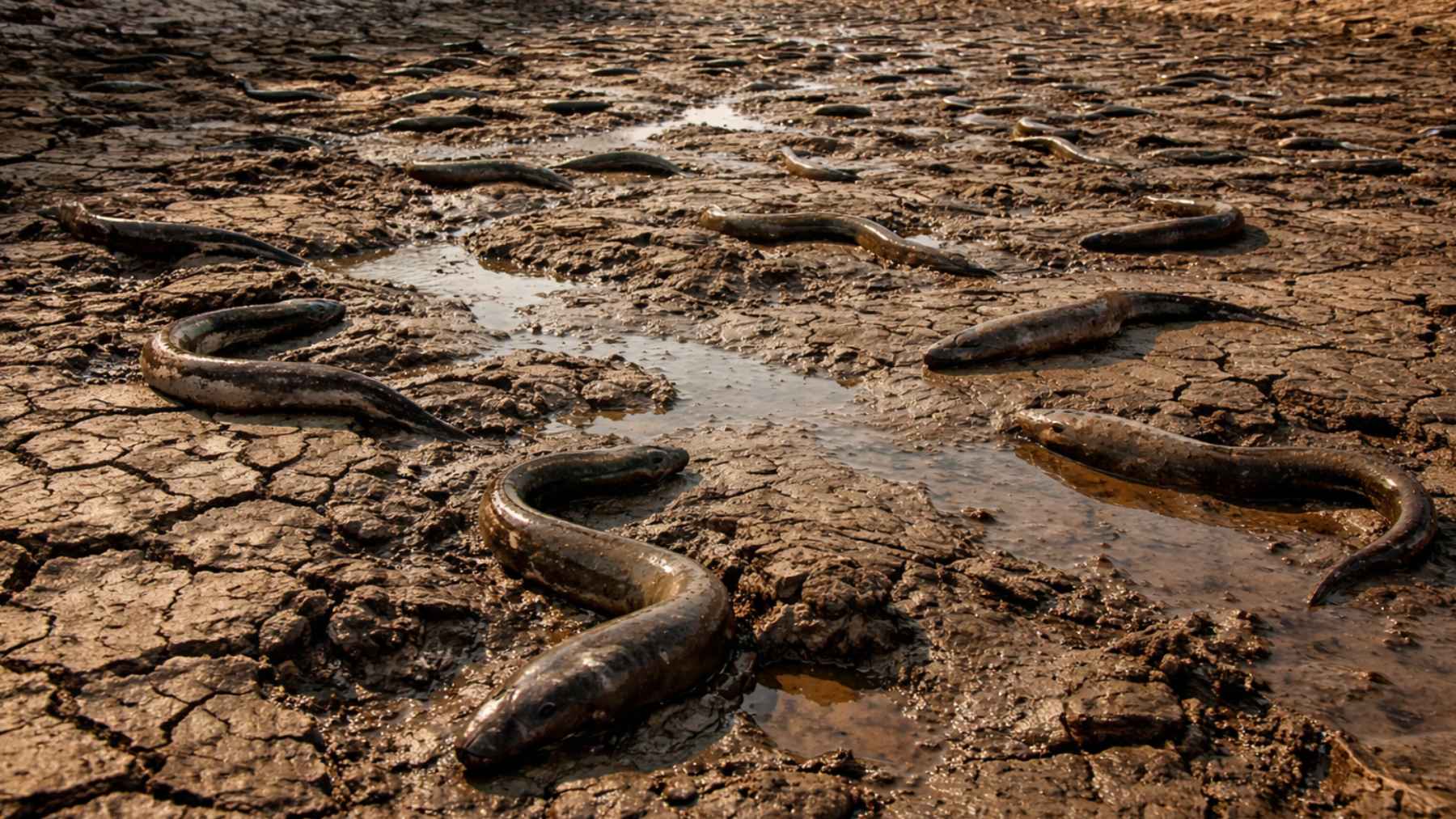
In eastern Spain, ecologists are sounding the alarm about a fish that is famous for epic journeys, yet can be wiped out by a few rainless weeks. In the rivers Canyoles and Albaida near Valencia, European eels are getting stranded in isolated summer pools when river sections dry up, and many die as oxygen levels fall and the water warms.
The uncomfortable takeaway is that this is not just a local “bad summer” story. Scientists have warned for years that the European eel is in steep decline across its range, and the species is listed as “Critically Endangered” on the IUCN Red List. That puts Valencia’s fish kills in a bigger frame, one where drought, river management, and fishing rules all collide.
A long distance traveler that dies close to home
Acció Ecologista-Agró says the problem shows up most clearly in summer, when flowing stretches break into disconnected pools. Eels trapped in those pockets can die from low oxygen and heat stress, turning a riverbed into a dead end.
Read More: {{post_title link:post}}
If you have ever walked past a river in late summer and seen exposed stones and a thin ribbon of water, you already understand the basics. Fish do not need a dramatic disaster to suffer, just a slow squeeze as habitat shrinks day by day. That is the quiet part of drought that rarely makes headlines.
Agró’s message is simple and very practical. Keep an “ecological flow” running during the driest months so fish are not boxed into stagnant pools, and it buys fish time. It also helps other river life, from invertebrates to native turtles, which often suffer in the same low water episodes.
Why drought hits eels in a special way
The European eel’s life story is almost unbelievable, and that is part of the problem. Adults spawn in the Sargasso Sea, the larvae drift toward Europe, and the young arrive as “glass eels” before moving into rivers and wetlands to grow.
This cycle depends on connection. An eel needs a continuous path between freshwater habitats and the sea, so when rivers dry into separated segments, it is not just uncomfortable, it can be fatal. And when barriers like dams and weirs block movement, even a river that still has water can function like a maze with locked doors.
There is also a sobering number behind the eel’s “vanishing act.” Research summarized by Spain’s Doñana Biological Station (CSIC) describes a collapse around 1980, with recruitment of young eels dropping by about 95%, and little sign of recovery since. In plain terms, the pipeline that refills European rivers with young eels has been running at a trickle for decades.
The legal paradox playing out in Spain right now
Here is where Valencia’s summer die offs meet politics. In Spain, the eel is not currently listed in the national threatened species catalog, which means fishing can continue under regional regulations and quotas. Yet internationally, the conservation status is far more severe, with the species recognized as “Critically Endangered” by the IUCN.
Read More: {{post_title link:post}}
In January 2026, Spain’s environment ministry (MITECO) said it would again propose granting the eel the highest protection category in the national protection listing process, arguing the move is grounded in “solid scientific criteria” and international recommendations. The proposal was set to be discussed with Spain’s autonomous regions, since inland fishing rules and enforcement often sit at the regional level.
But in mid February 2026, multiple regions rejected the proposal in the Flora and Fauna Committee, and the debate was pushed into a dedicated working group instead. That working group is meant to dig into causes, compare existing management plans, and weigh additional conservation steps, while the core question about strict legal protection remains unsettled. (elpais.com)
It is not only drought that is shrinking eel numbers
Drought can deliver the most visible blow, because it can kill fish quickly and in plain sight. Still, researchers and agencies repeatedly point to a bundle of pressures that stack on top of each other, which helps explain why the eel has struggled to rebound even in wetter years.
Read More: {{post_title link:post}}
River fragmentation is a major one in Spain and across Europe. The eel’s migration is easily disrupted by dams, weirs, and other infrastructure, and the species can suffer high mortality where it encounters turbines or impassable obstacles. In Valencia’s case, local reporting also highlights smaller barriers and altered river sections that interrupt the eel’s route between river and sea.
Water quality adds another layer. Nutrient runoff from agriculture can fuel eutrophication, where algae growth ultimately strips oxygen from the water, exactly the kind of condition that can turn a shallow summer pool into a trap. And then there is fishing pressure, including the high value market for juvenile eels and the persistent issue of illegal trafficking to Asia, which EU institutions also flag as a serious conservation challenge.
What the science is saying about fishing in 2026
If you want a snapshot of how worried scientists are, look at the latest fisheries advice. The International Council for the Exploration of the Sea (ICES) advises “zero catches” of European eel in all habitats in 2026, covering commercial and recreational fishing and including glass eels taken for restocking or aquaculture.
Europe’s policy response has leaned heavily on management plans and seasonal closures, and the European Commission notes that the EU has implemented temporary fishing closures in marine and brackish waters since 2018. At the same time, the Commission stresses that recovery is not just about fishing, because barriers, pollution, and illegal trade can erase gains even if fewer eels are landed. (oceans-and-fisheries.ec.europa.eu)
What could actually help the eel in Valencia
For Valencia’s rivers, the near term lifesaver is not complicated, even if it is hard to deliver in a drought. Keeping a minimum “ecological flow” during peak dry months can prevent the river from breaking into isolated pockets, and it buys fish time. It also helps other river life, from invertebrates to native turtles, which often suffer in the same low water episodes.
There is a numbers side to this, too. In an earlier appeal focused on the Canyoles, Agró cited an August ecological flow setting of 0.06 cubic meters per second, which is about 2.1 cubic feet per second, while also reporting that sections still stopped flowing and pools dried out. That gap between “on paper” flow and real world water on the riverbed is where enforcement, infrastructure, and drought planning suddenly matter a lot.
Read More: {{post_title link:post}}
Longer term, eel recovery looks like a checklist that is easy to say and tough to finance. Reconnect river corridors where possible, reduce pollution that steals oxygen from the water, and align fishing rules with the species’ real status so local tradition does not end up depending on a disappearing animal.
The press release was published on MITECO.