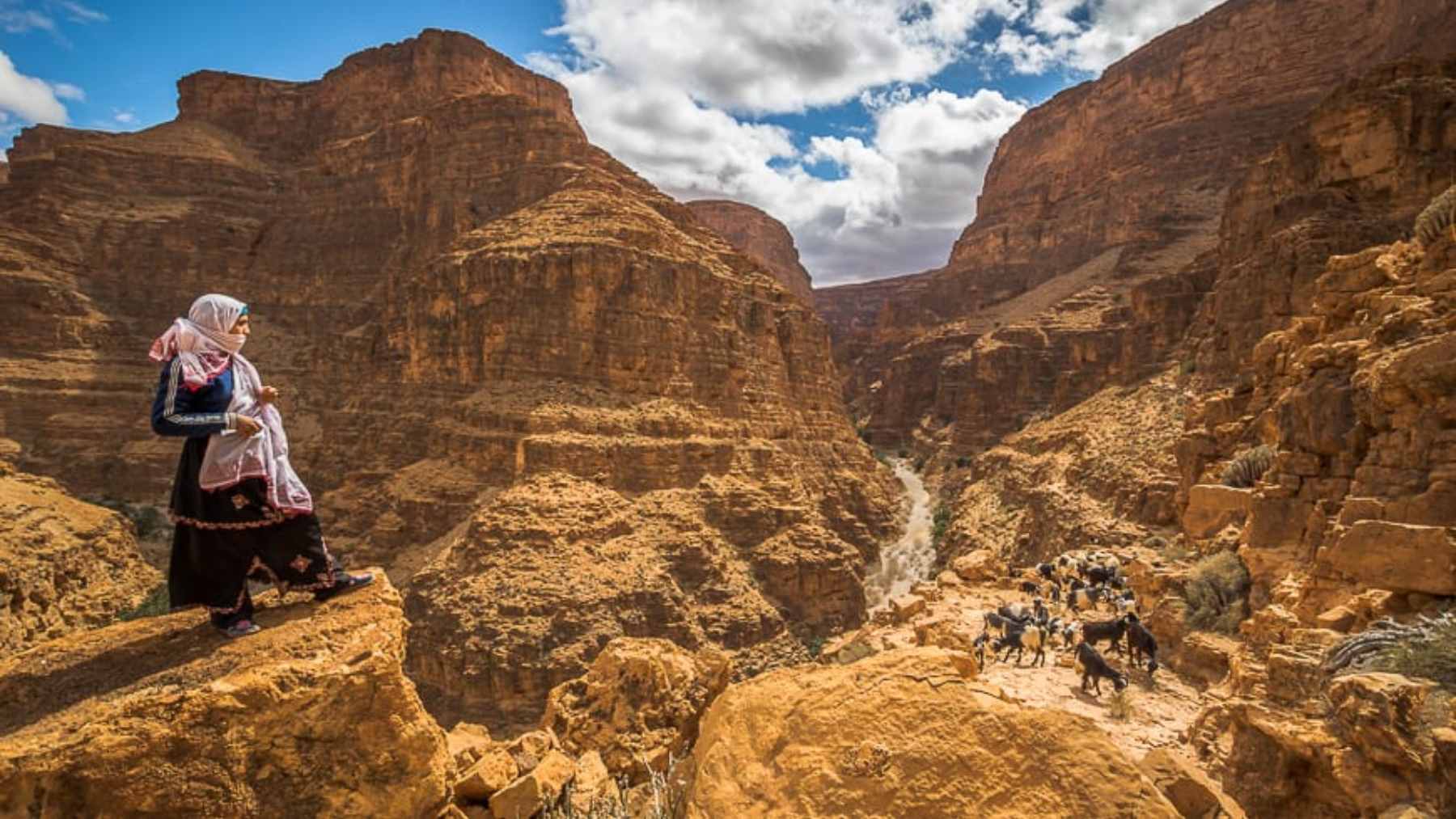
Have you ever watched fog roll across a hillside and thought of it as a water source? In Morocco’s Anti-Atlas Mountains, that passing mist is becoming a lifeline for villages where groundwater is no longer reliably replenished and drought has made daily life harder near the edge of the Sahara.
For years, women in Ait Baamrane spent long mornings walking for water, carrying five-gallon containers that weighed nearly 50 pounds when full. Now, fog nets installed high on Mount Boutmezguida collect Atlantic moisture and send clean water through pipes to village taps, turning a daily burden into something as ordinary as opening the faucet.
Water from thin air
Dar Si Hmad, a women-led Moroccan nonprofit, designed the fog harvesting system as a local answer to persistent water stress. The United Nations Framework Convention on Climate Change (UNFCCC) has described the project as a model of participatory climate adaptation that uses an environmentally friendly water source to push back against desertification.
In its earlier official profile, the system included about 6,460 square feet of nets, seven reservoirs with roughly 142,000 gallons of storage capacity, six solar panels, and more than 6 miles of piping. That setup served more than 400 residents in five villages, most of them women and children.
How the nets work
Fog harvesting sounds almost like a trick, but the mechanics are simple. Mesh panels hang between poles, wind pushes fog through them, droplets cling to the fibers, and the water falls into gutters before moving toward storage tanks.
The location matters. Mount Boutmezguida rises about 4,000 feet above sea level, in a place where seasonal fog and coastal humidity make the mountain useful in a way flat desert land would not be.
Modern engineering has helped turn an old idea into something more practical. Massachusetts Institute of Technology (MIT) researchers found that changes to mesh spacing, fiber size, and surface chemistry can increase fog-collecting efficiency by about 500%, a major gain for communities counting every gallon.
From mountain mist to village taps
Dar Si Hmad began studying the region’s fog potential in 2006. Later, the system expanded with honeycomb-style nets installed at the summit, where captured water is collected, mineralized, and piped toward individual households.
A 2022 Reach Alliance case study reported that the project served 16 villages and used about 18,300 square feet of netting.
The same report listed benefits that go well beyond drinking water, including reduced water-gathering time, better school attendance for girls, more freshwater access in homes and schools, and greater participation by women in natural resource management.
That is the heart of the story. This is not only water infrastructure – it is time returned.
Trust had to be earned
Still, not everyone immediately trusted water that came from fog. According to the Reach Alliance case study, some villagers saw fog as a nuisance, something that soaked clothing, confused livestock, and even seemed to block rainfall.
The skepticism faded only when the system delivered what it promised. One interviewee summed up the shift this way, “Once the water was open, it was a friend, no longer an enemy.”
There was another layer, too. Women had long been the “water guardians” of their households, so bringing water directly into homes changed daily routines and, in some cases, household authority. Dar Si Hmad responded with literacy training, water education, and “fog phones” that allowed women to keep reporting and managing problems in the system.
Why this matters
The human scale is hard to ignore. UNICEF has estimated that people in Africa spend 40 billion hours every year walking to collect water, while the World Bank says women and girls are primarily responsible for water collection in nearly 80% of households without direct water access in Sub-Saharan Africa.
That is why a tap inside a home can mean more than convenience. It can mean school instead of a water run, fewer miles under the sun, and less pressure on families already dealing with drought, migration, and shrinking rural opportunities.
But fog harvesting is not a universal fix. It needs the right mix of altitude, steady fog, wind, maintenance, and community trust. No net can catch fog that never arrives.
A climate tool with limits
For the most part, the Morocco project shows what climate adaptation can look like when it starts with local geography instead of a one-size-fits-all blueprint. In practical terms, it uses moisture that is already moving through the air, then relies on gravity, pipes, solar power, and local management to make it useful.
That does not replace desalination, groundwater protection, or broader water planning. It does show that in the right place, a simple mesh on a mountain ridge can do what trucks, dry wells, and long walks could not.
The official statement was published on the UNFCCC.