New Zealand spent decades planting pine trees to grow its forestry industry, stabilize land, and cover open landscapes with fast-growing trees. Today, some of those same trees have become one of the country’s most stubborn ecological problems.
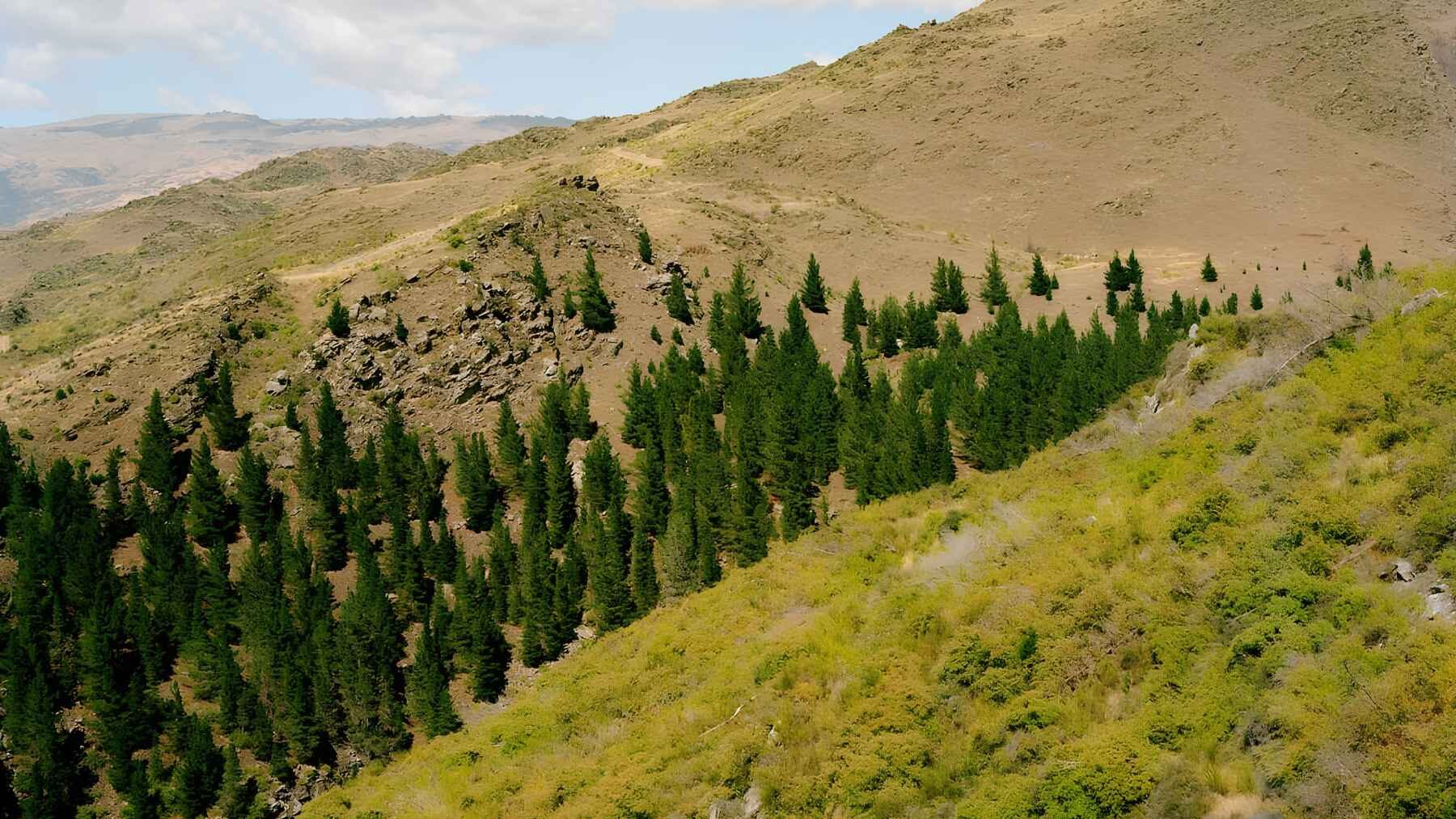
The issue is not the managed forests that supply timber. It is what happens when pines escape their boundaries, spread by wind, and start taking over grasslands, mountain slopes, and river catchments. More than 4.9 million acres of New Zealand are now affected by wilding pine infestations, and untreated areas are expanding by an estimated 5 percent a year, according to the New Zealand government.
When planted trees break loose
Wilding conifers are introduced pine and conifer trees that spread naturally outside planted areas. Their seeds can blow far beyond plantations, shelterbelts, and erosion-control plantings, then take root in places where dense pine cover was never supposed to grow.
At first, the change can look harmless. A few young trees on a hillside may not seem like an emergency. But give them time, and those scattered trees can turn into thick stands that shade out native plants and reshape open landscapes.
New Zealand’s Department of Conservation says conifers were introduced in the 1880s and now threaten native ecosystems, grazing land, recreation, tourism, and water supplies. It also warns that wilding conifers can reduce runoff into streams because they use more water than the open vegetation they replace.
The water problem is easy to miss
The most surprising part of the story is not that pines spread. It is that they can quietly reduce the amount of water reaching rivers, lakes, and reservoirs.
Here is the basic idea. Pine canopies catch rain before it reaches the ground, and the trees also move water back into the air through evapotranspiration. In practical terms, that means less rainfall becomes streamflow, especially in catchments that are already sensitive to dry periods.
That may sound technical, but the effect is familiar. Less river flow can matter for farms, hydroelectric generation, recreation, and wildlife. It can also matter for the electric bill if reduced hydropower has to be replaced by other sources.
How much water can disappear
Economic analysis prepared for New Zealand’s wilding conifer control work found that when pasture is replaced by dense radiata pine forest, annual surface water yield reductions of 30 percent to 81 percent have been reported in several catchment studies. The same analysis noted that wilding conifers can be especially damaging because they often grow in upper catchments where commercial plantations would not usually be planted.
That does not mean every invaded hillside loses water at the same rate. Rainfall, soil, slope, tree density, and the original vegetation all matter. Still, the warning is clear enough for policymakers to treat water yield as one of the major risks.
What does that mean on the ground? A river may still look like a river, but the hidden balance behind it can shift. Less water moving through the system can hit irrigation, native stream life, and hydro dams long before most people notice.
A cleanup bill that keeps growing
New Zealand has already spent heavily trying to contain the problem. From July 2020 to June 2021, the wilding conifer work program and its partners spent almost $22.8 million U.S. on control work, treating about 2 million acres. That conversion uses the Reserve Bank of New Zealand’s July 6, 2026 exchange rate of 1 New Zealand dollar equaling $0.56885 U.S.
The broader bill is even larger. Since 2016, about $99.5 million U.S. has been allocated by the government through the national program, with at least another $21.6 million U.S. contributed by partners. From July 2024, the program also has ongoing baseline funding of about $5.7 million U.S. each year.
Then came the latest boost. In May 2026, Biosecurity Minister Andrew Hoggard said Budget 2026 would add about $44.9 million U.S. over three years, taking the total commitment for that period to about $62 million U.S. “Wilding pines threaten productive farmland, water supplies in sensitive catchments, and native biodiversity,” he said.
Not all forests are equal
This is where the story gets tricky. Reforestation is often good for climate, soil, biodiversity, and carbon storage. But ecology has a catch that never goes away. The right tree in the wrong place can still become a problem.
Radiata pine and Douglas fir are important commercial species in New Zealand, and the Department of Conservation notes that both can be useful when planted in appropriate places and properly managed. The danger starts when fast-growing conifers move into ecosystems that evolved without them.
At the end of the day, this is not an argument against planting trees. It is a reminder that planting is not the same as restoration. A forest can store carbon and still harm a river catchment if the species, location, and long-term management are wrong.
A lesson beyond New Zealand
New Zealand’s wilding pine fight carries a lesson for any country racing to plant trees for climate goals. The headline number may be millions of seedlings, but the real test comes decades later, when those trees interact with water, fire risk, native species, and local economies.
The country is now trying to stay ahead of that spread through coordinated control, regional councils, landowners, iwi, researchers, volunteers, and government agencies. That is not glamorous work. It is chainsaws, aerial surveys, planning maps, and a long memory.
So, what should readers keep in mind? Trees are powerful tools, not magic fixes. New Zealand’s pine invasion shows that nature does not always follow the plan humans write for it.
The official statement was published on Beehive.govt.nz.