Scientists have uncovered a vast whale graveyard beneath the southeastern Indian Ocean, and it is much more than a pile of old bones. The site, found in the Diamantina Zone, stretches for about 745 miles across the seafloor and reaches depths of nearly 4.4 miles, making it the deepest and most extensive whale necropolis documented so far.
The discovery gives researchers a rare look at how whales, fossils, microbes, and deep-sea animals interact over enormous spans of time. It also raises a simple question with a complicated answer. How can one remote trench hold so many whale remains from so many different moments in Earth’s past?
A graveyard hidden in darkness
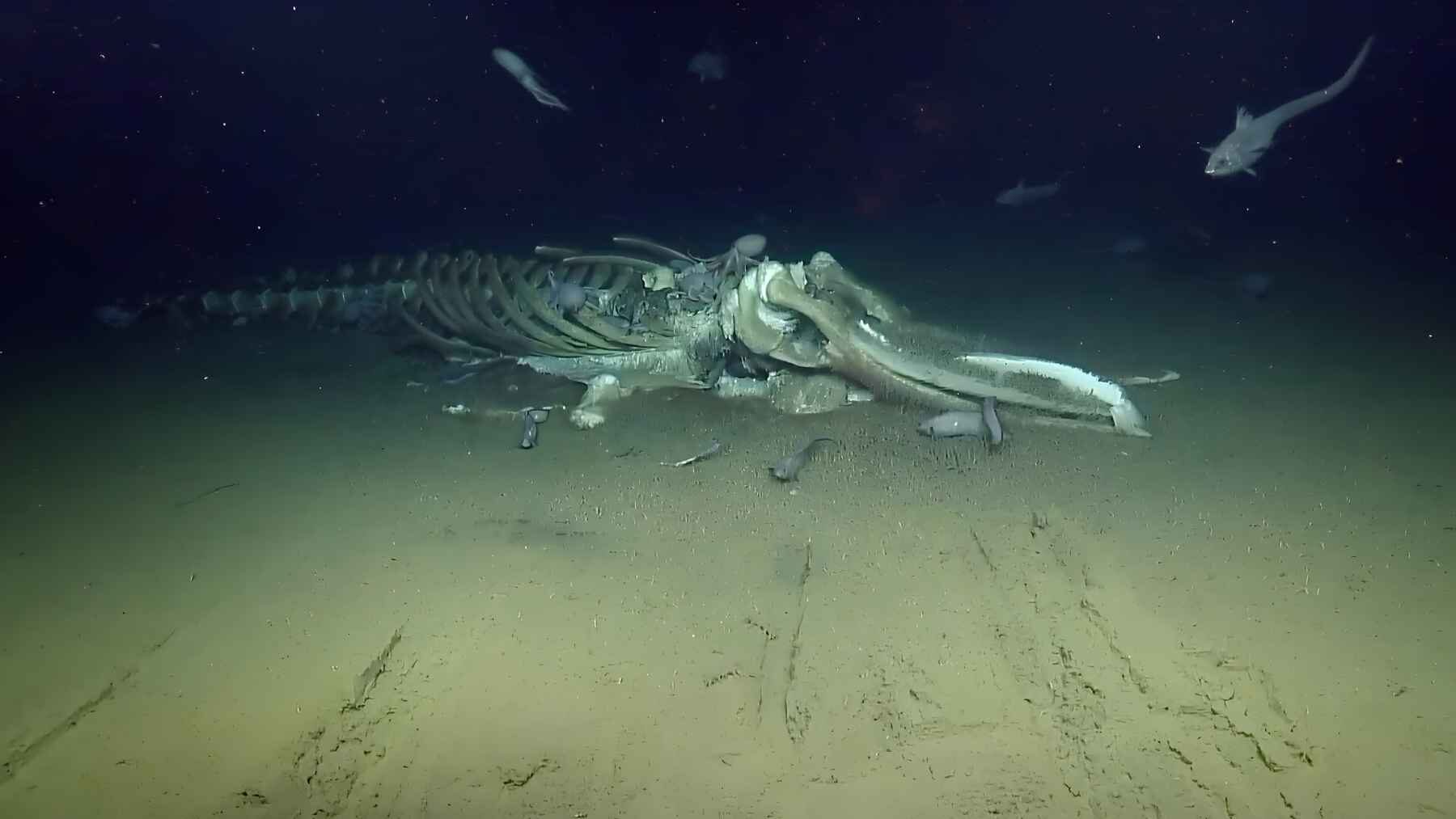
The site was discovered during a 2023 expedition using the human-occupied submersible Fendouzhe, which carried scientists down into one of the least explored parts of the ocean. Across 32 dives, researchers documented five modern natural whale-fall communities and 476 fossil cetaceans, with some records grouped into 485 whale-fossil sites and active falls.
That detail matters. This is not just a fossil bed locked in the past, but a living deep-sea system where recent whale carcasses still feed strange communities of animals.
Whale falls happen when dead whales sink to the ocean floor. In the deep sea, where food is scarce and sunlight never arrives, one carcass can become something like a neighborhood grocery store for microbes, worms, crustaceans, mollusks, and other creatures.
Why scientists were stunned
The scale of the find is unusual. According to the Chinese Academy of Sciences, whale remains in the area reached densities of up to about 1,970 individuals per square mile, and extrapolations suggest the broader zone could contain more than 10 million whale carcasses.
That number is not a final count. It is an estimate based on density, and experts will need more surveys to refine it. Still, even with that caution, the Diamantina Zone now looks like one of the most important deep-sea fossil sites ever found.
The fossils date back at least 5.3 million years, based on strontium isotope dating, placing some remains in the Early Pliocene. That means this underwater graveyard may have been collecting whale bones since long before modern humans existed.
Beaked whales take center stage
Many of the remains appear to belong to beaked whales, a mysterious group of deep-diving cetaceans that spend much of their lives far from human view. Giovanni Bianucci, a paleontologist at the University of Pisa and co-author of the study, said, “Most of the skeletal remains” belong to these deep-diving animals.
That makes sense, to a large extent. Beaked whales hunt at great depths, often diving into dark waters in search of squid and fish, so the Diamantina Zone may have been both a feeding area and a dangerous trap.
Researchers also identified living beaked whale species from the remains, including Andrews’ beaked whale and the strap-toothed whale. Among the extinct species was a newly described whale named Pterocetus diamantinae, a nod to the trench where it was found.
A natural funnel for whale bones
So why here? The answer may come down to geography, biology, and time working together in the same place.
The Diamantina Zone has a rugged, V-shaped seafloor that may funnel sinking carcasses into the trench. At the same time, the area may serve as a foraging ground for whales, especially deep divers that can push their bodies close to the limit during long descents.
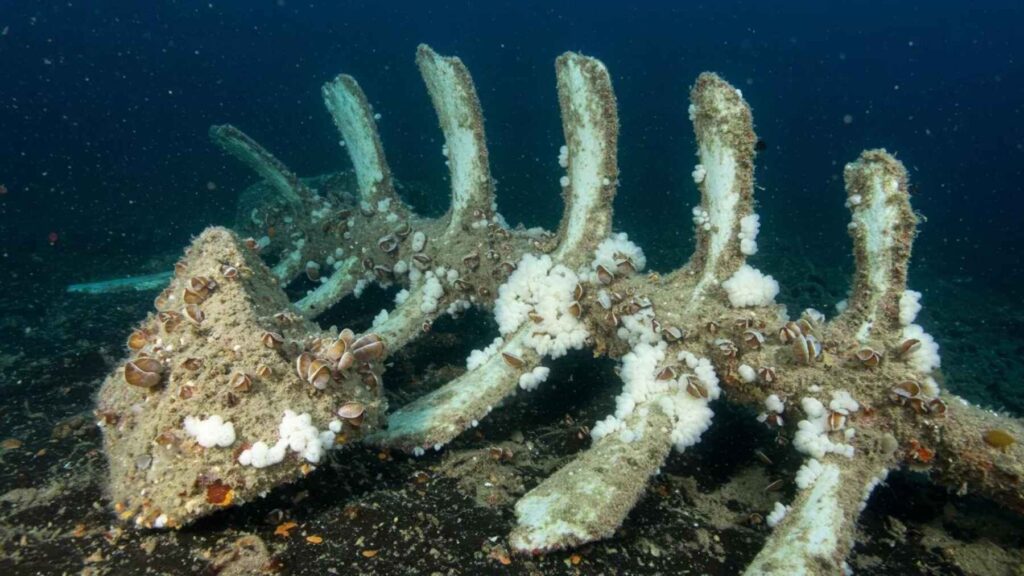
The bones also stayed visible because sediment builds up very slowly in this part of the ocean. Instead of being quickly buried, skeletal remains can sit exposed for very long periods, sometimes long enough to become coated with dark mineral crusts that help preserve them.
A feast for deep-sea life
The word “graveyard” sounds lifeless, but this one is anything but dead. The active whale falls were covered with microbial mats and animals such as brittle stars, bone-boring Osedax worms, and chemosymbiotic bivalves, which can survive by relying on chemical energy rather than sunlight.
One modern whale fall, made up of three beaked whale vertebrae, was found at about 4.2 miles deep. Researchers described it as the deepest active whale-fall ecosystem recorded to date.
The largest modern carcass found was an Antarctic minke whale about 16 feet long. Even that single body could feed deep-sea life for years, possibly decades, turning death into a slow release of nutrients in a place where every scrap counts.
A possible carbon vault
There is also a climate angle, though scientists are careful not to oversell it. The Chinese Academy of Sciences reported that, under one estimate, the site could represent about 7.4 million U.S. tons of sequestered carbon. This assumes an average beaked whale weight of 2.2 U.S. tons and 25% lipid content.
That does not mean whale falls are a simple climate solution. The ocean’s carbon cycle is far too complex for that kind of neat conclusion.
It does suggest that whale carcasses, however, may play a bigger role in deep-ocean carbon storage than previously understood. At the end of the day, these animals may shape the seafloor not only while alive, but long after death.
What comes next
Researchers believe the Diamantina Zone may be a previously unrecognized deep-sea corridor for whale-fall communities. That idea is exciting because whale falls can help species move across the ocean floor, much like stepping stones between cold seeps, hydrothermal vents, and other chemical-rich habitats.
More expeditions will be needed to test that theory, identify possible new species, and map the full size of the site. The trouble is, places this deep are hard to reach, expensive to study, and still full of surprises.
For now, the discovery changes how scientists view the deep ocean. Far below storms, ships, and beach waves, a hidden archive of whale evolution and strange life has been sitting in the dark for millions of years.
The study was published in Nature.