Self-fertilization has long carried a dramatic label in evolutionary biology. For decades, many scientists have wondered whether plants and other organisms that reproduce with themselves are quietly walking into an “evolutionary dead end.”
A new preprint now adds a careful twist to that story. After looking across 18 phylogenetically diverse families, the researchers found that mating system alone did not explain diversification patterns better than null models, while sexual system often did. In plain English, the way organisms arrange male and female function may matter more than self-fertilization by itself.
A fresh look at an old idea
Self-fertilization can sound like a shortcut. One organism produces offspring without needing a separate partner, which can be helpful when mates or pollinators are scarce.
Shortcuts can come with a cost, however. Earlier research has framed the “dead end” hypothesis as two linked ideas, that transitions toward selfing may be hard to reverse and that selfing lineages may face higher extinction or lower diversification over time.
That is why this new study matters. Instead of treating self-fertilization as a simple yes-or-no villain, the authors tested whether reproductive traits actually line up with speciation and extinction patterns across a wider evolutionary spread.
Why reproduction shapes biodiversity
Reproduction is not just a private biological detail. It can shape how species spread, adapt, survive bad years, and respond to changing habitats.
Think of a plant growing along a roadside, in a disturbed field, or on the edge of a forest after a fire. If pollinators are missing or nearby relatives are scarce, self-fertilization can help it produce seeds anyway. That can be a lifeline.
Still, there is a tradeoff. Selfing can reduce genetic mixing, and that may leave populations with fewer options when disease, drought, or heat arrives. Nature often works that way. A benefit today may become a weakness tomorrow.
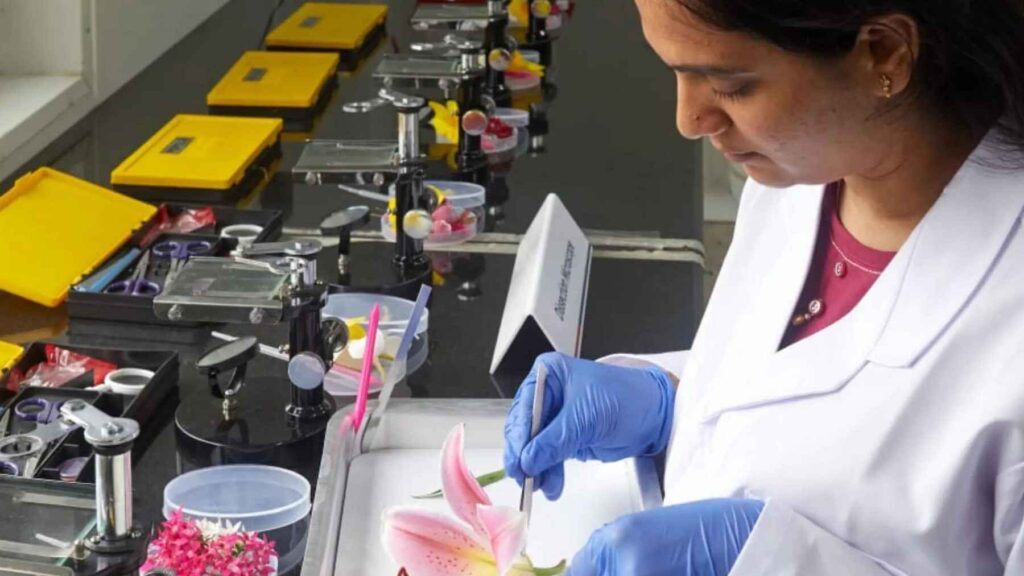
A researcher analyzes a flower in a laboratory as part of a study on plant reproduction, self-fertilization, and the evolutionary processes that shape biodiversity.
What the researchers tested
The study focused on two related but different pieces of reproductive biology. One was mating system, which includes whether lineages tend toward self-fertilization or outcrossing.
The other was sexual system. That refers to how male and female reproductive functions are arranged, such as whether they occur in the same individual or are separated among individuals.
To test these ideas, the authors used state-dependent speciation and extinction models, often called SSE models. These methods are designed to ask whether a trait is linked to faster speciation, higher extinction, or broader diversification patterns.
The big surprise
The headline finding is not that self-fertilization is harmless. It is more careful than that.
The researchers found that mating system, as a trait, did not explain diversification patterns better than null models in their broad analysis. That means the data did not support a simple rule saying selfing lineages diversify differently just because they self-fertilize.
Sexual system was different. According to the abstract, it often did explain diversification patterns, suggesting that the broader architecture of reproduction may be more important than the selfing label alone.
Hidden states matter
The study also used newer versions of SSE models, including “hidden state” and tree-only approaches. That sounds technical, but the idea is pretty down-to-earth.
Sometimes a visible trait is not the whole story. A plant may share the same reproductive label as another plant, but differ in ecology, geography, genome history, pollinator relationships, or many other hidden factors.
Hidden-state models try to account for that unseen complexity. They are a reminder that evolution is rarely a single switch. It is more like a control panel with many dials, some obvious and some tucked behind the machine.
Not every family tells the same story
One of the most important details is family-level heterogeneity. In other words, the pattern was not the same everywhere.
That matters because many earlier studies have focused on individual families. Those studies can be valuable, but one family may not speak for all life. A result from one group of plants may not carry neatly into another.
So, what should readers take away? For the most part, the study pushes against sweeping claims. Self-fertilization may be risky in some contexts, but calling it a universal evolutionary dead end now looks too tidy.
Why this matters for ecology
This is not just an academic debate about plant family trees. Reproductive systems help shape the biodiversity we see in forests, meadows, farms, wetlands, and even cracked sidewalks.
If selfing helps species persist when pollinators decline, it could influence how plant communities respond to environmental stress. If it also limits long-term genetic flexibility,however, conservationists still need to watch for hidden vulnerabilities.
That is especially relevant as habitats shift and pollinator communities face pressure. The trouble is, ecosystems rarely give simple answers. A reproductive strategy can be both a rescue rope and a constraint.
A more nuanced future
The new findings suggest that researchers may need to look beyond mating system alone. Sexual system, hidden traits, and family-specific history could all shape how lineages rise, stall, or disappear.
That is good science, even if it makes the story less punchy. Evolution does not always reward the cleanest headline. Sometimes the better answer is messier, but closer to the truth.
The study also appears as a preprint, meaning it has been shared publicly before formal peer review. bioRxiv says manuscripts posted there are not certified by scientific peer review before appearing online, so the findings should be read as preliminary while still useful for scientific discussion.
The study was published on bioRxiv.