Can nature’s deepest laws really contain numbers that sit outside the theory, waiting to be chosen by hand? A new study led by researchers connected to Kyushu University, CERN, the University of Turin, and Caltech suggests that, at least in one important mathematical setting, the answer may be no.
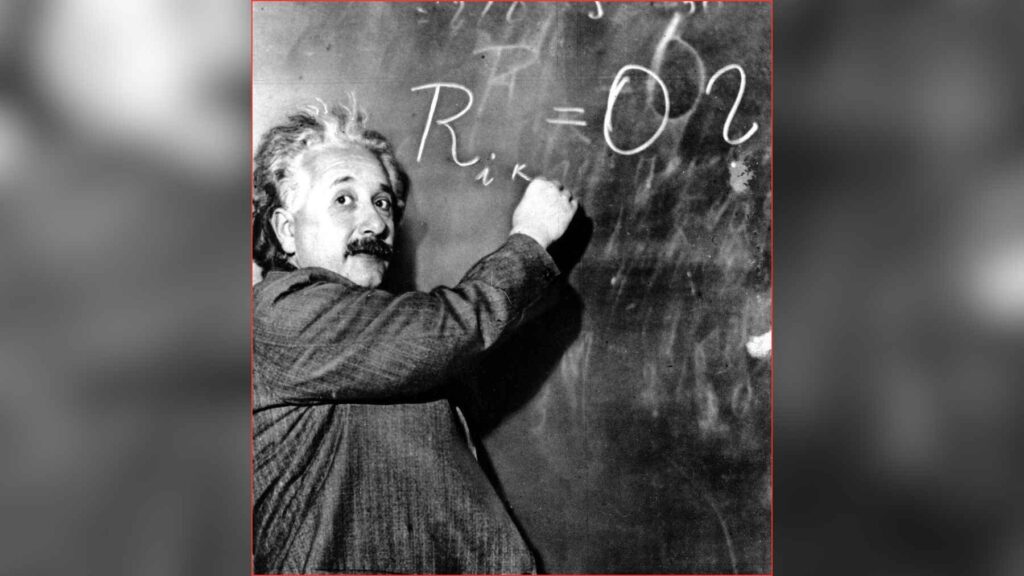
The work gives fresh support to a view often associated with Albert Einstein, who argued that the fundamental equations of physics should not depend on arbitrary values added from the outside. In this case, the team found that continuous changes in a theory can be traced back to local operators inside the theory itself, not to mysterious external knobs. That may sound abstract, and it is, but the question reaches straight into the search for quantum gravity.
Why hidden numbers matter
Physics is full of numbers. Some describe things we can measure, while others appear inside equations as parameters that help define how a theory works.
The trouble starts when those parameters look freely adjustable. If the deepest laws of nature depend on numbers that have to be selected from outside the theory, then physicists are left asking where those numbers came from in the first place.
Einstein’s instinct was that nature should be more self-contained than that. In practical terms, the laws should not feel like a machine with unexplained settings on the back panel.
The quantum gravity puzzle
Quantum gravity is the still unfinished effort to bring gravity and quantum mechanics under one roof. Gravity works beautifully for planets, stars, and galaxies, while quantum mechanics rules the tiny world of particles and fields.
Put them together, though, and things get difficult fast. Black holes, the Big Bang, and the structure of space itself all push scientists toward a theory that can handle both.
That is why these “free parameters” matter. If quantum gravity is truly fundamental, many physicists expect its equations to leave no room for arbitrary outside choices. The numbers should arise from the theory’s own physical ingredients.
A test using conformal field theory
The researchers approached the problem through conformal field theory, often shortened to CFT. These theories describe systems that, for the most part, behave the same way across different length scales.
Some CFTs can be changed smoothly without breaking their key conformal properties. The mathematical tools that allow those changes are called exactly marginal operators, and the smooth family of related theories is known as a conformal manifold.
At the heart of the study is a deceptively simple question. If that smooth family exists, does it mean an exactly marginal operator must exist too? The team answered yes under specific assumptions, showing that the operator can be recovered from inside the structure of the theory.
The interface clue
To get there, the team imagined two closely related CFTs separated by a conformal interface. Think of it as a thin mathematical boundary between two versions of a theory, a little like the line between two neighborhoods that are almost the same.
As the two theories become identical, that boundary becomes trivial. Before it disappears, however, it still responds when it is shifted slightly.
That response is the key. Under the team’s assumptions, an exactly marginal operator can be reconstructed from the interface displacement operator, which describes how the interface reacts to small movements. “Our work shows that continuous changes in a theory can be generated by local operators within the theory,” said Yuya Kusuki.
What this means for quantum gravity
The study does not claim to solve quantum gravity. No one has suddenly written the final rulebook for the universe.
Still, it offers an important clue. Through the anti-de Sitter space and conformal field theory correspondence, better known as AdS/CFT, certain CFT results can be translated into statements about quantum gravity in a special kind of curved space.
In that setting, the result supports the idea that continuous parameters are not external choices. Instead, they may correspond to fields or operators already living inside the theory. For a field that often feels like a maze, that is a useful compass.
The big limit
There is an important catch. The result currently applies to two-dimensional conformal field theories, not every CFT and not every possible version of quantum gravity.
That limit matters. Physics often advances by proving a difficult idea in a cleaner setting first, then testing whether it survives in messier and more realistic cases. This study is one of those steps.
The authors also rely on specific assumptions, including the existence of a conformal interface with the right properties and smooth behavior in certain correlation functions. In other words, the work is powerful, but it is not a blank check.
Why Einstein still echoes here
The striking part is not that one paper has settled a century of physics. It has not.
The striking part is that Einstein’s old intuition has gained a new mathematical foothold. The universe may still have hidden numbers, but this work suggests that at least some of them might come from the universe’s own internal grammar. Are nature’s laws chosen, or do they explain themselves?
For everyday life, nothing changes tomorrow morning. Your phone, your car, and your electric bill will look exactly the same.
The study was published in Physical Review Letters.