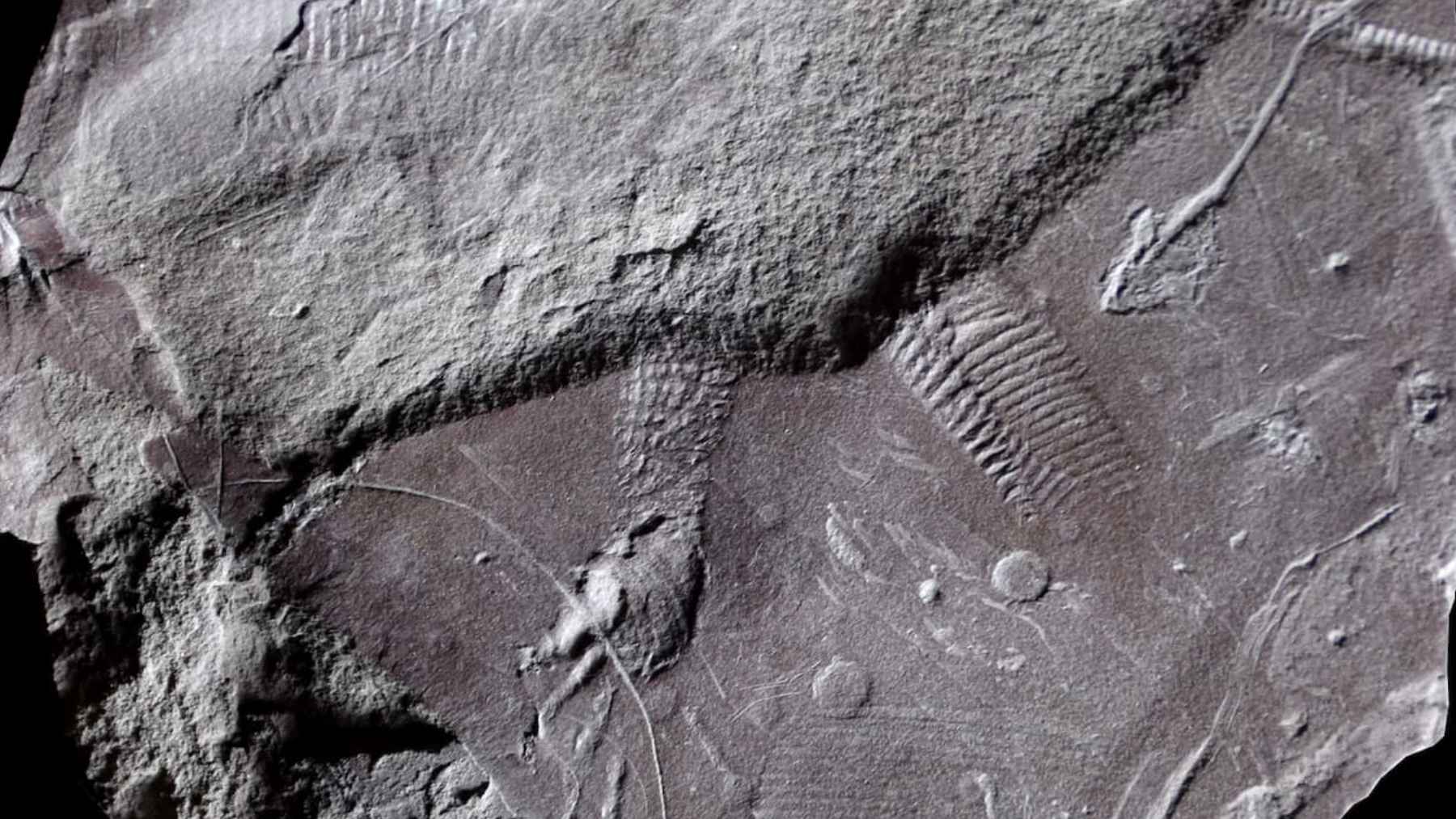
How do you fossilize skin, the kind that normally disappears within days or weeks? A new set of rock slabs from central Germany does it by preserving a reptile’s body impression in fine sediment, complete with scaly textures that look surprisingly modern.
An international research team led by paleontologist Lorenzo Marchetti says these marks are the oldest direct evidence of reptile skin identified so far, and one specimen may even preserve the outline of a cloacal opening near the base of the tail. The findings were announced by the Museum für Naturkunde Berlin and published in the journal Current Biology.
A fossil that is more than a footprint
The impressions come from the Thuringian Forest within the Goldlauter Formation, and they were discovered alongside tracks and “resting traces,” the subtle dents left when an animal settled its body onto soft ground. The newly described resting trace has been named Cabarzichnus pulchrus, and it captures more than toe marks.
Two sites anchor the story: the Cabarz quarry near the town of Tabarz and another locality in the municipality of Floh-Seligenthal. Using modern radiometric dating of volcanic ash layers within the same sediment package, the team dates the impressions to roughly 298 to 299 million years ago in the Early Permian.
The preserved scale patterns are not a single repeating motif. Researchers report shapes ranging from diamond-like to hexagonal and laterally pointed forms, a hint that early reptiles were already experimenting with different “skins.” The associated footprints also resemble those of bolosaurians, an early reptile group on the stem lineage leading toward modern lizards.
How scientists pinned down the age
A footprint can be ancient without being precisely dated. What makes this find stand out is that the sediment includes volcanic ash horizons, which can be dated with radiometric methods and used to lock down a narrow time window for when the impressions formed.
That timestamp matters because the Early Permian sits in a broader arc of shifting climates and landscapes. In the study’s abstract, the authors argue that differentiated epidermal scales were already present by the Asselian stage and that this skin adaptation likely predates major phases of Early Permian warming and aridification. That is a big claim, but it offers a clear ecological hypothesis to test.
Evolution often lays groundwork long before it becomes “necessary.” A trait can begin as a modest upgrade, then turn into a dealbreaker when conditions change. Anyone who has dealt with dry winter air and cracked hands knows how quickly water balance becomes an everyday problem.
Why scaly skin mattered on land
Reptile skin is famous for being dry, tough, and heavily keratinized, and that is not just a cosmetic detail. Classic anatomy references describe the reptilian outer layer as a key solution to the challenge of preventing desiccation through water loss, with waxes and keratinized cells forming a tight barrier.
The new fossils focus on epidermal scales, not the bony dermal scales found in many fish and some early vertebrates. IntechOpen’s overview of reptile skin notes that reptile scales are fundamentally different from fish dermal scales and are an integral part of the epidermis rather than detachable plates.
The researchers behind Cabarzichnus add that early amniotes likely saw epidermal and dermal scales coexist, with epidermal scale types differentiating very early in reptile history.
In practical terms, a better barrier means fewer hours hiding from dehydration and more time feeding, moving, and reproducing. On a Permian Earth that, for large regions, was trending toward dry to arid conditions as the supercontinent Pangea assembled, those small advantages could compound over generations.
The cloaca clue near the tail
The most attention-grabbing detail is also the one scientists handle with the most care. In one specimen from Cabarz, the team reports a narrow, slit-shaped impression near the base of the tail that they interpret as possible evidence of a cloacal opening.
A cloaca is a single opening used for both excretion and reproduction in most terrestrial vertebrates, with placental mammals as a major exception. The museum press release notes that this kind of soft tissue feature is almost never preserved in a clearly recognizable form, especially in rocks this old.
If the interpretation holds up, it suggests the cloaca’s shape and orientation differed from that of dinosaurs and crocodiles and more closely resembled those of turtles, lizards, and snakes. But it is also the sort of claim that will be revisited as new material appears and as imaging techniques improve.
Why this discovery matters beyond paleontology
Researchers have long known that some dinosaur fossils preserve skin impressions, feathers, and other body coverings, but the odds drop sharply as you move deeper into geologic time. “Such soft tissue structures are extremely rare in the fossil record,” Marchetti said in the museum’s announcement, underscoring why this find is unusual.
This is also a win for trace fossils, which record behavior as well as anatomy. “Trace fossils are far more than simple footprints,” Marchetti added, and he argues they preserve details that are often missing from bones alone.
For evolutionary and ecological research, that can be the difference between guessing an animal’s lifestyle and actually seeing how it touched the ground.
The work was completed within the BROMACKER research project, funded by Germany’s Federal Ministry of Research, Technology and Space, and it highlights a quiet truth about adaptation. Sometimes the most important innovations are not teeth or claws, but the skin that keeps an animal alive between meals.
The study was published in Current Biology.