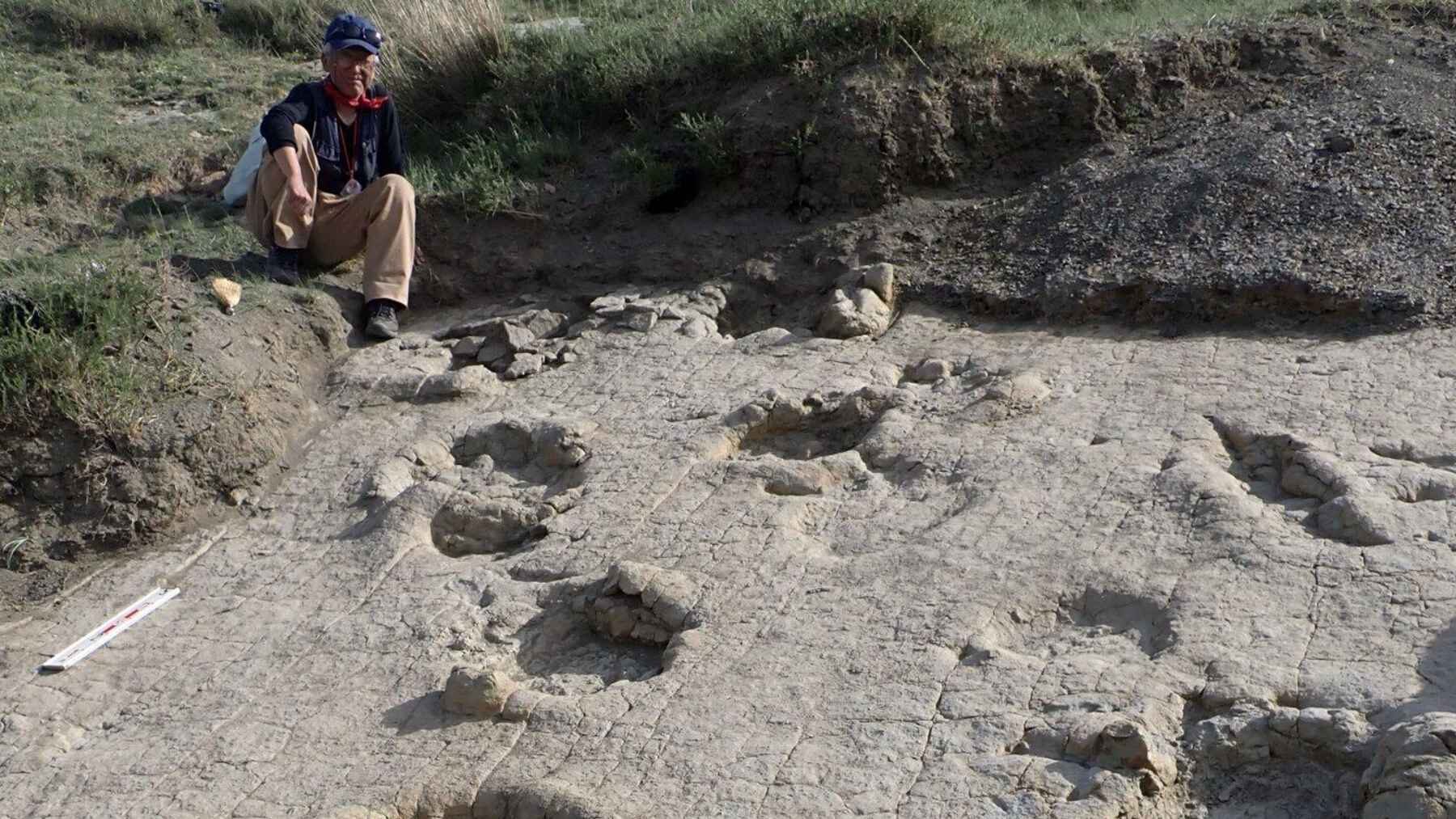
A dinosaur tracksite reported about 70 years ago, then effectively lost, has been rediscovered in northern Mongolia. Its 31 footprints show that enormous long-necked herbivores and large meat-eating theropods crossed the same lakeshore roughly 120 million years ago, extending the confirmed range of giant dinosaurs into a part of Early Cretaceous Asia where evidence had been scarce.
The find is not a movie-like chase scene frozen in mud. It looks more like a prehistoric traffic corridor, a route used when lake water pulled back, and that may be even more useful because footprints can preserve movement and behavior that skeletons alone rarely reveal.
A fossil site lost for decades
The Saijrakh locality first appeared in a brief report by a Mongolian geographer in the mid-20th century. With little technical description and no precise location to guide later teams, the place slipped out of scientific reach for decades.
Researchers from the Mongolian Academy of Sciences, the National University of Mongolia, and Okayama University of Science found the site again in 2024 with help from local people. They returned for detailed track and geological work in 2025, turning a two-page historical clue into a properly documented fossil site.
A lakeshore became a time capsule
The tracks sit in the Shinekhudag Formation, which preserves sediments from a large Early Cretaceous lake. Fine black clay settled in deeper water, while thin sandy layers formed during lower-water periods, when exposed ground became soft enough to take a dinosaur’s step much like wet soil holds a boot print.
Later sediment covered the impressions and helped preserve them on a single rock surface. That shared layer places the animals in the same ancient setting, but it does not prove the sauropods and predators were there at the exact same moment.
The sauropods left a walking story
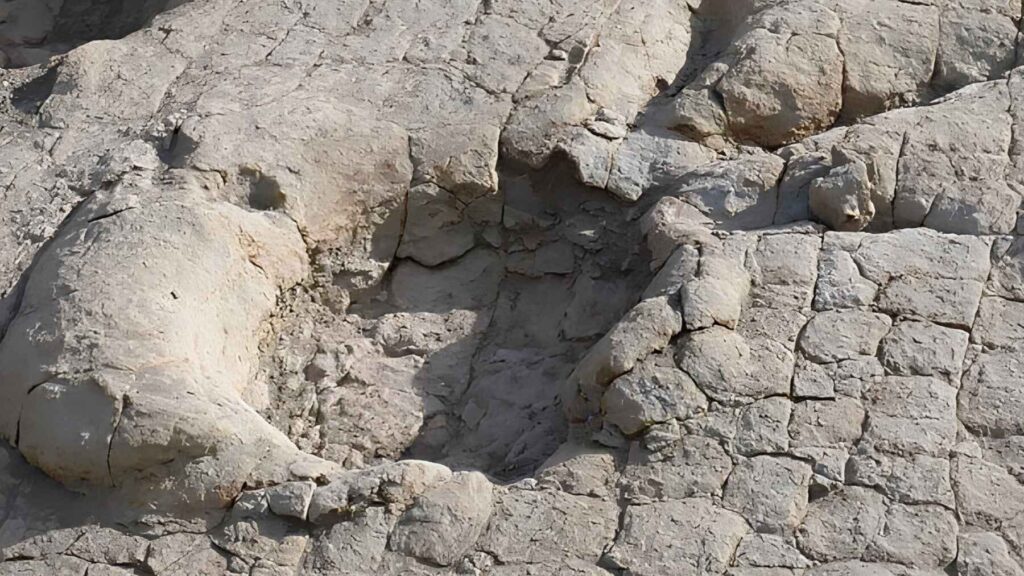
Two similarly sized sauropods, each estimated at more than 49 ft. long, left hind footprints about 28 in. in length. Their paths run in nearly the same direction and partly overlap, suggesting one animal followed the route of another, possibly at a slightly slower pace.
Modern elephants also reuse efficient paths, so the pattern offers a useful comparison. Still, two parallel trackways are not enough to prove herd behavior, and the study treats the idea with appropriate caution.
The tracks also preserve a rare mix of foot features. The broad walking stance, an inward thumb-claw mark on the front foot, and impressions from soft pads are “most consistent with a basal titanosauriform trackmaker,” meaning an early member of the wider group that included some of the largest land animals ever known.
Huge predators crossed the mud
Five theropod trackways appear on the same surface, and the largest three-toed footprint measures about 22 in. long. The animals that made them were estimated at more than 26 ft. from nose to tail, placing them among the major predators in this lakeside ecosystem.
A pack on the hunt? The evidence says otherwise. The trackways point in scattered directions, so the researchers found no sign that the five carnivores were moving together as a coordinated group.
That distinction matters because large Early Cretaceous predators were already known from China, South Korea, and Japan, but comparable evidence had been missing from Mongolia and eastern Russia. These prints now show that giant theropods had reached farther north than the local fossil record previously confirmed.
Why footprints matter so much
Bones can reveal a dinosaur’s anatomy, but tracks record a different kind of evidence. Step spacing, direction, stance, overprinting, and even soft-tissue impressions can show how an animal moved and how often a route was used.
At Saijrakh, the density and overlap of tracks suggest a busy shoreline rather than one dramatic encounter. Think of a path leading to the remaining water on a hot day, crossed again and again by animals with very different diets.
There is an important limit. Without matching bones or teeth, the researchers cannot safely name the exact dinosaur species, so the size estimates and broader identifications are best read as careful scientific approximations rather than tape-measure certainty.
A blank spot on the map shrinks
Mongolia is famous for Late Cretaceous dinosaurs, yet its earlier record is much thinner and has mostly featured small to medium-sized animals. That imbalance made northern Mongolia look unusually empty of giants during the Early Cretaceous, even while large dinosaurs were documented elsewhere in East Asia.
The new tracks suggest that at least part of that emptiness was a gap in discovery, not a true absence of animals. One site cannot answer every question, but it gives scientists a crucial point for comparing ecosystems across East Asia, eastern Russia, and North America during a period of major biological change.
Around 120 million years ago, the planet was generally warm and flowering plants were beginning to reshape land ecosystems. Mongolia’s position makes it especially valuable for studying how dinosaur communities spread and changed across the northern continents.
What researchers hope to find next
Sand layers containing gravel lie near the tracksite, and the team believes future searches could uncover bones or teeth from the animals that walked there. Such remains could identify the trackmakers more precisely and test whether the sauropod really belonged to an early titanosauriform branch.
For now, the footprints already change the view. Northern Mongolia was not an empty edge of the dinosaur world, but a well-traveled lakeshore where 49-foot herbivores and giant predators left their mark.
The study was published on Taylor & Francis Online.