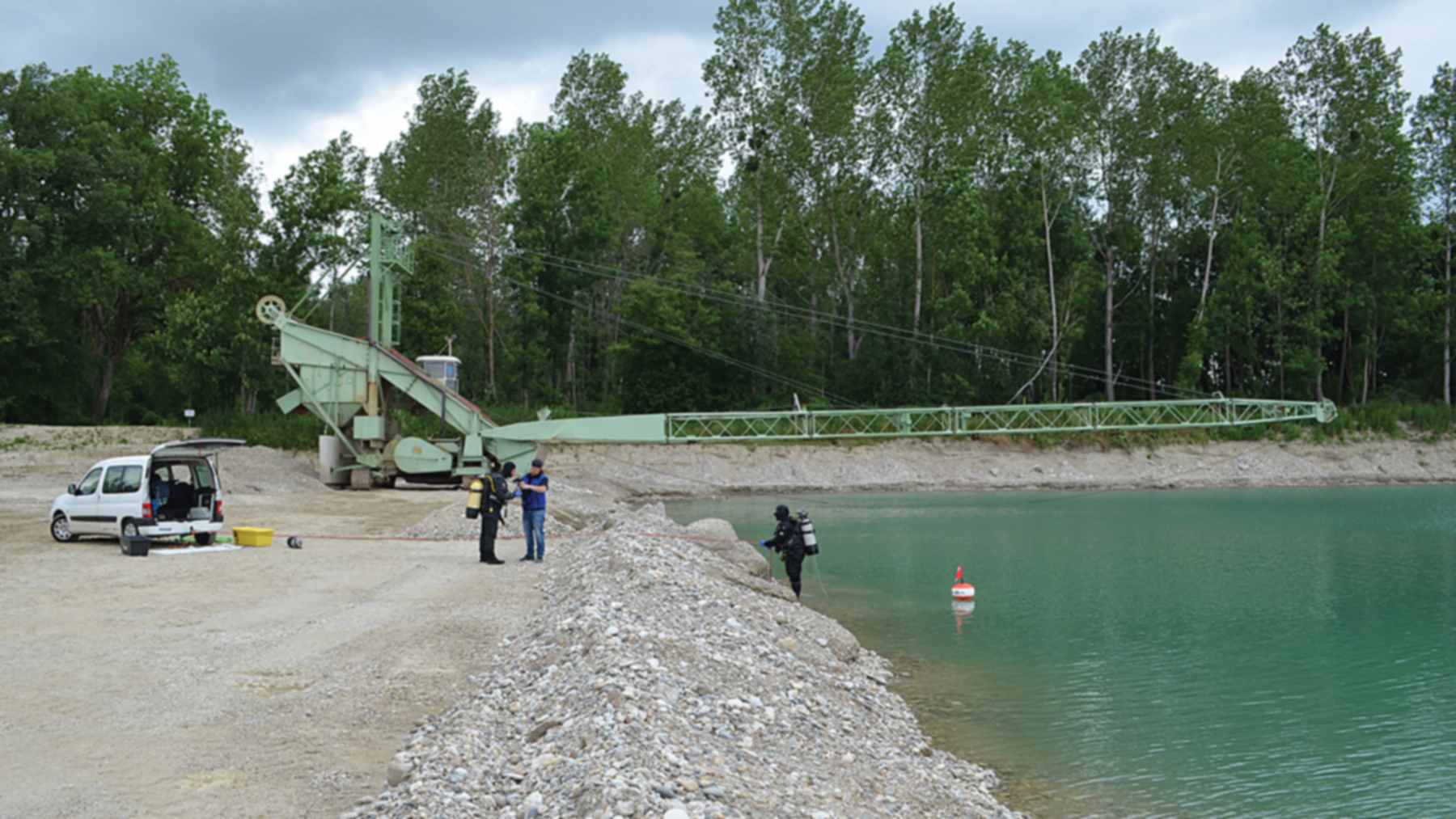
Gravel workers at Deinham, in Upper Austria, pulled up hundreds of rusty, pointed objects from a pit by the Danube in 2019. Archaeologists now say they are Europe’s largest known trove of Iron Age iron bars. There are at least 500, once weighing about 2,280 pounds (1,035 kilograms).
The study appeared on September 21, 2026, in the journal Antiquity. Its authors think the iron was cargo lost in a shipwreck more than 2,100 years ago. They are Peter Trebsche, professor of prehistory at the University of Innsbruck, and Marion Berranger of France’s Université de Technologie de Belfort-Montbéliard.
Pointed lumps in the gravel heaps
The pit lies on the right bank of the river, in the municipality of Hartkirchen an der Donau. The excavator kept bringing up double-pointed iron objects, so the workers called Austria’s Federal Monuments Office.
Archaeologists then picked more pieces by hand out of the gravel heaps. Divers checked the flooded pit where the bucket excavator had been digging. In all, the team gathered 540 fragments and matched them into exactly 500 bars.
River iron usually surfaces as shapeless rust, and the authors note that it tends to end up with scrap dealers. “It is nothing short of a minor miracle that the largest mass find of prehistoric iron bars in Europe did not end up at scrap dealers, but was reported to the Austrian monument authority,” Trebsche said in the University of Innsbruck announcement.
In 2023 the finders donated the collection to the Upper Austrian state museums in Linz. It is stored there today.
Forged to shape, never cast
Each bar is what archaeologists call a semi-product. A smith had hammered the raw metal into a set form, but nobody had made it into a tool yet.
The bars taper toward both ends, a form known as bipyramidal. The authors avoid the word ingot, because the bars were forged rather than poured into molds.
The 193 complete bars average about 11.2 inches (285 millimeters) long. Weighed without gravel, 65 of them average 4.6 pounds (2,070 grams). Yet the lightest weighs 2.1 pounds and the heaviest 8.4, so nobody forged to one fixed weight.
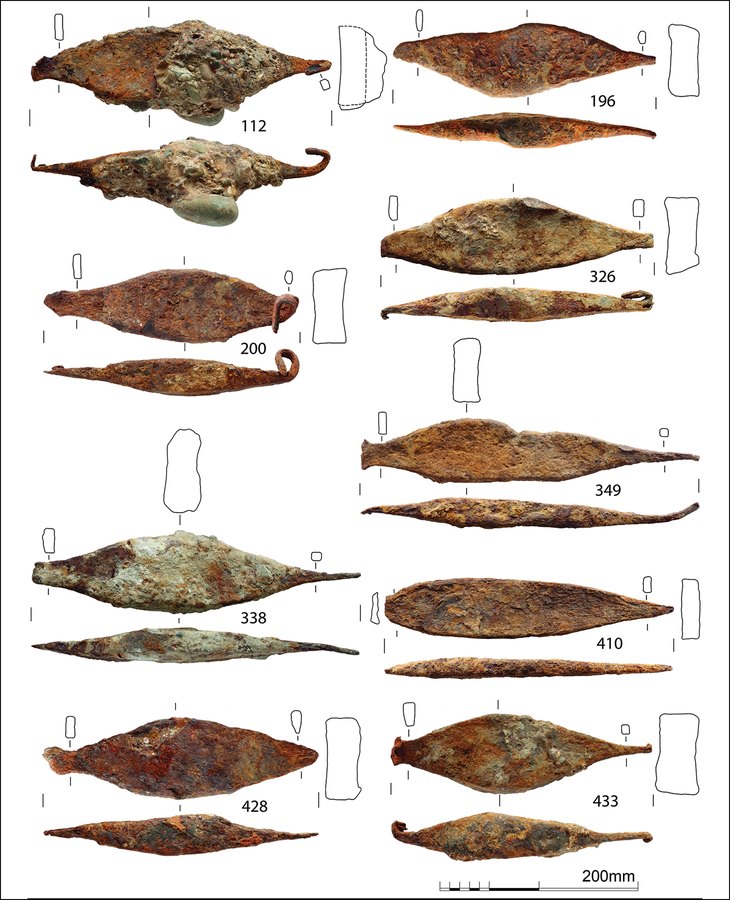
Some still wear a crust of pebbles cemented to the rust, while the clean ones owe their look to the gravel crusher, the study says. Most have one pointed end and one flat end, and a few have tips rolled inward or bent right back.
Carbon locked inside the metal
Double-pointed bars turn up from France to Hungary, mostly without any datable context. They are usually assigned to the eighth to fifth centuries BC. For Deinham, a lab at the University of Paris-Saclay dated carbon trapped in the iron itself, using two tiny drilled samples from each of three bars.
Two peaks came out of the lab. One sits in the late fourth century BC, the other from the end of the third century into the second.
Only the later window fits the few similar bars found in dated layers, such as one from Manching in Bavaria. That points to the second century BC, the late La Tène period, when Celtic Europe was making far more iron than before.
Enough for 500 swords
“The iron semi-products found at Deinham weigh around one tonne of iron, which is enough to forge approximately 500 swords with an average weight of 1.5–2kg,” Trebsche explained. Even with losses at the forge, he added, it could have armed a large group of warriors.
Swords are only one option in the paper. Up to 8,000 nails of 4.4 ounces (125 grams) each could have come out of the same metal. Celtic towns used such nails to pin the timber frame of a murus Gallicus, their stone rampart.
By the authors’ math, that is enough for almost half of the 4.3-mile (7-kilometer) wall around Manching. Closer to the find, at Gründberg in Linz, a tenth of it would have nailed the whole southern wall.
Downstream from Bavarian forges
Old navigation maps show the bars lay in silted-up side channels of the Danube, a river whose low water has exposed other shipwrecks. That ground formed only around A.D. 1600, so the bars count as a river find.
Until railways arrived, rivers carried most heavy goods across Europe. Late Iron Age dugout canoes are known from Austria, Bavaria and Czechia. According to the study, a single logboat can carry well over a ton.
The bars were probably forged upstream in Bavaria, where iron-production sites cluster around oppida, the large fortified towns of Iron Age Europe. The closest matches for the bar shape come from Manching, which sits near a large iron mining area.
People in Iron Age Europe also left offerings in rivers, and the authors do not rule that out. Ritual deposits, though, tend to mix many kinds of objects. Deinham holds one uniform batch of half-made iron.
Settling the bill in gold
Paying for a ton of iron raised its own problem, the authors argue. Grain, salt or wine would have been too bulky to haul back upstream. Glass, coral or amber were rarely available in such amounts.
That leaves tribute or a dowry, payment in livestock or enslaved people, or a far more precious metal. Celtic coins, struck at mints like one found in France, reached this stretch of the Danube around the second century BC.
The gold hoard from Manching held 443 coins weighing 8.2 pounds (3.7 kilograms). In the study’s view, it might plausibly have matched the value of a ton of iron.
“It is incredible that such a large quantity of iron was transported at once and was available in a single exchange transaction in the Late Iron Age,” Trebsche said. Gold and silver coins have also turned up at large Celtic settlements elsewhere in Central Europe, such as one excavated in Bohemia.
Boat, buyer and mine still missing
No trace of a boat turned up, which the authors call unsurprising. An excavator dug out the bars and wrecked their original setting.
Nobody knows where the cargo was headed, and the Manching gold is only a yardstick, with no direct tie to these bars. Trace element tests now underway should show where the raw iron came from. Metallographic work should also reveal whether one workshop made all 500.
The full study was published in Antiquity.
Photo: Heinz Gruber, Bundesdenkmalamt