Chinese astronomers went back through radio data from 33 planetary systems in a search for alien signals. One narrow tone passed their first filters. It came from K2-155, a small red star about 238 light-years away, observed in 2021 by China’s FAST radio telescope.
The team was led by Zi-Qi Li of Beijing Normal University and Zhengzhou University. Its paper in The Astronomical Journal claims no discovery. The clues lean toward interference from human technology or the telescope itself, though the exact source is still unknown.
A tone at 1,148.4167 megahertz
The researchers labeled the event NBS 260108, short for narrowband signal. It sat at 1,148.4167 megahertz with a signal-to-noise ratio of about 15. Nearly all its energy was packed into a very thin slice of the radio band.
That thinness is what draws attention. Stars and gas clouds tend to spread their radio emission across wide ranges, while engineered transmitters can squeeze it into a sliver. For that reason, NASA lists narrowband radio among possible technosignatures, or detectable signs of technology.
During the scan, the tone slid downward by about 0.038 hertz per second. Such drift can come from the Doppler effect, the shift that changes a passing siren’s pitch. The authors found the rate plausible for a moving source, but interference can drift as well.
So the drift alone could not settle anything. The team had to look at how the signal behaved inside the telescope.
Nineteen beams, only one hit
FAST, the Five-hundred-meter Aperture Spherical radio Telescope, has a dish about 1,640 feet (500 meters) across. The Chinese Academy of Sciences calls it the world’s largest single-dish radio telescope, and it sits in a natural hollow in Guizhou province. For this survey, its receiver watched 19 patches of sky at once, called beams.
The central beam stayed on the target star, and the other 18 covered neighboring spots. Interference from the ground usually leaks into several beams together. NBS 260108 appeared only in Beam 1, the one aimed at K2-155.
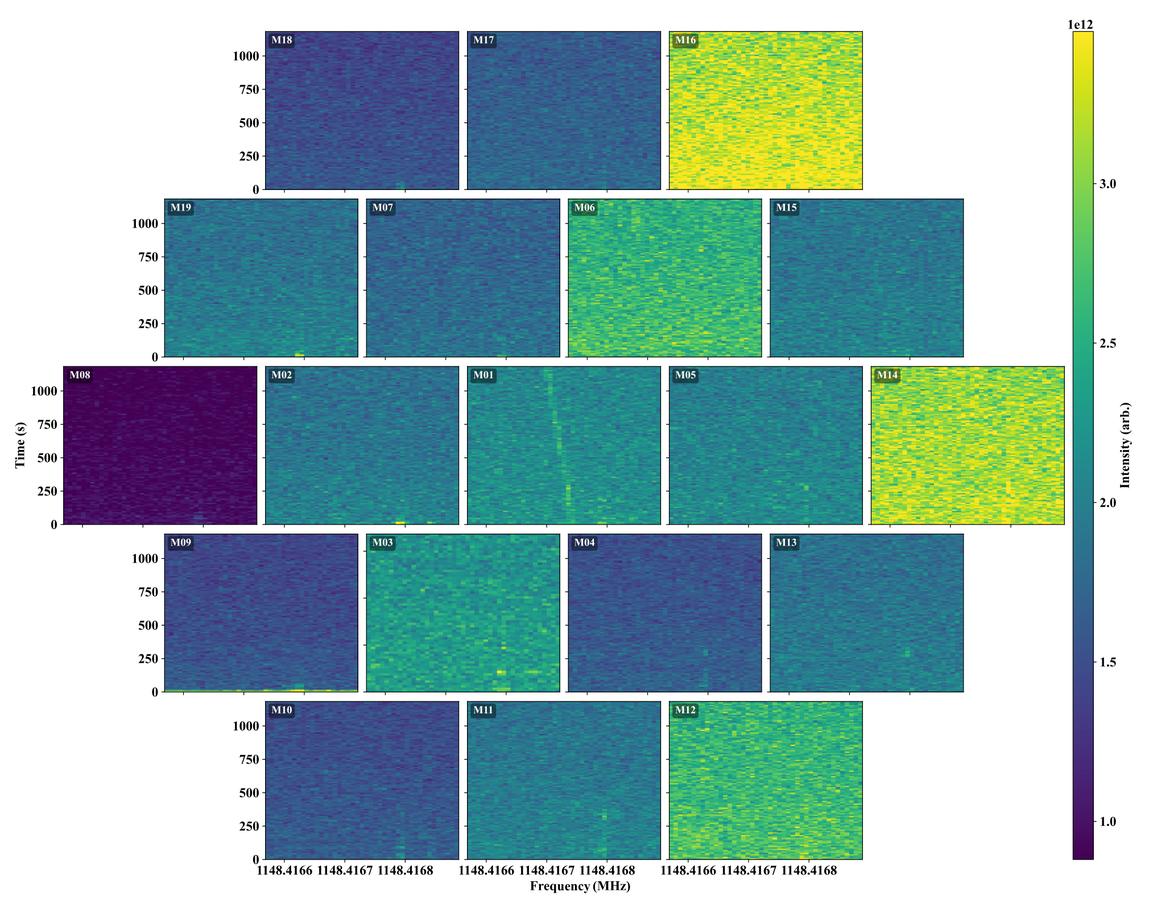
That let it clear a standard check called multi-beam anticoincidence. It did not prove the signal came from the star.
From 139,127 detections to 803
Finding one tone in noisy data is mostly a sorting job. Li and his colleagues paired machine learning with wavelet analysis, a math technique that separates broad patterns from fine detail. They trained the software on simulated spectra to spot the thin, slanted tracks of drifting signals.
On the real FAST data, the pipeline returned 139,127 detections. These merged into 6,402 events that could be compared across beams. After a veto that discards anything seen in more than one direction, 803 candidates were left.
Those numbers count steps in a filter, not transmitters. Two events stood out in the end. One was an earlier signal toward the star Kepler-438, already traced to interference, and the other was the new tone from K2-155.
Same frequency, three other stars
FAST records radio waves in two polarization channels, each tuned to a different orientation of the wave. The K2-155 tone was strong in one channel, with a signal-to-noise ratio near 23. In the other channel it was absent, and the authors describe a single-channel response as “a common warning sign of instrumental or terrestrial contamination.”
Next, the team checked the rest of that night. On September 10, 2021, FAST also observed K2-18, GJ-9066 and Ross 128. All three pointings showed similar narrowband features near the same frequency, in the same channel.
None of them was an exact copy of the K2-155 tone. The Ross 128 feature sat slightly off in frequency, the K2-18 one was very weak and the GJ-9066 one barely drifted.
Even so, the repeat pattern “strongly favors a common interference origin over a signal located at K2-155,” the researchers write. They also tested satellites, navigation systems and radar as suspects. None fit cleanly, partly because their known frequencies sit tens of megahertz away.
A super-Earth on a 40-day orbit
K2-155 was an appealing target because of its outermost planet. The star, a cool M dwarf, hosts three planets larger than Earth. The NASA catalog entry for K2-155 d lists it at about 1.9 times Earth’s radius, with a 40.7-day orbit.
Its discoverers placed it near the star’s habitable zone, where surface water could stay liquid. Their climate models assumed an Earth-like atmosphere, which nobody has measured. Nothing in the radio data ties the tone to this planet.
No transmitter matched to the tone
The authors leave NBS 260108 unclassified and state that it “is not confirmed as a technosignature.” Naming the culprit would take new observations linked to a specific transmitter.
The team also admits a gap in its own case. Its data cannot show whether the repeats across four stars reflect a real connection or chance.
For the next step, the researchers point to raw voltage recordings from FAST’s 19 beams. Cross-checking them could fix a candidate’s position on the sky and track its motion. That would catch radio frequency interference far better than filtering signal shapes alone.
Like other unexplained radio signals, the K2-155 tone remains an open question. It also shows the limits of artificial intelligence in sky surveys. Software can shrink a pile of faint radio signals to a short list, but it cannot say where they came from.
The full study was published in The Astronomical Journal.
Photo: SCJiang / Wikimedia Commons, CC BY-SA 4.0