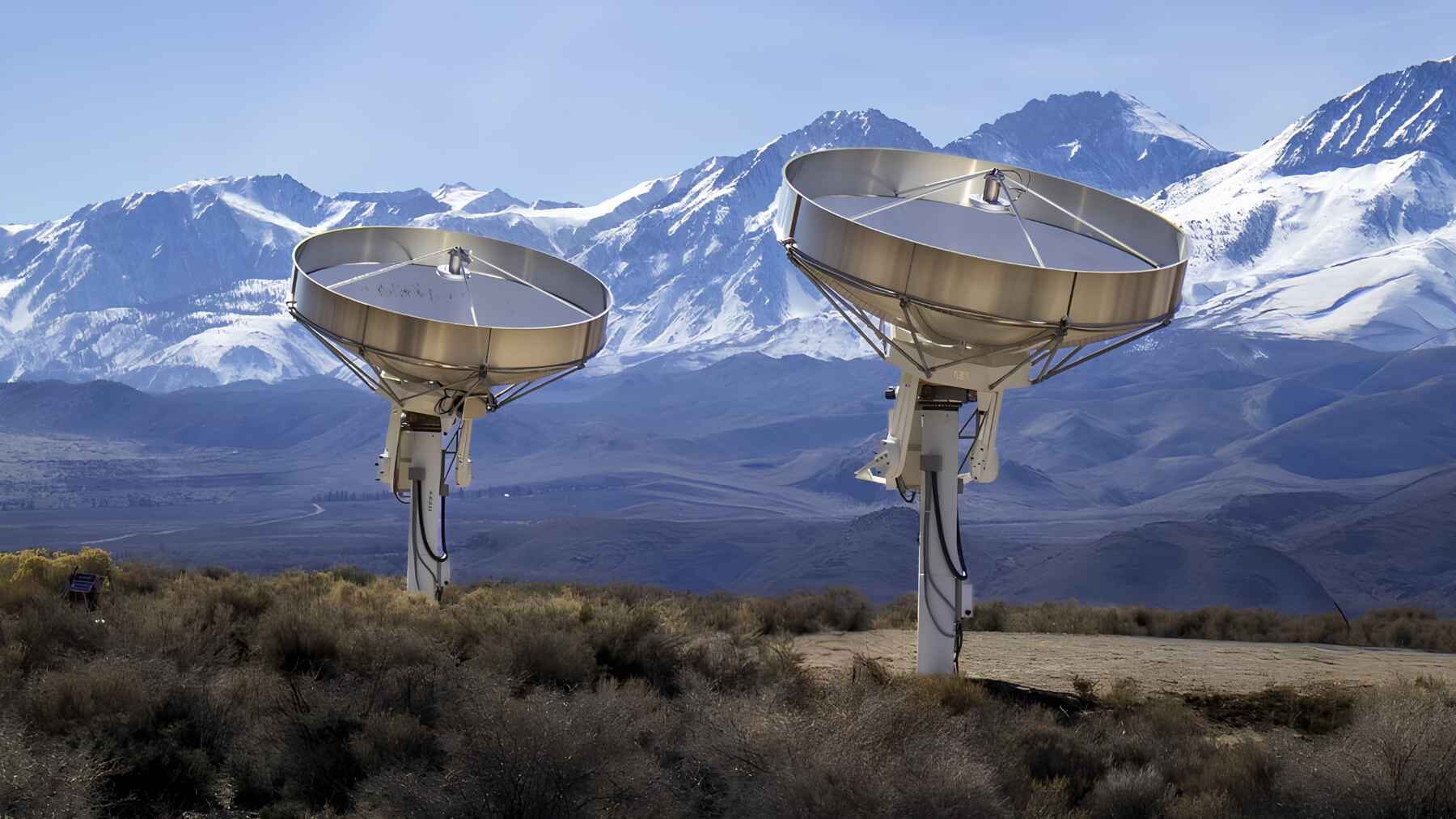
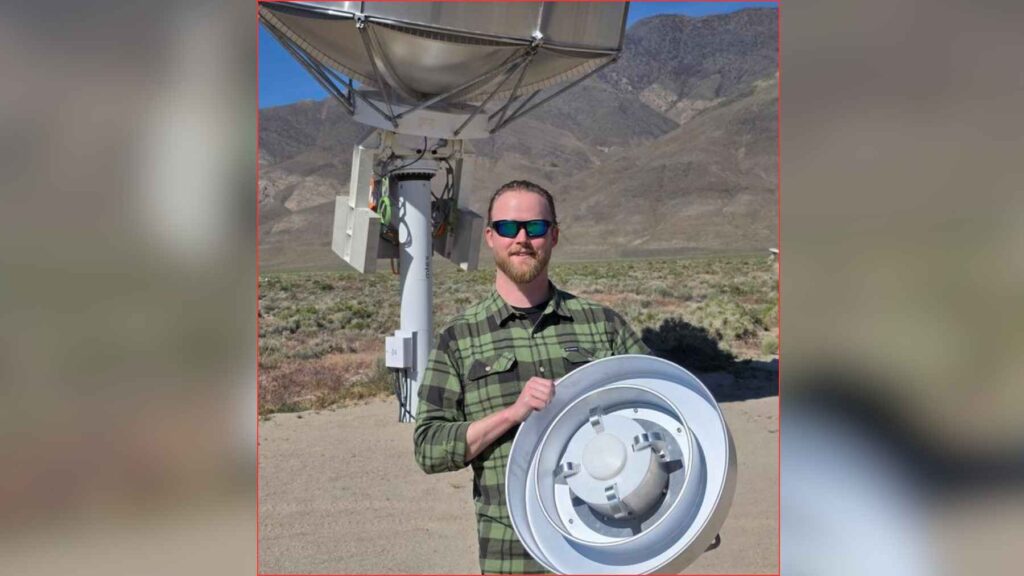
A remote Nevada valley is set to become home to an instrument unlike any radio telescope operating today. The California Institute of Technology, better known as Caltech, has cleared the Deep Synoptic Array’s final design review and secured construction funding from Schmidt Sciences, with completion targeted for 2029. The project will use 1,650 radio dishes, each about 20 ft. wide.
The scale is striking, but speed may be the bigger story. The array is designed to survey the sky 100 times faster than any existing radio telescope, make images in real time, and identify about 20 million radio sources on its first day. By the end of its initial five-year survey, the team expects it to uncover roughly 1 billion new sources.
What radio telescopes actually see
Stars, galaxies, and black holes do not shine only in the light our eyes can see. They also release radio waves, an invisible form of energy that can cross vast distances and pass through dust that blocks ordinary light. Radio astronomy listens for those signals and turns them into information about the universe.
A single large dish can catch very faint waves, while a group of dishes can combine its observations to make sharper images. The Deep Synoptic Array will bring both strengths together across an area about 12 miles by 10 miles. Think of 1,650 sensitive ears listening to the same cosmic conversation from slightly different places.
From a sketch to a photograph
Vikram Ravi, the project’s co-principal investigator and an astronomy professor, described the change in simple terms, saying, “radio astronomy is about to go from sketch to photograph.” The point is not merely to create prettier pictures, but to reveal many more objects and track how they change.
That repeated coverage matters because the radio sky is not frozen. Stars erupt, black holes feed, and distant sources can flash for only a fraction of a second. One picture may miss the action, while repeated scans work more like a security camera that keeps watching for the moment something changes.
The first real-time radio camera
Many radio observatories collect enormous amounts of raw information and then spend weeks or months processing it into usable images. This array is designed to do that work almost immediately. Its dishes will send signals to an off-site supercomputer built with rack-scale Nvidia graphics processors, chips that can handle many calculations at once and produce science-ready pictures as observations arrive.
A parallel system called the Chronoscope will also search the sky at 1,000 frames per second, looking for sudden events that would be easy to overlook. Essentially, the telescope will take still images and fast radio “movies” at the same time. That could make follow-up observations much quicker when the universe suddenly lights up.
An internet-sized flood of data
There is a catch, however. According to the project team, 1,650 dishes will generate raw data at a rate comparable to all current internet traffic in the United States. Storing everything from the full survey would require about 100 billion gigabytes, roughly five million hard drives housed in a facility covering several football fields.
Gregg Hallinan, the principal investigator and director of the Owens Valley Radio Observatory, summed up the solution in six words: “The radio camera solves this problem.” Instead of keeping every raw signal, the system will process the information immediately and preserve the far smaller set of useful images and measurements.
Black holes, pulsars, and radio bursts
What might appear in those images? The telescope is expected to detect radio emission from millions of stars and galaxies, while also probing black holes, exploding stars, and pulsars. Pulsars are dense remains of dead stars that spin rapidly and sweep radio beams across space like lighthouse lights.
The array is also expected to find more than 100,000 fast radio bursts, brief but powerful flashes that often come from distant galaxies. A 2024 catalog produced with the smaller DSA-110 pathfinder linked 11 such bursts to their host galaxies, showing how this telescope family can turn a mysterious flash into a precise cosmic address. The new array should do that on a far larger scale.
Why these discoveries matter
Locating fast radio bursts can help scientists study the thin gas spread between galaxies, material that is difficult to see directly. Large samples may also improve measurements of the universe’s expansion and test ideas about dark energy, gravity, and tiny particles called neutrinos. These are ambitious targets, so the final gains will depend on how well the instrument performs after construction.
The wide view should also help astronomers respond to neutron star mergers, violent collisions that create gravitational waves and scatter heavy elements into space. By quickly narrowing down where a faint event occurred, the radio array could point other telescopes toward the right patch of sky. In astronomy, knowing where to look is often half the battle.
Built to be shared
The resulting radio images are expected to be free to the public without an exclusive waiting period for the project team. That means professional astronomers worldwide could examine new data almost immediately, but access would not stop at major research centers. A student with a strong question and the right tools could also search the same sky maps.
The design builds on about a decade of work with smaller pathfinder arrays, including DSA-110 and the Long Wavelength Array, which were supported by the National Science Foundation. Those projects tested the dishes, signal receivers that work without costly cooling systems, and computing methods needed to make a much larger network practical. Now the blueprint is moving toward steel, cables, processors, and a very different view of the radio universe.
The official project announcement was published by Caltech.