Supermassive black holes have already gained the reputation of being the universe’s most extreme phenomena. They can weigh millions or even billions of times more than the Sun, sit at the hearts of galaxies, and bend nearby matter into glowing disks before some of it vanishes past the point of no return.
Now, a new study suggests those cosmic giants may have something even stranger around them. Using a technique often described as “echo mapping,” astronomers found hints that some supermassive black holes could be wrapped in dense concentrations of dark matter, the invisible substance that outweighs ordinary matter across the cosmos.
The finding is not proof yet, but it gives scientists a new way to study one of the universe’s biggest mysteries.
A hidden mass problem
Dark matter is frustrating because, for the most part, it refuses to behave like the stuff we know. It does not shine, absorb, or reflect light, which means even powerful telescopes cannot simply take a picture of it.
Still, scientists see its fingerprints through gravity. NASA says ordinary matter makes up about 5 percent of the universe, while dark matter accounts for about 27 percent, with dark energy making up most of the rest. In everyday terms, the stars, planets, dust, and people we can see are only a small slice of the cosmic pie.
That’s why the new work matters. If dark matter piles up near supermassive black holes, those regions could become natural laboratories for studying something that remains almost completely unknown.
Listening for cosmic echoes
The team used reverberation mapping, a method that tracks how light echoes through the gas around active galactic nuclei. These are energetic galactic centers where supermassive black holes are feeding on nearby matter.
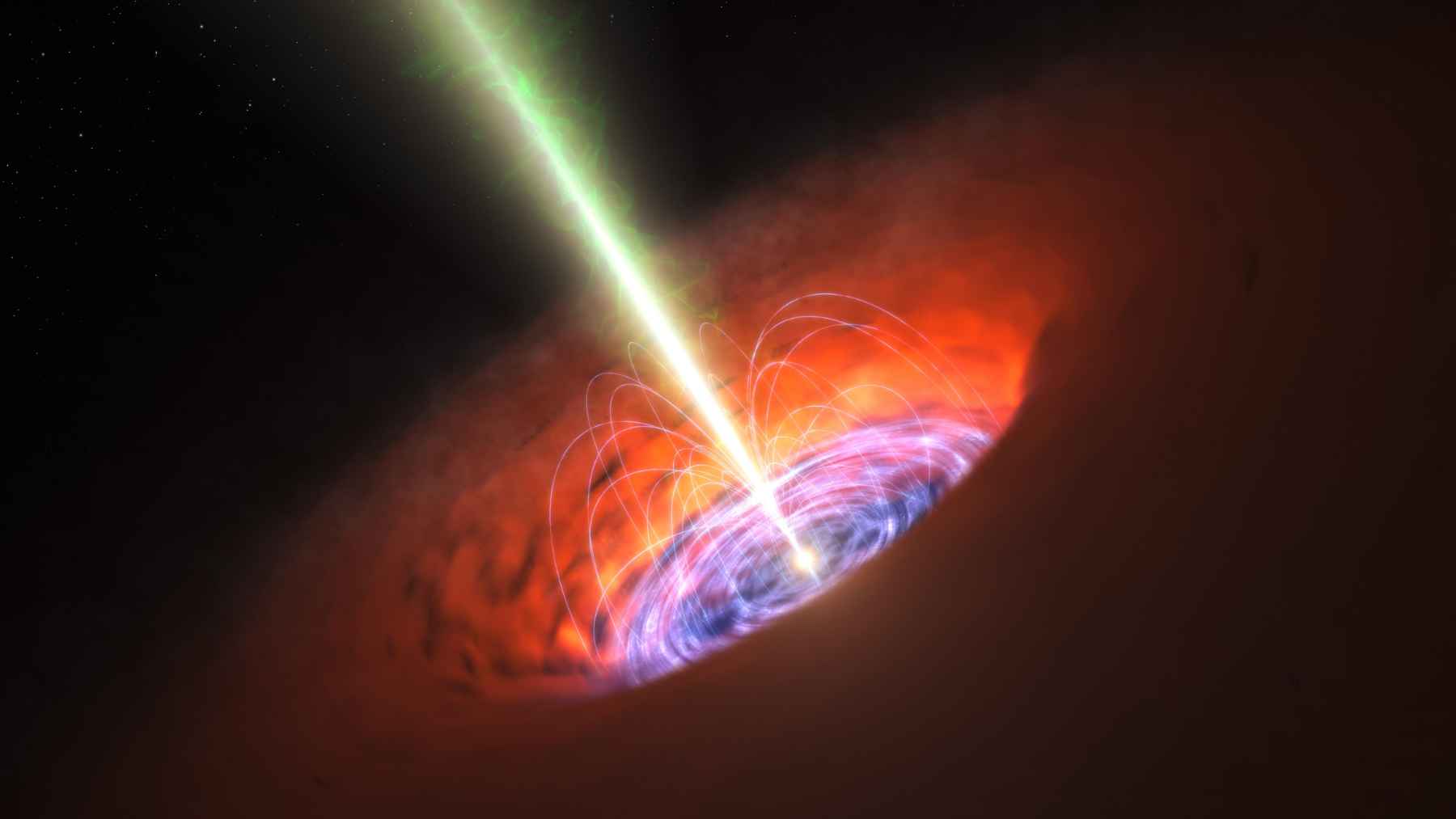
Here is the basic idea. When material falls toward a black hole, it can release a burst of energy from the hot accretion disk around it. That flash then travels outward, reaches surrounding gas, and produces a delayed response, like a shout bouncing back from a canyon wall.
Because light travels at a known speed, astronomers can use the delay between the first flash and the echo to estimate how far that gas sits from the central black hole. In practical terms, that means they can begin to map mass at different distances from the center.
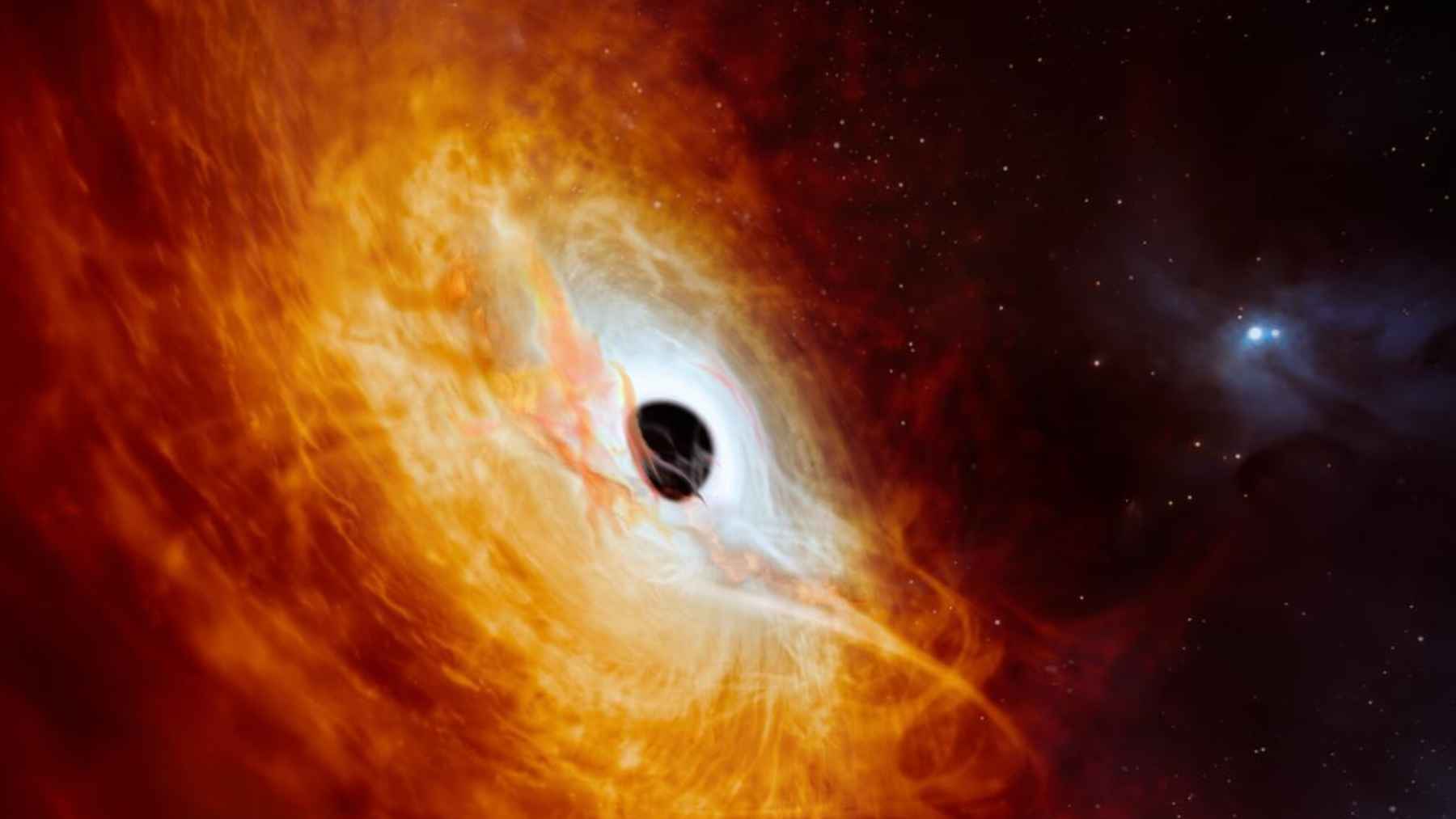
An artist’s concept depicts a supermassive black hole surrounded by a bright accretion disk, where astronomers used reverberation mapping to search for possible concentrations of dark matter.
What the team found
Mayank Sharma of Virginia Tech and his colleagues applied the method to a sample of 14 active galactic nuclei. In five of them, the mass appeared to grow with distance from the central black hole in a way that hinted at extra material beyond the black hole itself.
That extra material could be dark matter. The paper describes the evidence as a 1 to 2 sigma hint, which means it is interesting but still early. Science moves carefully here, and rightly so.
“These galaxies are definitely showing a hint that there is extra material that cannot be explained by just the supermassive black hole,” Sharma said. “The prospects are exciting.”
Why telescopes cannot just see it
It might sound odd that something around a black hole could be missed. After all, the Event Horizon Telescope has captured glowing rings of material around supermassive black holes, including Sagittarius A*, the giant at the center of the Milky Way.
But dark matter is different. It does not interact with light in the usual way, and it does not heat up and glow like ordinary matter falling into an accretion disk. No sparkle. No bright trail.
That means astronomers have to study its gravitational effects instead. The trick is not to look for dark matter itself, but to look for what it does to everything else nearby.
A clue near black holes
Supermassive black holes are promising places to search because their gravity dominates the centers of galaxies. If dark matter forms steep “spikes” or dense clouds there, its pull could affect how gas moves and how mass is measured at different distances.
The researchers found a preferred dark matter profile with a radial steepness index of about 1.6 for the five objects with the strongest hints. That may fit a scenario where a dark matter spike has been softened over time by interactions with stars.
But there is an important caution. The authors also note that current reverberation mapping mass measurements carry large systematic uncertainties, which limit how firmly the method can be used today. In other words, the compass is promising, but it still needs sharper calibration.
Sagittarius A* and the bigger picture
Sagittarius A*, the black hole at the center of our own Milky Way, has a mass of about 4 million Suns. It is a familiar example of the kind of environment where scientists want to understand what matter, visible and invisible, is doing under extreme gravity.
The new study focused on distant active galactic nuclei, not a direct detection around Sagittarius A*. Still, the broader question is the same. What surrounds these cosmic monsters besides the bright gas we can see?
That question matters because galaxies are not just collections of stars. They are shaped by gravity, gas, black holes, and a vast dark component that still has not revealed its true nature.
What happens next
The study does not claim that supermassive black holes are definitely wrapped in dark matter clusters. It points to a possible signal and a method that could become much more powerful with better observations.
The authors argue that future reverberation mapping and interferometry campaigns could target multiple emission lines and improve mass measurements. That would help scientists test whether the hidden material is really dark matter or whether some ordinary astrophysical explanation is still missing.
For now, the result is a careful hint from a very dark place. Sometimes, the universe does not show us what is there. It lets us hear the echo instead.
The study was published on Physical Review D.