Even when your phone is lying on a table, it is not truly standing still. Earth spins, orbits the Sun, and rides inside the Milky Way, while our galaxy itself is moving through space toward a mysterious region called the Great Attractor at roughly 1.3 million miles per hour.
That number sounds like science fiction, but it comes from a real cosmic puzzle. Astronomers have long measured large streaming motions of galaxies toward the Hydra and Centaurus region of the sky, with speeds reaching about 600 kilometers per second, which is about 1.3 million miles per hour.
A pull in the dark
The Great Attractor is not thought to be a single monster object, such as a black hole swallowing everything surrounding it. Better understood as a dense gravitational region, it is a place where enough mass is gathered to tug on whole groups of galaxies.
NASA describes the nearby Norma Cluster, also known as Abell 3627, as part of this area and places it about 220 million light-years away. The same region is hard to study because the bright stars and thick dust of the Milky Way sit in the way, blocking much of what optical telescopes can see.
How scientists noticed it
The story took shape in the 1980s, when a team nicknamed the Seven Samurai found that the Milky Way and neighboring galaxies were moving toward a huge concentration of matter. One member of that group, Roger Davies, later described the result as surprising because the motion was so large across such a big volume of space.
So how do you detect something so far away that’s almost totally obscured from vision? Astronomers compare the expected motion of galaxies from the expansion of the universe with their actual motion. The leftover movement is called peculiar velocity, which simply means a galaxy’s extra drift caused by gravity.
The hidden zone
The Great Attractor sits in a part of the sky known as the Zone of Avoidance. That name sounds dramatic, but it is really a practical label for the area hidden behind the crowded, dusty plane of our own galaxy.
Optical telescopes struggle there, much like trying to see a streetlight through fog and glare at the same time. Infrared, radio, and X-ray observations help astronomers peek through some of the dust, but the deepest part behind the Milky Way remains difficult to map clearly.
Laniakea changed the map
In 2014, R. Brent Tully of the University of Hawaii worked with Hélène Courtois, Yehuda Hoffman, and Daniel Pomarède to redraw our cosmic address. Their work described the Laniakea Supercluster, a vast region about 500 million light-years wide that contains roughly 100,000 galaxies.
The team did not define Laniakea just by where galaxies sit. They mapped how galaxies move, like watching falling leaves drift towards the trough in a giant field. In that picture, the Great Attractor acts like a broad gravitational valley, pulling motion inward across the supercluster.
A bigger neighborhood
The map is still being refined. A 2024 Nature Astronomy study led by Aurélien Valade used Cosmicflows-4 data, a catalog of galaxy distances and motions, to examine gravitational basins of attraction in the local universe.
That newer work suggests our Milky Way may be linked not only to Laniakea, but perhaps to the even larger Shapley basin of attraction. In plain English, our cosmic neighborhood may be bigger and messier than the neat map scientists drew a decade ago.
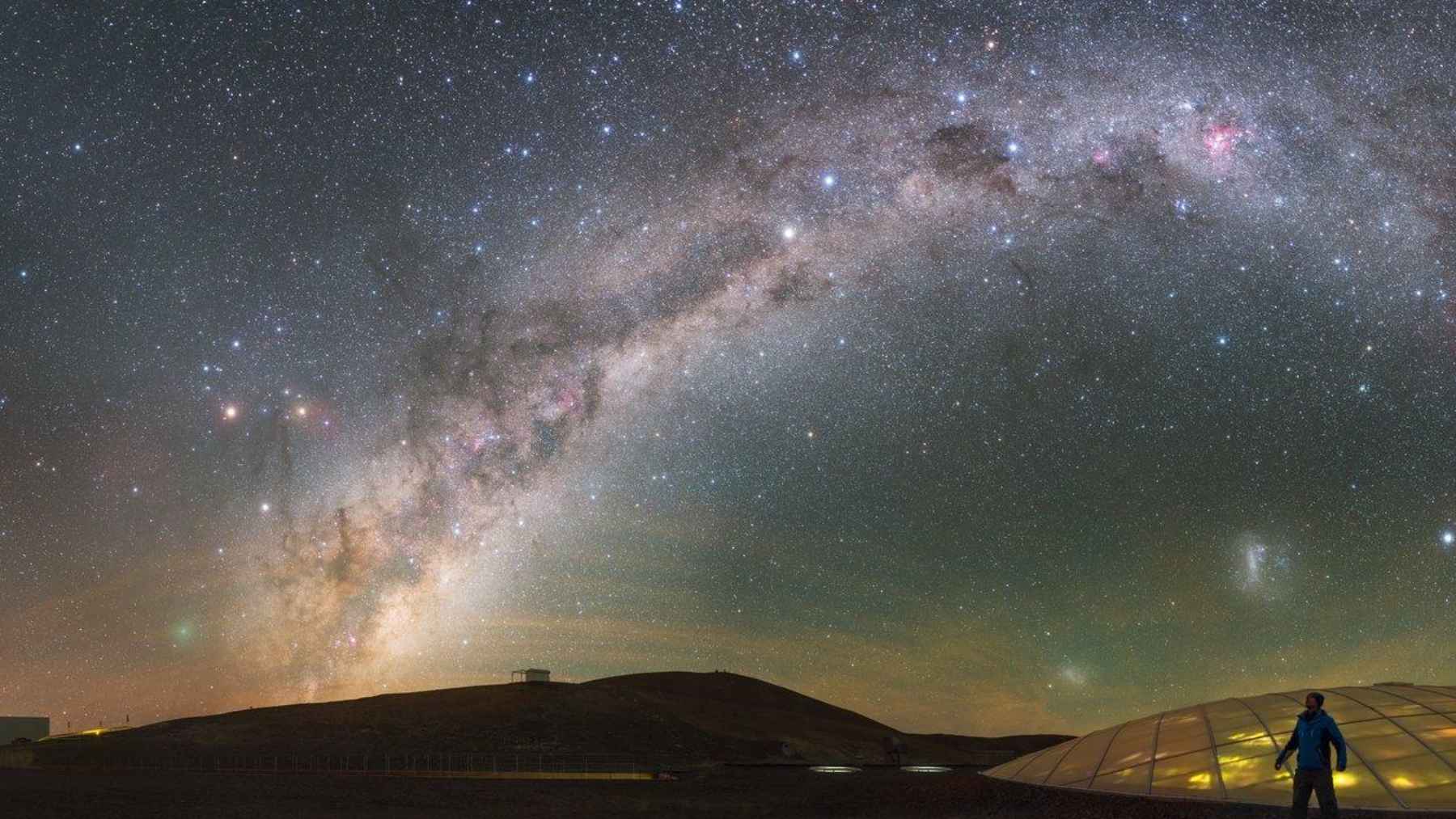
The Milky Way stretches across the night sky as astronomers continue studying the hidden gravitational pull of the Great Attractor, a massive region influencing the motion of our galaxy.
Will we ever get there?
Here is the twist. The Milky Way is being pulled toward the Great Attractor region now, but that does not mean our galaxy is guaranteed to arrive there in the far future.
The reason is cosmic expansion. NASA explains that the universe’s expansion began speeding up billions of years after the Big Bang, driven by the unknown force scientists call dark energy. A basin of attraction is also not always a permanently bound structure, because distant regions can be dominated by cosmic expansion instead of local gravity.
Why it matters
This is not meant to spark panic. The Great Attractor will not rip Earth from the Sun, and it will not suddenly pull the night sky apart.
What it does show is that galaxies are not scattered randomly like dust on a shelf. They gather in clusters, strands, walls, and valleys, forming a cosmic web where gravity still writes the rules of motion, even across distances too large to fathom.
At the end of the day, the Great Attractor is less like a space monster and more like a clue. It tells scientists that our galaxy is part of a much larger flow, and that even the Milky Way has a place in an ever-continuing evolution of the cosmic map.
The main study has been published in Nature.