For nearly a century, dark matter has been the invisible scaffolding of modern cosmology. It helps scientists explain why galaxies hold together, why clusters bend light, and why the universe appears arranged in its vast cosmic web.However, what if part of that cosmic bookkeeping is pointing us in the wrong direction?
A University of Ottawa study led by physicist Rajendra Gupta argues that the universe may not need dark matter or dark energy at all.
His model, known as CCC+TL, combines changing natural constants with the idea that light can lose energy over vast distances, and it also revives an earlier estimate that the universe could be about 26.7 billion years old, not the standard 13.8 billion years. That is a huge claim, and for now, it is best read as a challenge to the standard model rather than a settled replacement.
A challenge to cosmic bookkeeping
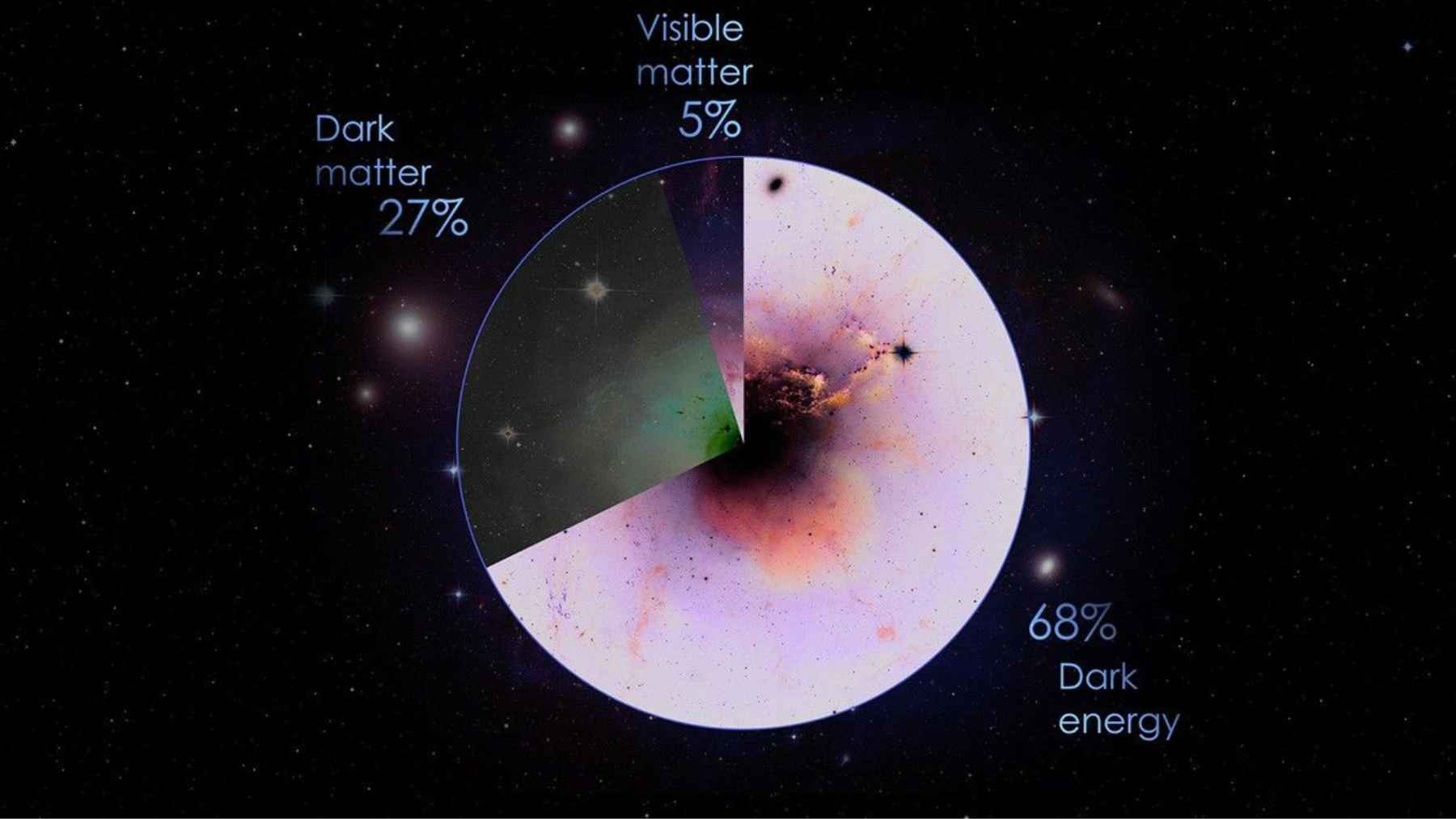
The standard picture says ordinary matter makes up only about 5% of the universe. Dark matter accounts for roughly 27%, while dark energy makes up about 68%, according to NASA’s current explanation of the cosmic mix.
Read More: {{post_title link:post}}
That model has worked well across many observations. Still, it leaves one awkward fact on the table, since dark matter has never been directly seen in the way we see stars, dust, or glowing gas.
How CCC+TL changes the story
Gupta’s approach uses covarying coupling constants, or CCC. It asks whether nature’s rulebook has stayed exactly the same since the beginning of cosmic time.
The second piece is “tired light,” often shortened to TL. Instead of treating redshift only as a sign that space is expanding and stretching light, this idea suggests photons may also lose a little energy while traveling across enormous distances.
Put together, CCC+TL changes how scientists might read distance, time, and expansion from the sky. Gupta says the model supports the idea that “the universe does not require dark matter to exist,” according to the University of Ottawa release.
Why most scientists still defend dark matter
Dark matter did not become popular because scientists wanted a mystery. It emerged because galaxies and galaxy clusters appeared to move as if more gravity were present than visible matter could explain.
NASA traces the modern dark matter story back to Fritz Zwicky in the 1930s and Vera Rubin’s galaxy rotation work in the 1970s. Later evidence, including gravitational lensing and the Bullet Cluster, gave researchers more reasons to think invisible mass is shaping the universe.
Read More: {{post_title link:post}}
So the debate is not simple. For the most part, mainstream cosmology still treats dark matter as real, even if its particle identity remains unknown. The trouble is, a missing particle can keep a mystery alive for a long time.
A universe with more time
One reason Gupta’s idea has drawn attention is the James Webb Space Telescope. Some early galaxies seen by JWST look surprisingly mature for objects from the young universe, which has pushed scientists to revisit how quickly massive galaxies can form.
In Gupta’s earlier work, the CCC+TL model stretches the universe’s age to 26.7 billion years. That extra time could make the formation of large early galaxies feel less rushed, a bit like giving a construction crew a full week instead of one frantic afternoon.
This does not automatically prove the model. It does, however, offer a different way to think about an old tension in cosmology, especially when the sky seems to be showing galaxies that grew up very fast.
The tests that come next
The newer paper focuses on baryon acoustic oscillations, which are ancient sound-wave patterns left in the distribution of matter. Think of them as faint cosmic ripples, still readable across the universe like marks left in wet sand after a wave pulls back.
The paper reports an absolute BAO scale of 151.0 megaparsecs, plus or minus 5.1 megaparsecs. Converted into everyday astronomical units, that is about 492 million light-years, plus or minus roughly 17 million light-years.
Even the paper itself leaves room for caution. Its abstract says it still remains to be seen whether the model fits the cosmic microwave background power spectrum, Big Bang nucleosynthesis, and other major observations. That is where the real test begins.
Dark matter and the bigger question
If Gupta’s model keeps matching observations, it could force scientists to rethink some of the universe’s deepest assumptions. That would affect not only dark matter, but also dark energy, cosmic expansion, and the way redshift is used as a distance marker.
Read More: {{post_title link:post}}
If it fails a key test, that will matter too. Cosmology moves forward when bold ideas meet hard data, and the universe has a way of rejecting theories that sound elegant but do not fit the sky.
For now, the safest conclusion is that dark matter has not vanished from science. However, the study does something valuable anyway, since it asks whether the invisible ingredients in our cosmic recipe are truly necessary or whether the recipe itself needs a rewrite.
The study was published in The Astrophysical Journal.