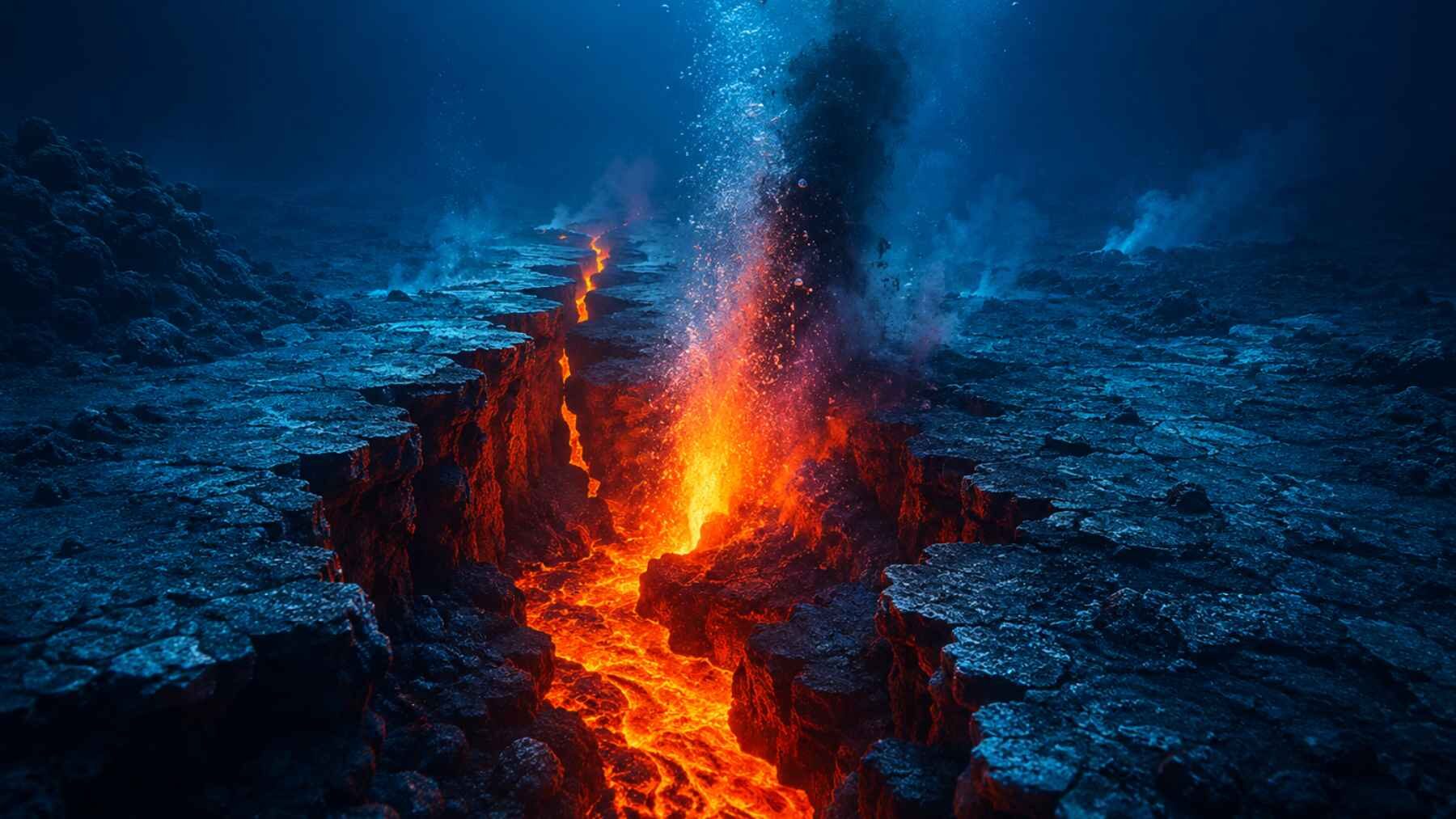
Far below the southern Indian Ocean, scientists recorded Earth’s crust pulling apart and fresh lava building a new patch of ocean floor as it happened. The team describes it as the first known in-situ observation of a mid-ocean ridge rifting event to combine acoustic, pressure, distance, and repeated mapping data. The 2024 event released as much as 5.6 billion ft.³ of lava over roughly 16 days, while the floor of an underwater valley sank more than 13 ft. and widened by over 3 ft.
The bigger surprise was not simply the size of the eruption. The measurements suggest that seafloor spreading can store decades of tectonic motion and then release much of it in one short burst, with around 76% of the associated fault movement happening without the shaking normally detected as earthquakes. One pulse represented about 39 years of normal divergence at this ridge.
A rare event caught at the right moment
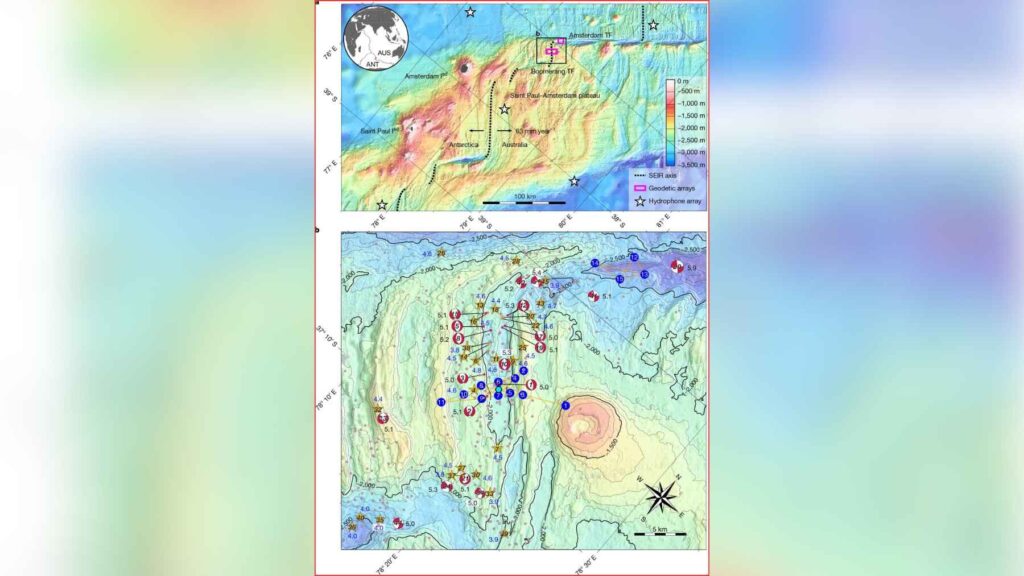
The French-led team had installed the OHA-GEODAMS observatory across the Southeast Indian Ridge in late February 2024. Its sensors sat 1.24 miles below the ocean surface near 37° south, where the plates normally separate at about 2.5 inches per year.
Then, only two months later, the ridge moved. The authors wrote that they were “lucky enough to capture” the event. As geologist Douwe van Hinsbergen, who was not involved in the work, put it, “Sometimes you get a gift, and this is one.”
The seafloor dropped before lava arrived
The episode began at four minutes before 8 p.m. UTC on April 26, 2024, with several small signals and then a magnitude 4.9 earthquake. A migrating swarm followed, including multiple earthquakes around magnitude 5, as fractures and a blade-like sheet of magma called a dike moved along the ridge for several miles.
Pressure instruments showed the valley floor dropping rapidly as magma drained from a reservoir below. The total fall reached 13.8 ft. in six days, and 83% of that movement occurred during the first 16 hours.
A vast lava field formed in 16 days
As the underground reservoir deflated, magma rose through the dikes and reached the seabed. Scientists estimate that between 5.2 billion and 5.6 billion ft.³ of lava poured out, creating deposits nearly 300 ft. thick in places and one major patch about 2.5 miles long.
Cold seawater rapidly hardened the lava into basalt, adding new oceanic crust where the plates had separated. This did not create an entirely new ocean, but it did let researchers watch one of the small building steps that, repeated over immense periods of time, creates ocean basins.
Mid-ocean ridges quietly build the planet
Mid-ocean ridges form a connected underwater mountain system stretching roughly 40,000 miles around the globe. About two-thirds of Earth’s surface was created along these boundaries, where mantle material rises, partially melts, and becomes new crust as plates move away from one another.
So how can a floor that normally moves only a few inches a year suddenly shift by feet? Picture two extremely slow conveyor belts moving in opposite directions. Most days, nothing dramatic seems to happen, but the new study indicates that the motion may arrive in sudden “quantum events” rather than as a perfectly steady crawl.
The process is also part of a planetary recycling system. New crust forms at ridges, travels across ocean basins, cools and grows denser, and can eventually sink back into the mantle at subduction zones.
Most of the fault movement made little noise
The ridge produced plenty of earthquakes, including events stronger than magnitude 5. Yet the researchers’ models indicate that only about 24% of the fault slip was seismic, while roughly 76% occurred aseismically and produced little or no detectable shaking.
That finding may help explain a long-standing puzzle. Mid-ocean ridges accommodate enormous amounts of plate movement, but global earthquake records show less seismic energy there than scientists would expect, and magma-driven silent slip may account for part of the missing motion.
An underwater observatory heard the crust change
No single instrument could have reconstructed the event. Hydrophones detected earthquake sounds and short acoustic bursts from hot lava meeting seawater, acoustic beacons measured changes in distance across the valley, a pressure recorder tracked vertical movement, and later sonar surveys mapped the new lava.
Between April 26 and May 2, the hydrophones located nearly 500 earthquake-related sound events and more than 2,000 signals linked to lava and seawater interactions. For researchers working miles from land and far below ordinary cameras, sound and pressure became the closest thing to watching the seafloor move.
This was not a live video of glowing lava. In this case, “live” means the instruments continuously recorded the rupture, sinking, widening, heat changes, and acoustic signals as the event unfolded, rather than scientists reconstructing everything years later from cooled rocks.
Decades of motion released in days
The study estimates that the combined magmatic and tectonic movement was equivalent to about 39 years of normal divergence at this section of the ridge. Simply put, the ocean floor did not grow evenly year after year, but saved up much of its change and delivered it in a dramatic geological pulse.
The planet is still building itself, but most of the work is hidden under miles of water. More long-term observatories could show how often these bursts happen elsewhere.
The study was published on Nature.