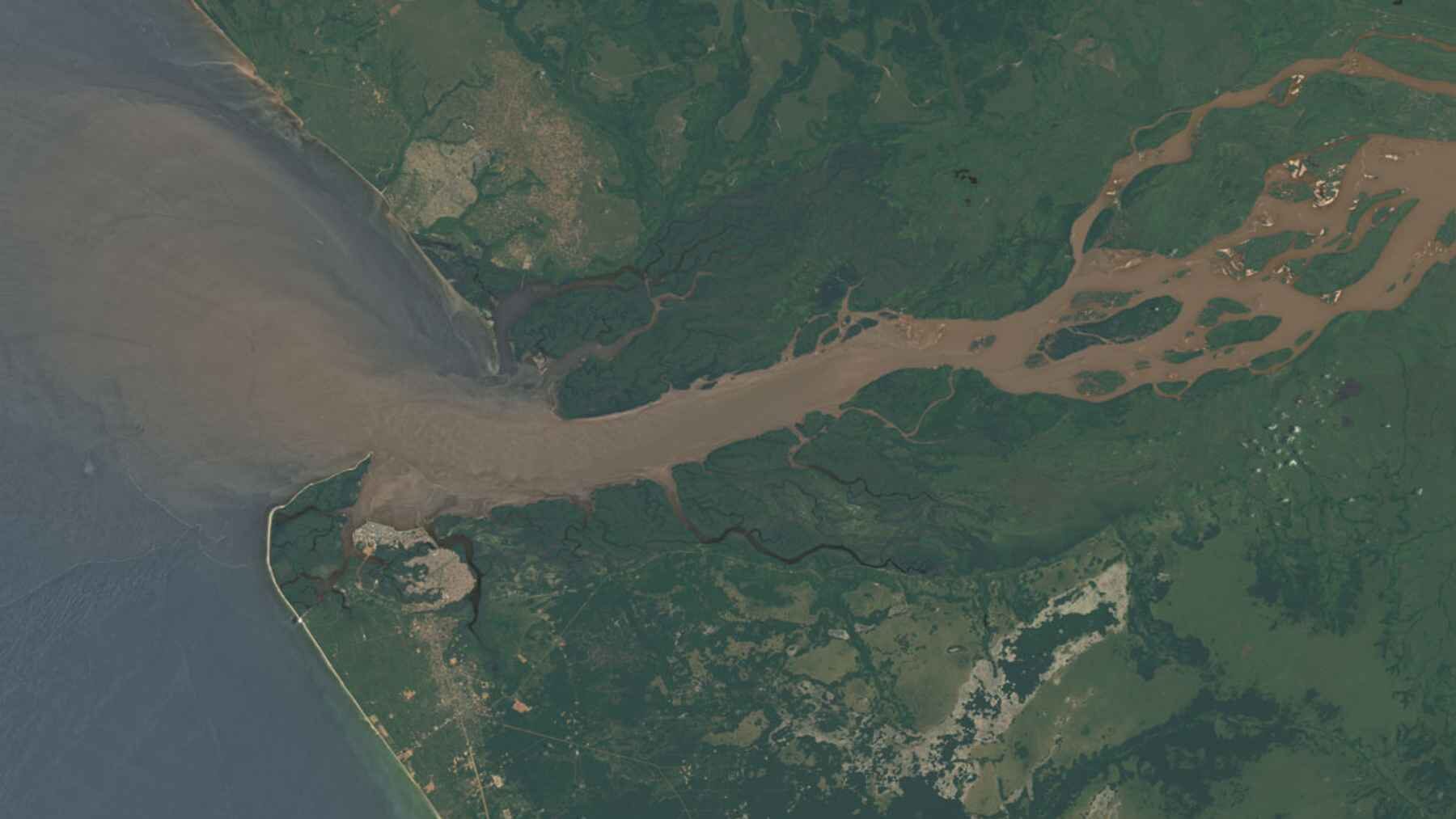
The Congo River sends an average of about 10.6 million gallons of freshwater into the Atlantic every second. That enormous flow creates a low-salinity surface plume that can stretch nearly 500 miles from Africa, but new research shows the water does not simply spread in a smooth, predictable sheet.
Instead, rotating currents known as “mesoscale eddies” can capture pieces of the plume and carry them toward the open ocean. One striking event in 2016 lasted 49 days, reached a radius of over 90 miles, and moved trapped freshwater about 124 miles offshore before breaking apart.
A freshwater layer
The Congo is the world’s second-largest river by discharge. Because freshwater is lighter than salty ocean water, the outflow tends to remain near the surface, forming a broad lens whose shape changes with winds, currents, and the river’s seasonal cycle.
During the wet season, that plume often shifts southwest. There, it can meet swirling currents tens of miles across, a little like moving roundabouts in the sea that collect water on one side and release it somewhere else.
How researchers tracked it
Camille Cardot and colleagues at the Laboratory of Space Geophysical and Oceanographic Studies, known as LEGOS, combined real-world observations with a high-resolution ocean model. Their NEMO simulation used grid cells about 1.9 miles wide and focused on 2016, when unusually useful records were available.
Those records came from the PIRATA mooring network, satellites, and estimates of surface currents based on ship-tracking information processed by eOdyn. The team compared the simulation with measurements of sea-surface salinity, sea level, and currents, and the model reproduced the plume’s size, position, and seasonal movement.
The 49-day ocean courier
The clearest case unfolded in March and April 2016. An “anticyclonic” eddy, which rotated counterclockwise in the Southern Hemisphere, formed close to the plume and trapped a large amount of low-salinity water in its core.
It grew to 93 miles in radius and remained active for seven weeks. By the time it weakened, the eddy had carried that freshwater 124 miles from the coast, turning a spinning patch of ocean into a temporary delivery vehicle.
Rewinding 5,000 journeys
How could the researchers tell where the water had started? They released more than 5,000 virtual particles inside the model and traced their paths backward through time, effectively rewinding the ocean’s movement.
The particles found in the eddy’s core during April led back to the southern part of the Congo plume in early March. That result showed the trapped freshwater had not appeared by chance, but had been gathered from a specific part of the plume and transported as a coherent mass.
Big eddies, smaller fronts
The study found that long-distance freshwater export is not just a slow leak from the river mouth. Mesoscale eddies can produce intense but intermittent bursts of transport, especially when the plume reaches its widest seasonal extent.
Smaller “submesoscale” features also mattered during brief events, locally contributing more than 30% of salinity transport. Still, the authors found that broader seasonal dynamics dominated when the entire year was considered, adding an important note of caution to the headline finding.
Why salinity matters
Why pay attention to a patch of less salty water? Salinity helps determine seawater density, so shifting a large freshwater lens can change how the upper ocean forms layers, mixes, and exchanges heat with deeper water.
Those physical changes may affect marine habitats and fisheries, although this research did not directly measure fish populations or ecosystem responses. In practical terms, the route taken by the plume can alter where coastal and offshore waters meet, and the study identifies that exchange as an important part of regional ocean circulation.
The ocean is not passive
At the end of the day, the Atlantic is doing much more than receiving river water. It is sorting, trapping, and redirecting that water through currents that are difficult to see from a boat or a beach, much as wind can suddenly gather fallen leaves into one moving swirl.
That is the study’s most useful shift in perspective. The Congo plume is not a static stain on a map, but a moving system whose path can be reorganized by short-lived ocean events.
What scientists still need
The analysis centers on 2016, which offered strong observations but still represents only one year. More multi-year research is needed to determine how often major export events occur, how their routes change between seasons, and how much they vary from one year to the next.
There is another lesson here. Monthly or yearly averages can make the plume look smooth, but a 49-day eddy can do a disproportionate amount of work, so brief events deserve closer attention from satellites, moorings, and future high-resolution missions.
A hidden highway
The Congo’s freshwater route is less like a broad stain spreading evenly across the Atlantic and more like a highway with temporary express lanes. The eddies come and go, but while they last, they can move an enormous amount of water far from shore.
That hidden transport may help scientists improve regional ocean models and better understand the changing boundary between coastal and open water.
The full study was published on AGU Publications.