Galaxies are not sprinkled evenly through space. They clump in clusters, stretch into filaments, and leave behind huge “voids.” A new study published on January 27, 2026, says our region is part of a giant, flattened structure.
The claim is straightforward. The mass around the Local Group seems to lie in a plane that stretches tens of millions of light-years, with emptier regions above and below it. That geometry helps explain why most nearby galaxies drift away so calmly, even with big galaxies close by.
A sheet of invisible mass around the Local Group
The Local Group is our galactic neighborhood, anchored by the Milky Way and the Andromeda galaxy. For decades, many models treated the surrounding mass like a roughly spherical bubble, but the new work finds a flatter layout better matches the real motions.
Dark matter is central because it does not emit light, so researchers track it by watching how gravity tugs on visible galaxies.
The research was led by Ewoud Wempe with Simon D. M. White, Amina Helmi, Guilhem Lavaux, and Jens Jasche, and Helmi said, “Based purely on the motions of galaxies, we can determine a mass distribution.”
Their institutions include the Kapteyn Astronomical Institute at the University of Groningen, the Max-Planck-Institut für Astrophysik, the Institut d’Astrophysique de Paris at CNRS and Sorbonne Université, and the Oskar Klein Centre at Stockholm University.
Why the nearby universe has looked oddly calm
Almost a century ago, Edwin Hubble showed that distant galaxies recede as space expands. Yet Andromeda is coming toward us at about 62 miles per second, close to 224,000 miles per hour. That approach implies the Local Group contains far more mass than its visible stars can explain.
Now here is the odd part. Many galaxies just outside the Local Group still move away in a smooth “Hubble flow,” meaning they mostly follow expansion with only small extra motions. Older spherical models struggled to match that quietness unless they assumed surprisingly little mass beyond the two main galaxies.
This contradiction goes back generations. A 1959 timing argument paper by Franz Kahn and Lodewijk Woltjer used the Milky Way-Andromeda motion to infer a huge amount of unseen mass, an early clue pointing to dark matter. The record for that work is available at ADS.
How scientists built “virtual twins” of our neighborhood
To tackle the puzzle, the team relied on a simulation approach called Bayesian Origin Reconstruction from Galaxies, or BORG. In plain terms, it starts with likely conditions in the early universe and evolves them forward, while using today’s observations to keep the outcome realistic. It explores many plausible cosmic histories.
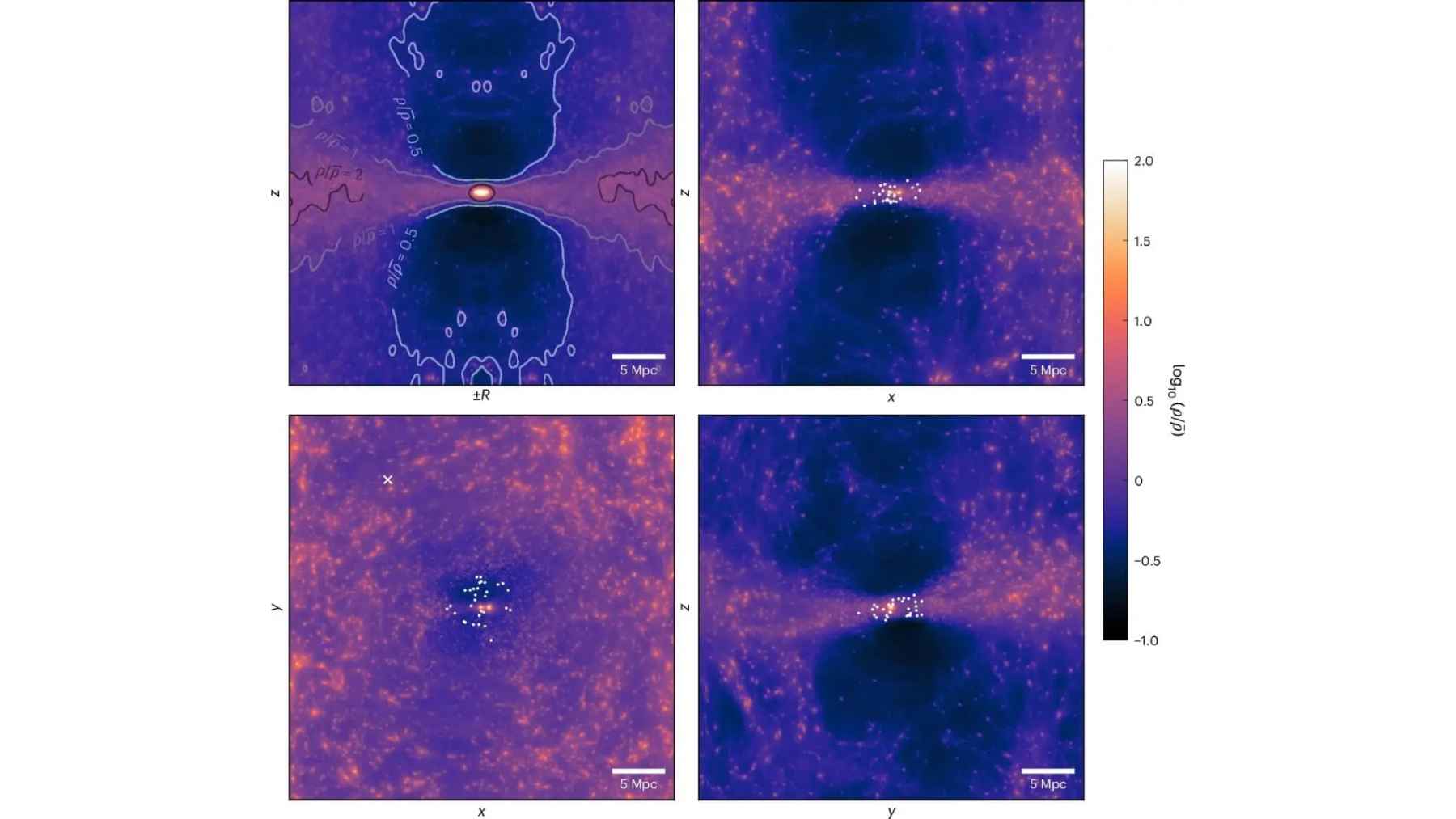
From this framework, the researchers ran 169 independent, high-resolution simulations of a region about 130 million light-years across. Each simulation was required to produce Milky Way and Andromeda-like galaxies with the right separation and relative motion.
The simulations also had to match the distances and recession speeds of 31 nearby galaxies out to roughly 13 million light-years.
When they compared those virtual twins, a flattened mass distribution kept showing up. The data repeatedly favored a plane, not a sphere, plus void-like regions above and below. A plain-language summary of the result is posted at Rug.
What the simulations say the sheet looks like
In the best-fitting picture, the mass is concentrated in a sheet that extends past about 30 million light-years from the Local Group. The central part of the sheet is roughly 5 million light-years thick, thin on cosmic scales. Near the middle of the sheet, the average matter density is about double the cosmic average.
Move above or below the plane and the density drops sharply, down to roughly one quarter to one third of the average. The sheet’s surface density also rises farther from the Local Group, meaning there is more mass spread across each patch of the plane at larger distances. The paper itself can be read at Nature.
How a “flat” universe changes the pull of gravity
Gravity in a plane behaves differently than gravity in a sphere. In a spherical setup, extra mass mostly adds an inward pull toward the center, which should slow or reverse the outward motion of nearby galaxies. In a sheet, mass spread along the same plane can tug in ways that partly counteract the Local Group’s inward pull.
The study’s velocity maps reflect that. Within the sheet, the strongest pull inward is limited to the inner region within about 8 million light-years, and farther out the extra motions can point away from the group. Above and below the sheet, the simulations predict much stronger flow toward the plane, reaching around 62 miles per second in some regions.
So why have astronomers not seen that dramatic flow already? The paper argues there are few good “tracer” galaxies in those directions, meaning galaxies with well-measured distances and speeds, so the pattern is easy to miss. A separate explainer of the historical puzzle is at su.se.
What this means for dark matter and what comes next
For cosmologists, the main payoff is a cleaner fit. A flattened dark matter sheet can reconcile Local Group mass estimates with the calm local Hubble flow, without abandoning the standard Lambda Cold Dark Matter model, the leading picture of how structure forms in the universe. It is a reminder that local geometry can matter as much as total mass.
The result also sets up practical next steps. If future surveys measure more galaxy distances and speeds above and below the plane, the team expects a clearer signature of flow toward the sheet. That prediction is testable, which is what you want from a model like this.
The preprint version of the new paper is also published on Arxiv.