Dark matter is still one of the biggest missing pieces in modern science. Astronomers can see its gravitational pull on galaxies, but they have not yet identified what it is made of, and that mystery keeps sending researchers to stranger and more powerful tools.
Now, a new search using China’s giant Five-hundred-meter Aperture Spherical radio Telescope (FAST) has looked for one possible answer, a tiny hypothetical particle called the axion. The team did not find the long-sought signal, but the result still matters because it draws a tighter boundary around where axion dark matter can hide.
A new kind of dark matter search
Axions are one of the more serious candidates for dark matter. In simple terms, an axion would be an extremely light particle that rarely interacts with normal matter, which is exactly why it would be so hard to catch in the first place.
The idea behind this search is surprisingly direct. Under the right conditions, an axion could turn into a radio photon, which is a tiny packet of radio-wave energy, when it passes through an intense magnetic field.
That conversion is linked to the Primakoff effect, a physics process in which particles and light can swap identities in the presence of strong electromagnetic fields. In this case, the “lamp” would not be in a lab. It would be the magnetic environment around a dead star.

Why neutron stars matter
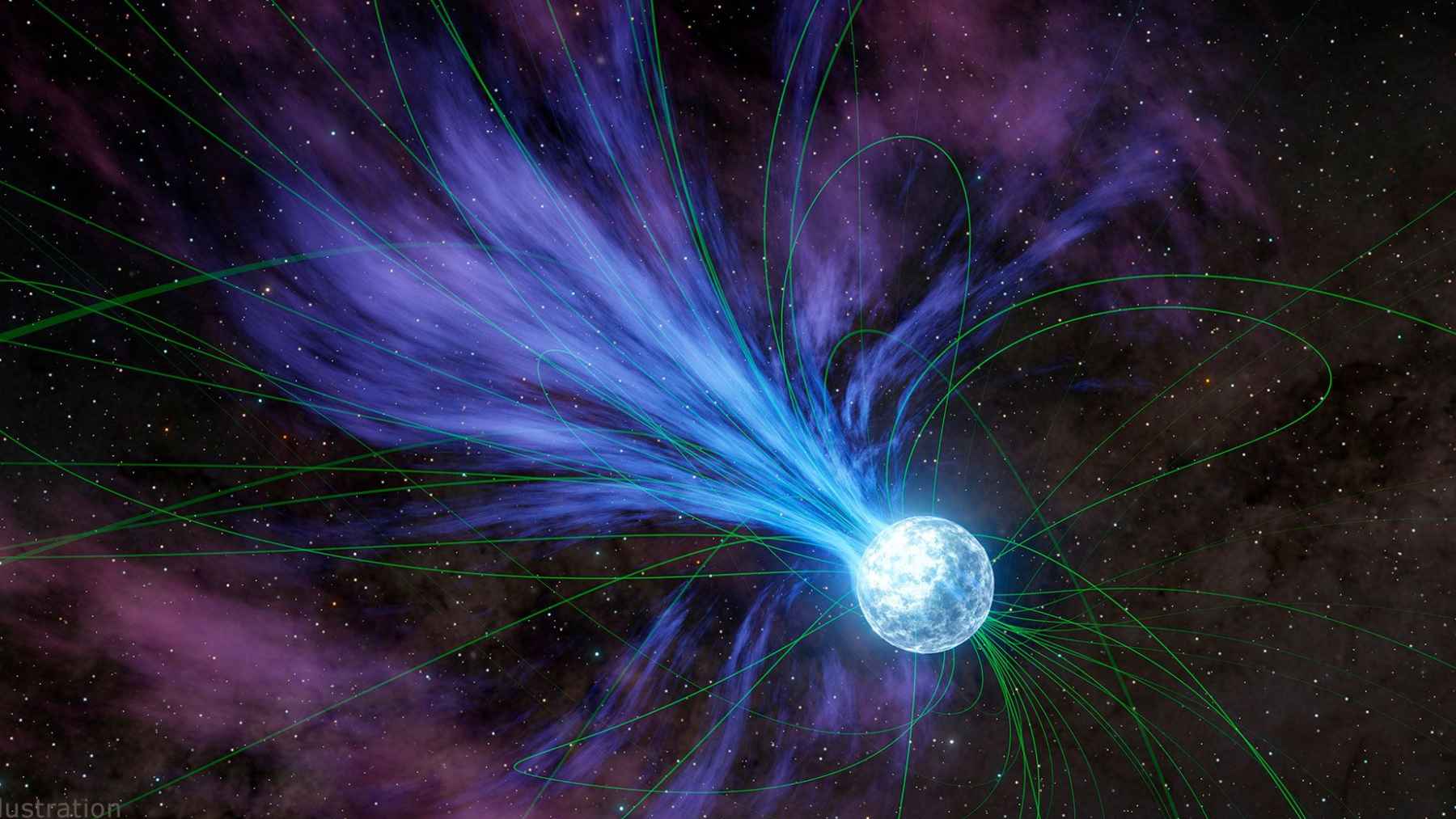
Neutron stars are the crushed remains of massive stars that exploded. They are small by cosmic standards, yet their magnetic fields can be enormous, making them natural places to search for faint particle signals.
The new work focused on two X-ray-dim isolated neutron stars, RXJ1605.3+3249 and RXJ1308.6+2127. These objects were chosen because models predicted they could produce some of the strongest axion-conversion radio lines within FAST’s view of the sky.
Think of it like scanning an old radio dial for one clean whistle buried under static. If axions are present and convert in the right part of a neutron star’s magnetic bubble, the result should be a very narrow radio line rather than a broad cosmic blur.
What FAST actually looked for
FAST is built in a natural basin in Guizhou, China. Its main reflector is about 1,640 ft. across, and official materials describe it as the world’s largest single-dish radio telescope.
The paper, by Sinuo Gao, Chen Wang, and Maoyuan Liu, lists affiliations with Tibet University and the Chinese Academy of Sciences network, including the National Astronomical Observatories, the University of Chinese Academy of Sciences, and the Key Laboratory of Radio Astronomy and Technology. The observations used FAST’s L-band receiver, which covered radio frequencies from 1 to 1.5 gigahertz.
The team observed one target for a total of 4.2 hours and the other for about 2.2 hours. During the search, they compared time spent pointing at the neutron star with time spent looking at nearby blank sky, a practical way to subtract background noise and instrument drift.
The signal did not show up
The headline finding is not a detection. The researchers reported that no significant axion conversion line appeared at the 5-sigma level, a strict threshold often used to reduce the chance of mistaking random noise for a real signal.
That might sound disappointing, but in particle physics and astronomy, “nothing found” can still be valuable because it tells scientists what kinds of particles are less likely to exist.
In this case, the FAST observations set a new upper limit on how strongly axions in a very small mass range could couple to photons. The range covered axion masses from 4.14 to 6.20 microelectronvolts, a tiny mass scale tied to the radio band used in the search.
Why the result matters
The team says this is the tightest limit so far in that axion mass range among searches using the same neutron-star radio-line method. This means the search space has been narrowed, even though the mystery has not been solved.
This also shows why astronomy and laboratory experiments can work together. Lab searches can be cleaner and more controlled, yet neutron stars offer magnetic fields that no Earth-based machine can reproduce.
Earlier work helped set the stage for this strategy. A 2018 study in Physical Review Letters argued that axion dark matter could show up as narrow radio lines from neutron star magnetospheres, and a 2020 search using the Green Bank and Effelsberg radio telescopes also looked for this kind of signal without finding evidence of axions.
The next steps
The FAST result does not rule out axions. It only rules out some versions of axions in one specific mass range and under the assumptions used in the analysis.
The authors point to longer observations as one obvious next move. They also note that more realistic models of neutron star plasma, line brightness, polarization, and the bending of radio waves could sharpen future searches, though those improvements would bring new uncertainties too.
At the end of the day, the study is a reminder that the dark matter hunt is not one grand experiment but a long campaign. Sometimes the universe answers with silence, and even that silence can tell scientists where to listen next.
The official preprint of the study has been posted on arXiv.