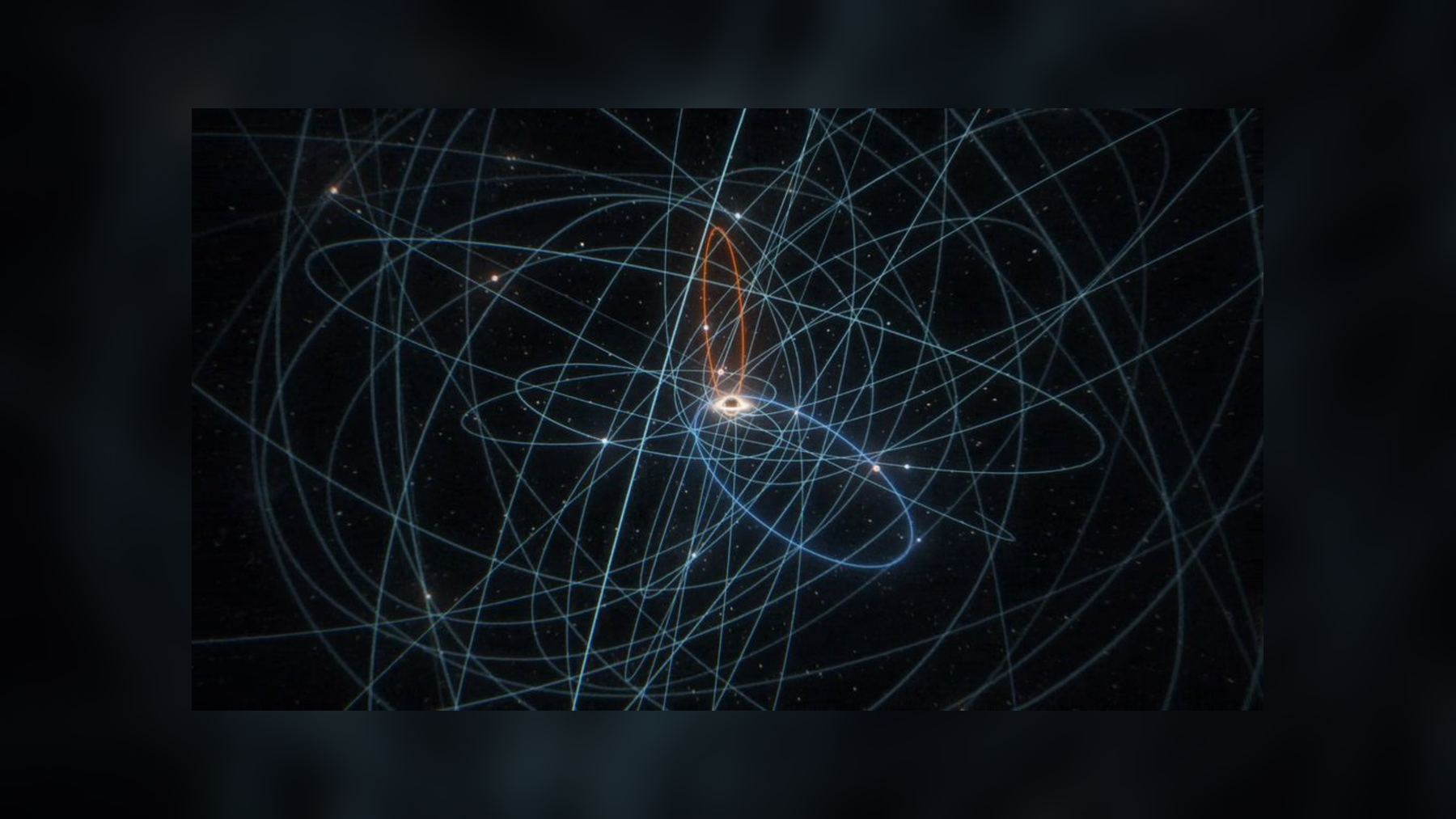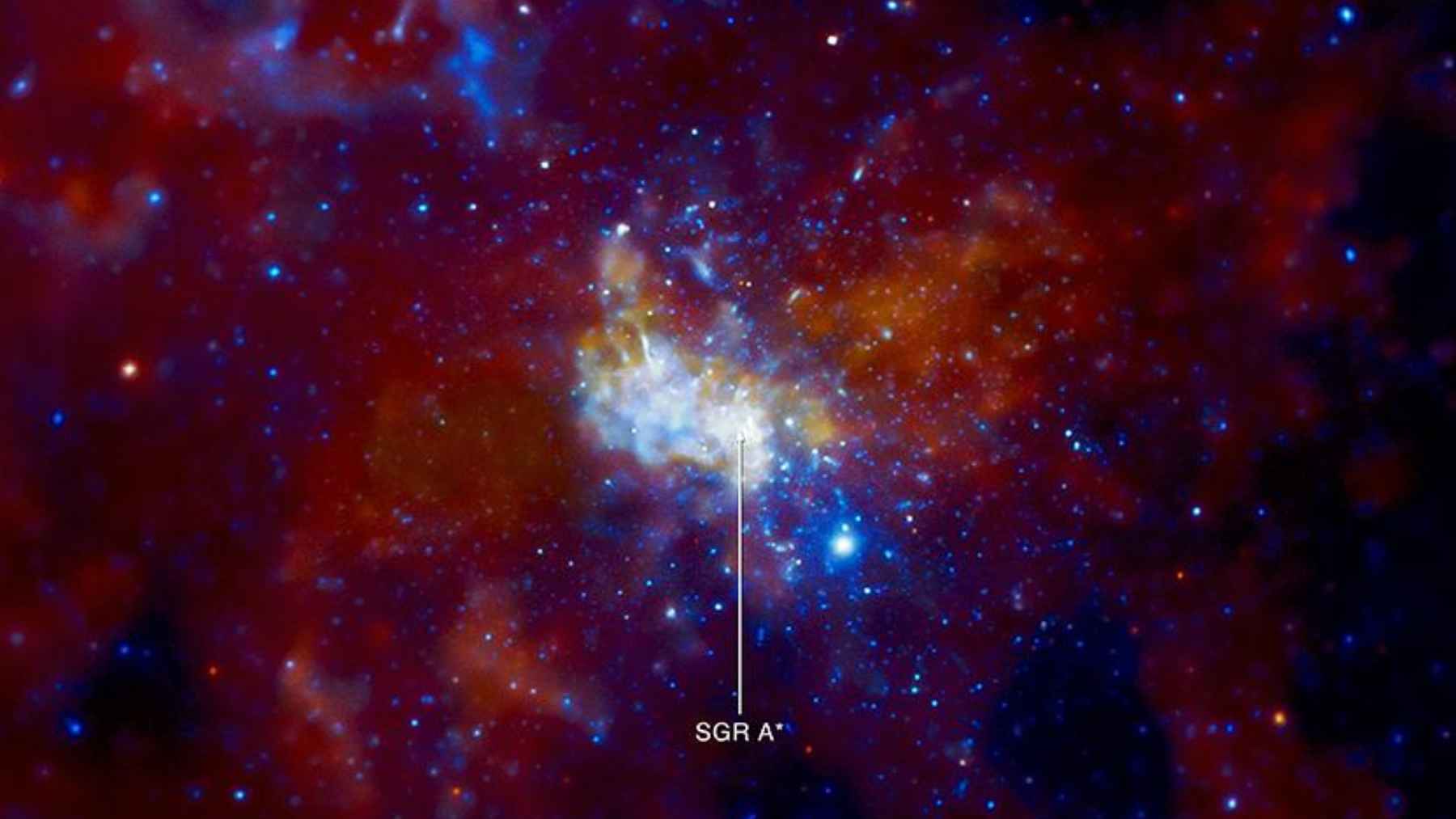
What could punch a nearly round hole in the glowing gas near the Milky Way’s central black hole, then disappear from the scene? A new astrophysics study suggests the answer may not be a single explosion, but a fast-moving group of stars that blasted through the region roughly 300 years ago.
The object in question is the “mini-cavity,” a low-density pocket inside the “mini-spiral,” a stream-like complex of ionized gas swirling around Sagittarius A* (Sgr A*), the supermassive black hole at the center of our galaxy.
The new paper argues that powerful winds from stars in the nearby IRS 13 cluster may have carved the cavity when the cluster crossed the area, while a possible intermediate-mass black hole inside IRS 13 may have produced X-ray flares now seen as echoes in surrounding molecular clouds.
A hole with no obvious maker
The mini-cavity sits in the Bar region of the mini-spiral, a tangled environment of gas streams close to Sgr A*. The cavity has a radius of about 0.04 parsecs, which is roughly 0.13 light-years, or about 760 billion miles. It is also about 0.46 light-years in projected distance from Sgr A*, close enough to belong to one of the most extreme neighborhoods in the Milky Way.
That neat shape is the strange part. A round cavity often points to a wind-blowing star, almost like a leaf blower clearing dust from a sidewalk, but astronomers do not currently see a suitable star sitting inside the cavity, which leaves a simple question hanging in the air. What if the culprit has already moved on?
IRS 13 enters the picture
The study focuses on IRS 13, a compact star cluster located just outside the mini-cavity’s northwestern rim. Two of its stars, known as E2 and E4, are Wolf-Rayet stars, a rare and intense class of massive stars that shed material through powerful stellar winds.
According to the authors, the motion of E2 and E4 suggests they could have been near the center of the mini-cavity roughly 300 years ago. Their motion is estimated at about 124 miles per second, while their speed relative to the surrounding gas may have been closer to 62 miles per second. That is not a gentle stroll.
The researchers propose that when IRS 13 crossed the Bar region, winds from these Wolf-Rayet stars blew open the low-density bubble. Those stellar winds may have acted like a cosmic drill, clearing a pocket in the gas before the stars continued along their orbit.
The winds were strong enough
The model gives E4 the leading role because its wind is much stronger than E2’s. The paper estimates E4’s terminal wind speed at about 1,367 miles per second, compared with about 466 miles per second for E2.
With that kind of outflow, the cavity could have grown to its current size in about 120 years, although the authors note that this is likely an upper limit because the bubble could have kept expanding after the stars left.
There is another important clue. The cavity’s average expansion speed is estimated at about 205 miles per second, more than three times faster than the assumed relative speed between the stars and the gas. That helps explain why the structure remained nearly circular instead of being stretched into a long scar.
Still, this is not a finished case. The authors make clear that their model is simplified, because real gas streams near a supermassive black hole are messy, turbulent, and hard to map in three dimensions. Space rarely gives scientists a clean laboratory.
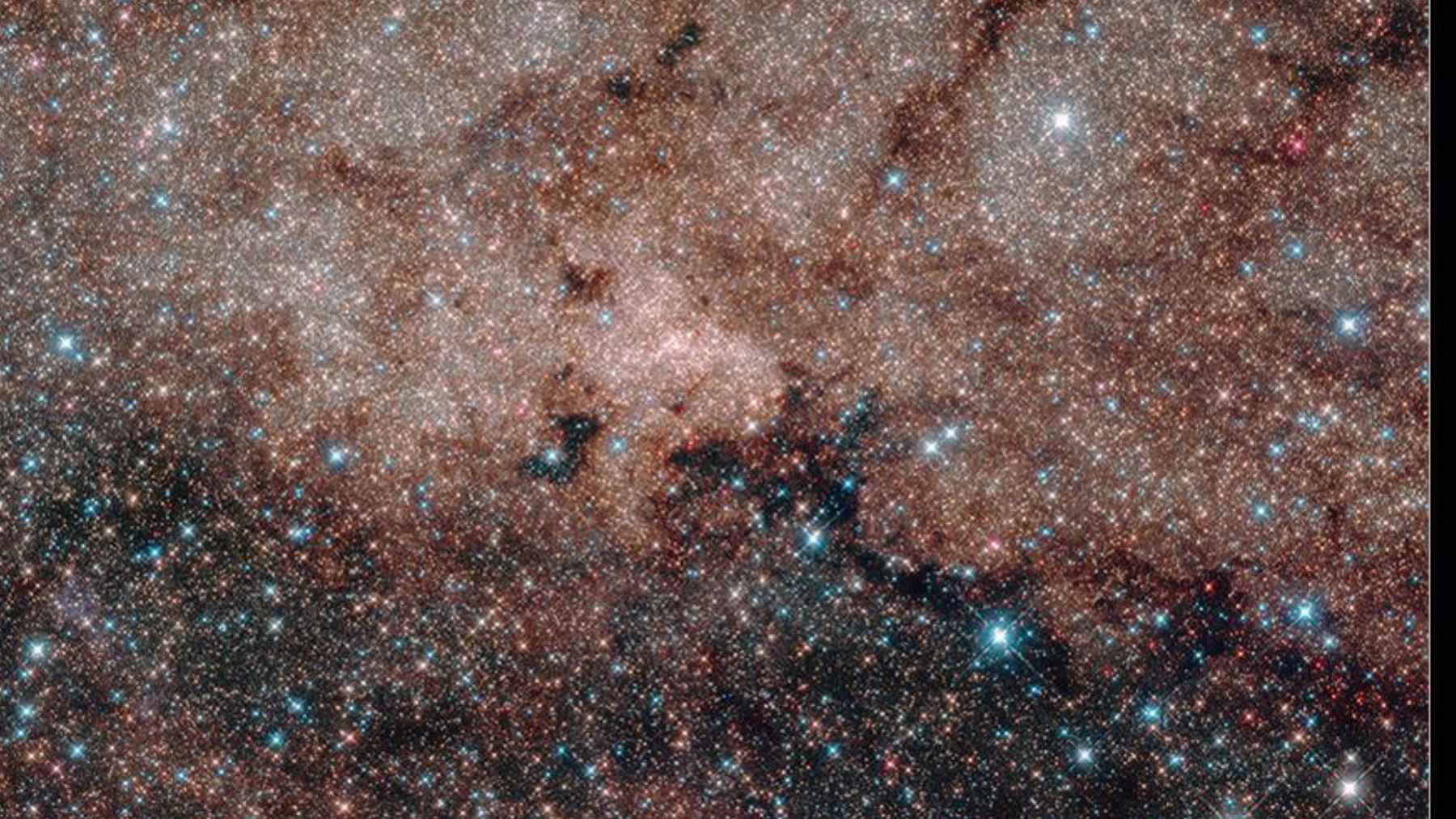
Hubble captures the crowded center of the Milky Way, home to Sagittarius A* and the region where researchers believe the IRS 13 star cluster may have carved a mini-cavity through powerful stellar winds.
A possible flare from a hidden black hole
IRS 13 has also been proposed as a possible home for an intermediate-mass black hole. That idea remains uncertain, but it matters here because such an object could have swallowed some of the dense gas in the mini-spiral during the cluster’s passage.
If that happened, the study estimates that the black hole may have produced multiple X-ray flares with luminosities around 10^39 erg per second, equal to about 10^32 watts. Those flares would not be visible to people today as fresh bursts. Instead, the light could still be showing up as X-ray reflections on molecular clouds in the Sgr A, B, and C complexes.
That idea connects the mini-cavity to a bigger Galactic Center mystery. Chandra researchers have described how X-ray flares from Sgr A* can travel outward and light up molecular clouds over time, rather like a medical scan revealing slices of hidden structure.
Why this matters
Sgr A* itself is already one of astronomy’s most famous objects. The Event Horizon Telescope Collaboration released the first image of it in 2022, providing direct visual evidence of the black hole at the center of the Milky Way. It has about 4 million times the mass of the Sun and lies roughly 27,000 light-years from Earth.
This new work, however, shifts attention slightly away from Sgr A* and toward its crowded surroundings. The trouble is, the Galactic Center is not shaped by one object alone. It is a busy place where stars, gas clouds, stellar winds, black holes, and gravity all tug on the same material.
The authors are careful about the uncertainty. They say better three-dimensional measurements of IRS 13 stars, including the source E3 that is often linked with the possible intermediate-mass black hole, will be needed to test the hypothesis. More detailed modeling of the gas flow around the mini-cavity will also be essential.
For now, the study offers a fresh way to read an old scar near the Milky Way’s heart. A cavity that once looked like a missing piece of gas may instead be a fossil trace of a stellar crossing, a brief flare-up, and a cluster that kept moving.
The study was published on arXiv.