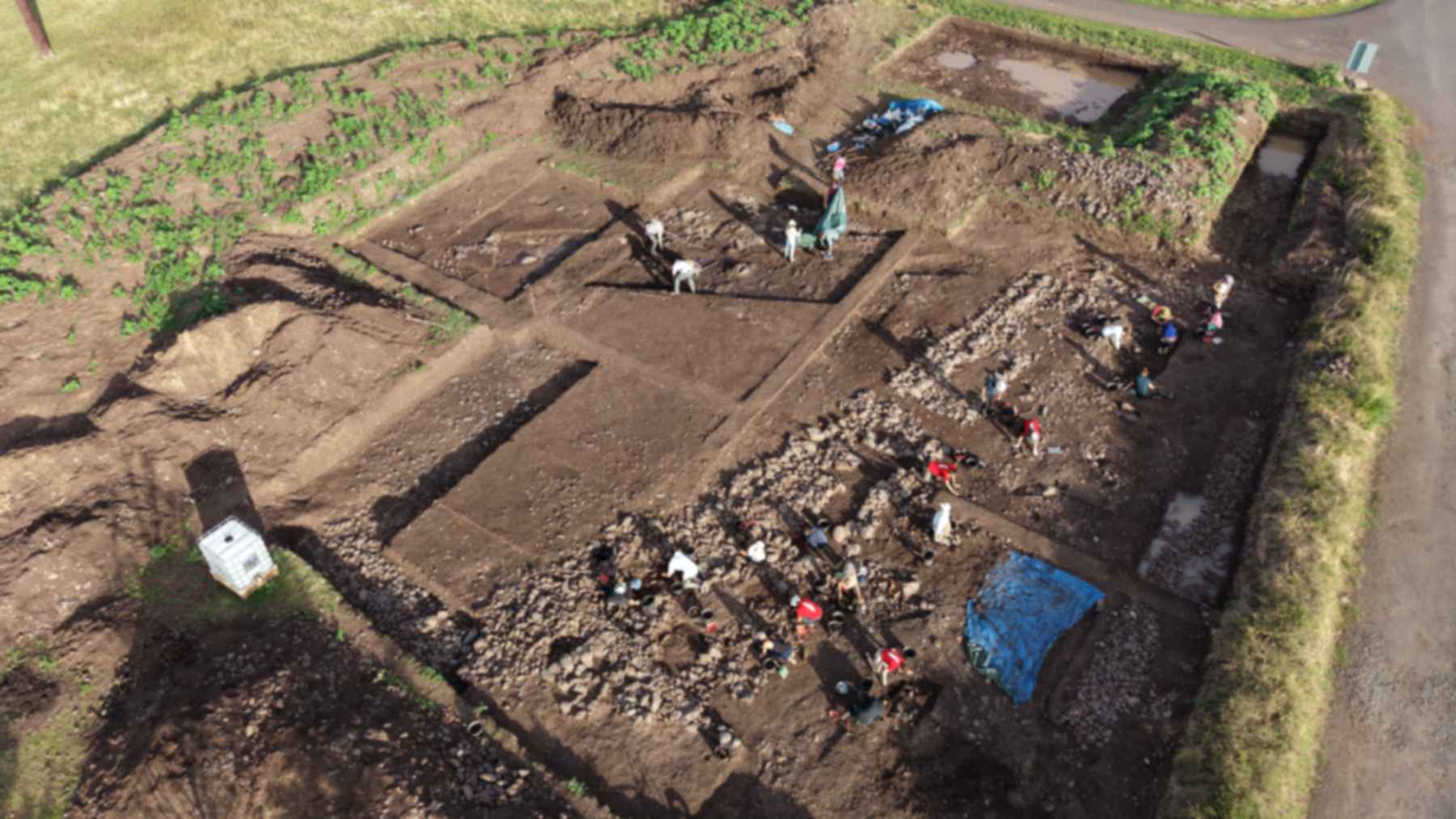
On the Corent plateau in France’s Puy-de-Dôme department, archaeologists have uncovered what was most likely a Gallic mint: five or six stone-built workshops stretching more than 131 feet (40 meters) at the edge of an ancient town square. Nearly 100 students and volunteers cleared them in the summer of 2026, and the team says the Arverni people struck gold and silver coins there around 60 to 50 B.C.
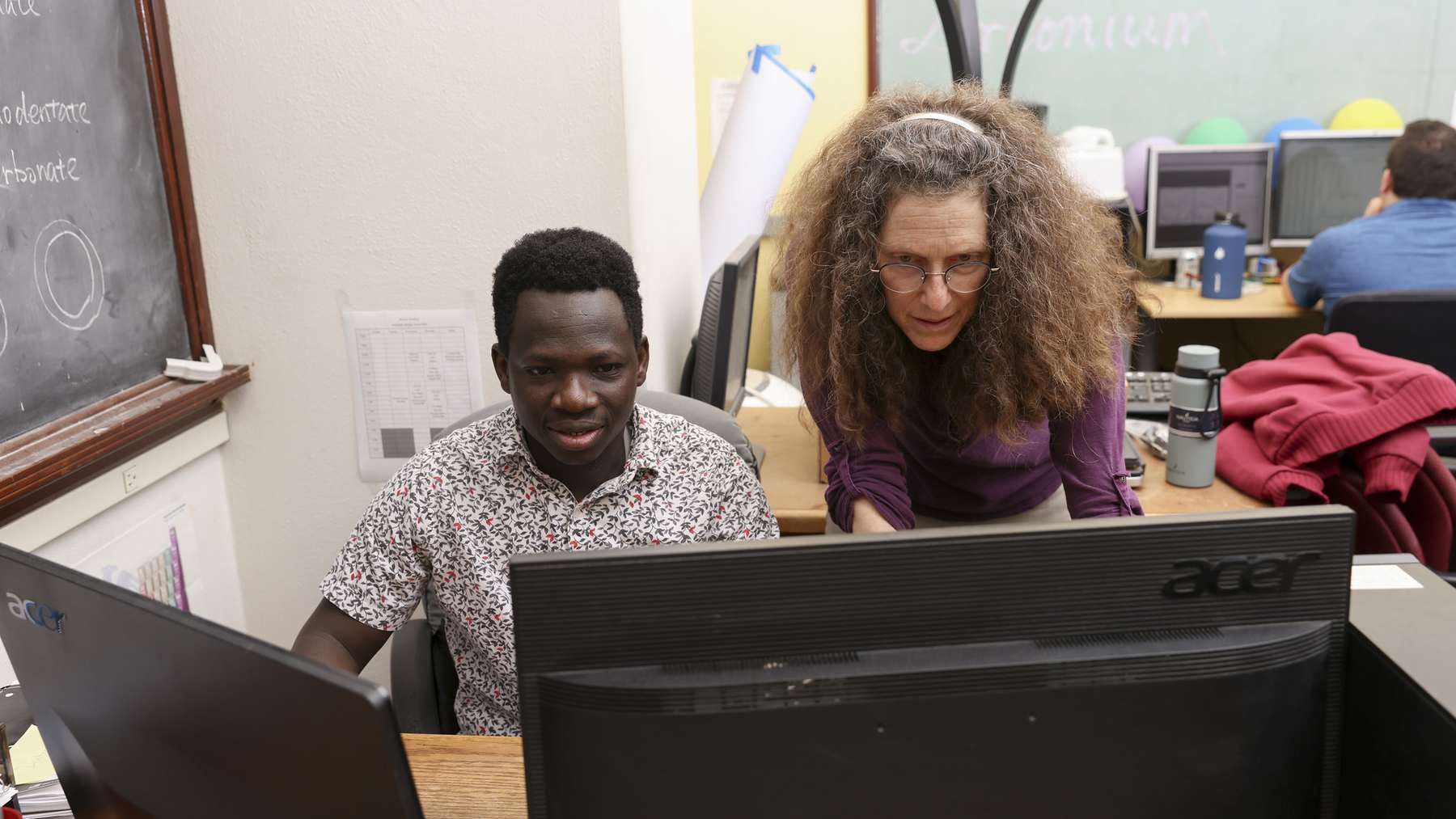
The dig ran from July 20 to September 10, 2026, under Matthieu Poux, a professor of archaeology at Lumière University Lyon 2 who has led excavations at the Corent oppidum since 2001, according to his university profile.
In an announcement published on October 1, the LUERN association, which runs the excavation, calls the complex “the largest and most complete excavated to date in the ancient world.” The nearby Musée de Gergovie, in its own announcement, attributes that assessment to Poux.
Five or six workshops behind a thick wall
A portico on the front of the workshops, a roofed walkway held up by posts or columns, brings their overall span to more than 26 feet (8 meters). Behind them ran a massive wall that, according to LUERN, isolated the workshops and protected them from the rest of the town.
All of the buildings stood on stone foundations, which the association calls almost unprecedented for the Gallic period. In 2024, digging in the Corent archaeological park had turned up a first workshop that made small bronze coins stamped with a fox, and LUERN says the 2026 results went well beyond expectations.
Crucibles with specks of yellow and silver metal
The floors of several workshops held dozens of tools made of iron, stone or ceramic, the kind used to make coins. The diggers also found many broken crucibles, small heat-resistant pots used to treat ore and melt metal alloys.
Some of those fragments kept tiny traces of yellow or silvery metal that could be gold and silver. Lab analyses still have to confirm what the residues are.
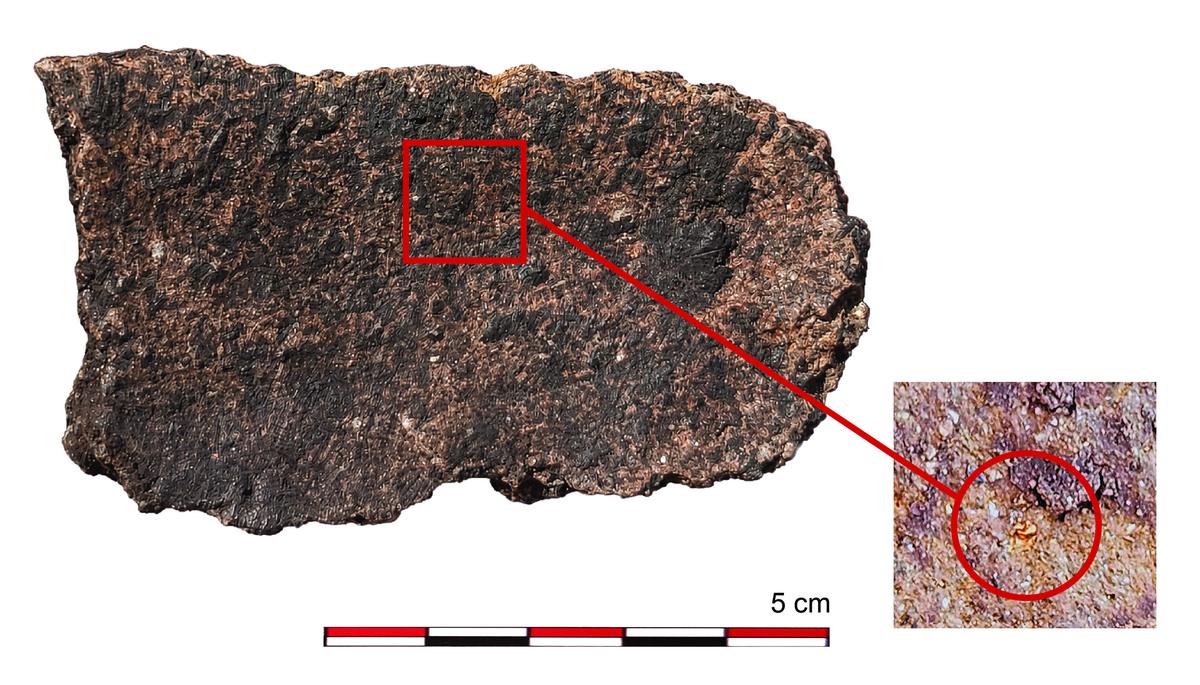
No precious metal waste was left on the floors, which the association says had evidently been carefully cleaned, and not one gold or silver coin turned up, the museum notes.
Even so, the researchers say the remains make it possible, for the first time, to follow the whole chain of coin production in one place. According to the museum, some rooms had hearths or furnaces and even basins fed with water by pipes, for treating raw ore and melting metal alloys.
That treatment involved cementation, a way to pull silver out of gold, and cupellation, in which lead and other cheap metals are burned off in a hot, shallow dish while the gold or silver stays put. Other rooms were for shaping the blanks, and in the last ones workers cut the dies and hammered out the coins.
A lead disk and a charioteer stater
The best clue is a small disk of lead with two coin designs pressed into it. The marks were left by coin punches, engraved tools used to stamp a design into metal.
Both marks match a variant of the Arverni stater “with the charioteer and the four-part wheel,” in LUERN’s words. Staters were coins of gold or electrum, a natural alloy of gold and silver.
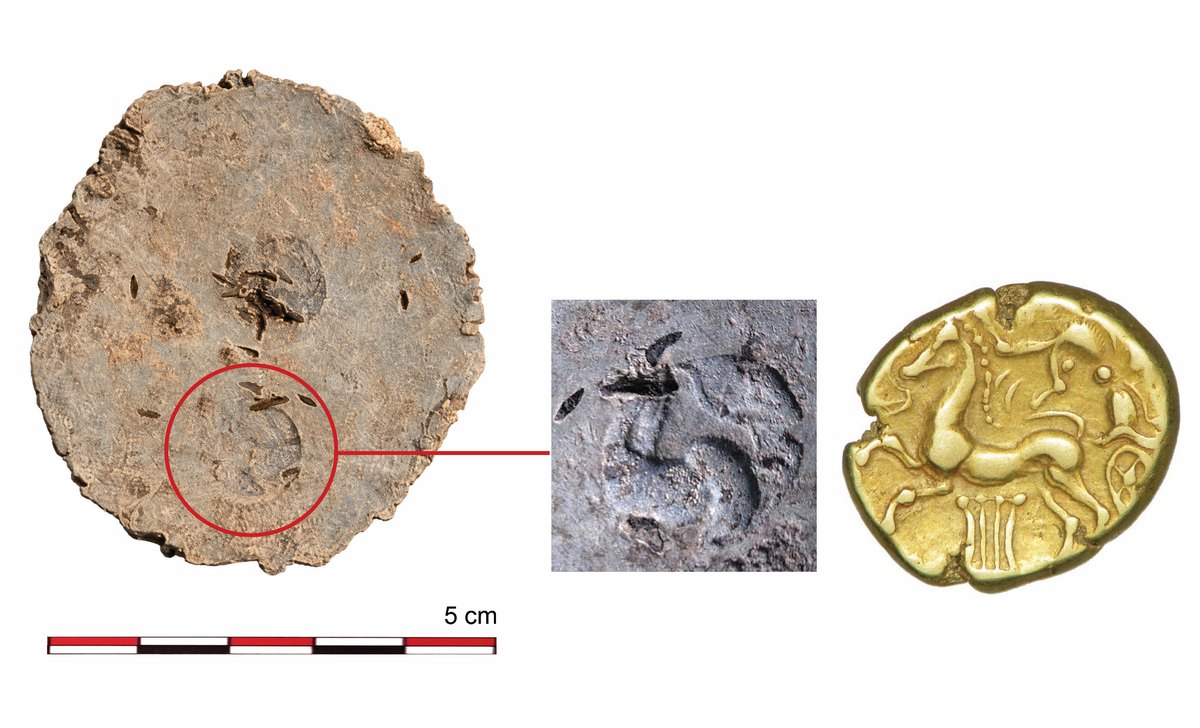
Staters of this type are well known in Arverni territory, especially at Corent and Gergovie, and two turned up among the remains of the Battle of Alesia in 52 B.C.
Near the end of the dig, the team recovered a small bronze coin die. It may belong to the same stater type, or to a still unidentified variant of the Arverni drachm, a silver coin.
Fox coins that never left town
Numismatists had long suspected that Corent made its own money. The first proof came in August 2024: wooden structures, metalworking tools and production waste, along with the blanks, punches and casting leftovers LUERN lists on its page about the mint.
The fox coins hardly ever left home. About 500 have been recorded in Auvergne, more than 95 percent of them on the Corent plateau and over 300 inside the sanctuary alone. LUERN puts their range at no more than about 3 miles (5 kilometers).
The association links the fox to an Arverni king “whose name meant fox, who, for his electoral campaign, handed out coins and organized banquets,” a sign that money also served as propaganda.
Other Celtic towns had busy workshops too, from a 62-acre Celtic settlement with gold and silver coins near Hradec Králové in Bohemia to a field in Essex, England, that has produced Iron Age gold coins from the 1st century B.C.
A capital on the eve of the Gallic War
The busiest years of the mint, 60 to 50 B.C., fall on the eve of the Gallic War, when Julius Caesar conquered Gaul. The workshops faced the central square of the oppidum, a large fortified town of the late Iron Age, and their size and location reminded the team of the state mints of Athens, Thessaloniki and Rome.
LUERN says striking gold and silver coins took significant organization, specialized techniques and “rigorous control of precious metals.” In its view, such a complex “strengthens the status of capital of the Arverni attributed to Corent before the Gallic War.”
Archaeologists in Romania made a similar case for a 6,000-year-old pottery kiln with an 81-square-foot floor, built for more than one household.
Corent did not last much longer. LUERN says the town was abandoned shortly afterward, amid the events around the Battle of Gergovie, fought a few miles to the north in 52 B.C.
What the lab still has to settle
Nobody has run the lab tests yet. Until then, the gold and silver are an inference drawn from yellow and silvery specks, one lead disk and one small bronze die. The ranking as the largest and most complete complex belongs to the excavators, and no peer-reviewed paper on the 2026 season has come out.
The link to Athens or Rome rests on size and location, and nothing found so far names the people who ran the mint or guarded its metal. The association says the next stage is scientific analysis, to confirm the nature of the metals and clarify how the workshop operated.
Photo: M. Poux / LUERN / Université Lumière Lyon 2