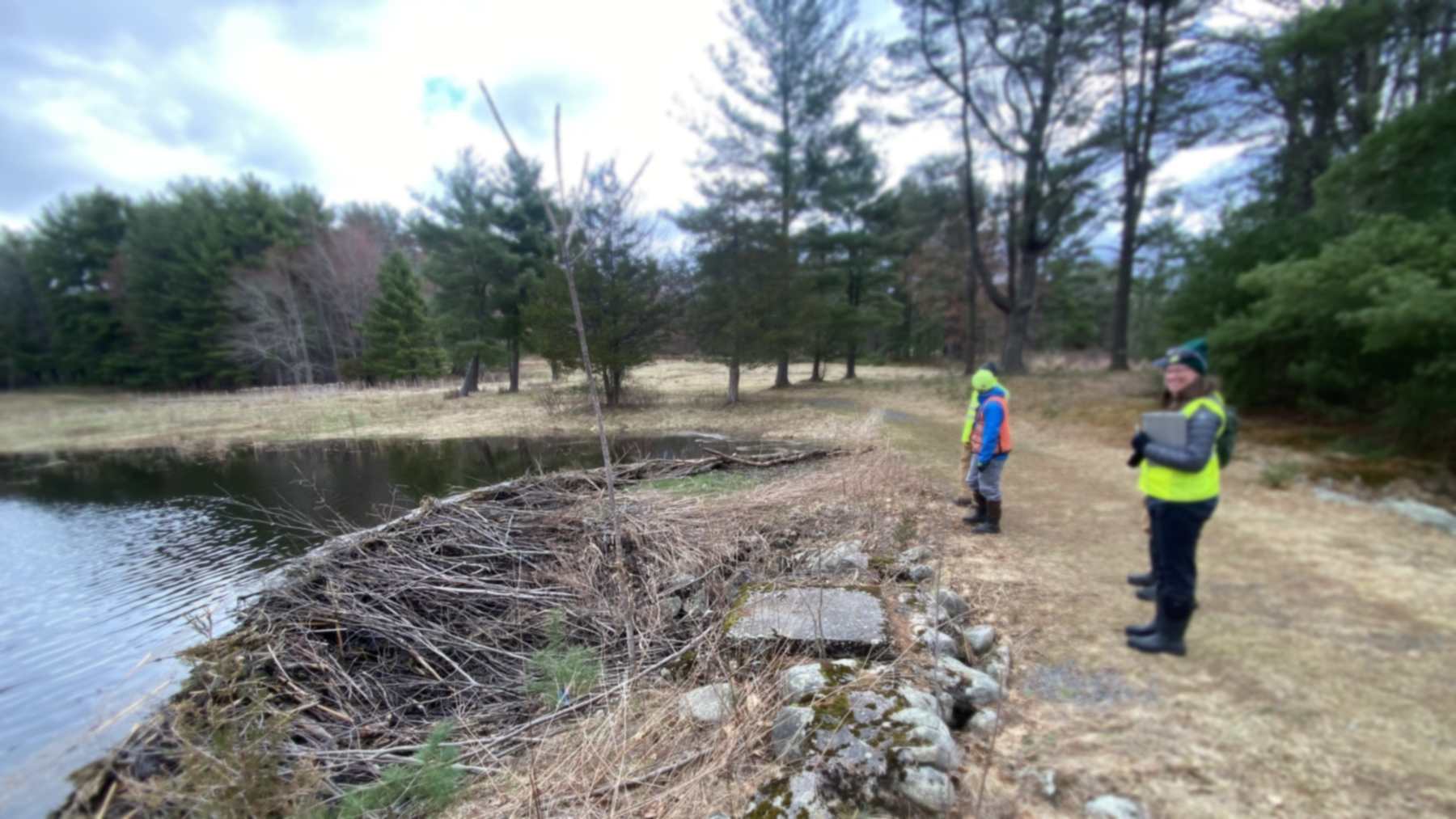
Northampton, Massachusetts, has finished the first phase of turning the 105-acre former Pine Grove Golf Course back into wetland and forest, and in August 2026 the city won a $2.8 million state grant to finish the job. Over the summer, crews pulled a failed culvert out of Nashawannuck Brook, stripped the armoring from the stream and installed beaver dam analogues, human-built versions of the dams beavers make.
The city calls the project “the first golf course restoration to break ground in Massachusetts.” It is working with the state Division of Ecological Restoration (DER), which lists the brook among its Priority Projects, and with Mass Audubon, which holds the conservation restriction on the land.
A course built to drain fast
Pine Grove was a golf course from the 1960s to 2020. In that time, according to the city, Nashawannuck Brook went from a meandering stream with wetlands around it to “a straight channel that carries water and sediment away quickly.”
The city’s fact sheet lists what the golf years left behind: dams, culverts and an armored channel along the brook, and wetlands that were turned into fairways. The city also warns that more frequent severe storms will make the brook’s unstable behavior worse over the coming decades.
Northampton bought the course in 2020. An earlier $225,000 state climate grant paid for a first cleanup, and a state case study of that work says crews removed every catch basin and irrigation head, the large concrete blocks, the irrigation pump house and half a dozen bridges across the stream. That alone let about 10 acres of the site start growing back into wetland.
What the first phase changed
SumCo Eco-Contracting mobilized in early April 2026, according to the city’s weekly construction updates. The job list included removing the culvert under Old Wilson Road, relocating a water main, restoring the stream, installing a pedestrian bridge and building a parking lot and turnaround. The U.S. Fish and Wildlife Service was also scheduled to do “chop and drop” tree cutting to improve habitat.
DER put $154,650 toward construction through its Priority Projects Program. In its February 2026 award announcement, the agency described the work as “restoring floodplain connection, enhancing stream habitat, creating wetland habitat, and replanting the riparian corridor on a former golf course in Northampton.”
The city says the first phase was completed this summer and that the brook reopened to visitors in July.
Dams built with beavers in mind
The beaver dam analogues were installed “to increase water quality and provide flood storage,” the city says. One of the goals in its fact sheet is to promote aggradation of the streambed, the slow build-up of sediment that lifts a stream back toward its floodplain.
Real beavers can do that work on their own. In England, two beavers released in Dorset built a 115-foot dam in a single year, and researchers in Switzerland found that a beaver-shaped stream held on to about 26 percent of the carbon that entered it over one year.
The $2.8 million second phase
The state’s Municipal Vulnerability Preparedness program awarded Northampton $2,818,397 for the next phase. According to the state’s project description, it will remove “an earthen dam that impounds a former irrigation pond,” two culverts and other obstructions in the channel, restore wetlands that were altered during the golf years, and add an all-persons trail and boardwalks.
Volunteers will then plant more than 7,000 trees and shrubs, using climate adaptive species chosen for cooling and carbon storage. “The work will have significant benefits for habitat improvement, flood storage and storm buffering,” the state’s description says.
What is still uncertain
Nobody can promise that wild beavers will move into the analogues or stay. Their dams can be a headache near roads and canals, as Oregon engineers learned when beavers kept rebuilding dams in an aging canal, and where the animal is not native, as in Tierra del Fuego, they turn into a costly problem.
The city is also clear that the result will take time. “The area will change over time as habitat and wetlands evolve,” its project page says, and the state case study calls the full restoration of the site’s hydrology and forest “a multi-decade project.”
When DER announced the February grants that included Northampton’s, its director, Beth Lambert, said, “Together we are improving public safety, strengthening climate resilience, and bringing natural systems back to health.”
Project details and the August 2026 grant are posted on the City of Northampton’s Pine Grove Restoration page.
Photo: City of Northampton Office of Planning and Sustainability