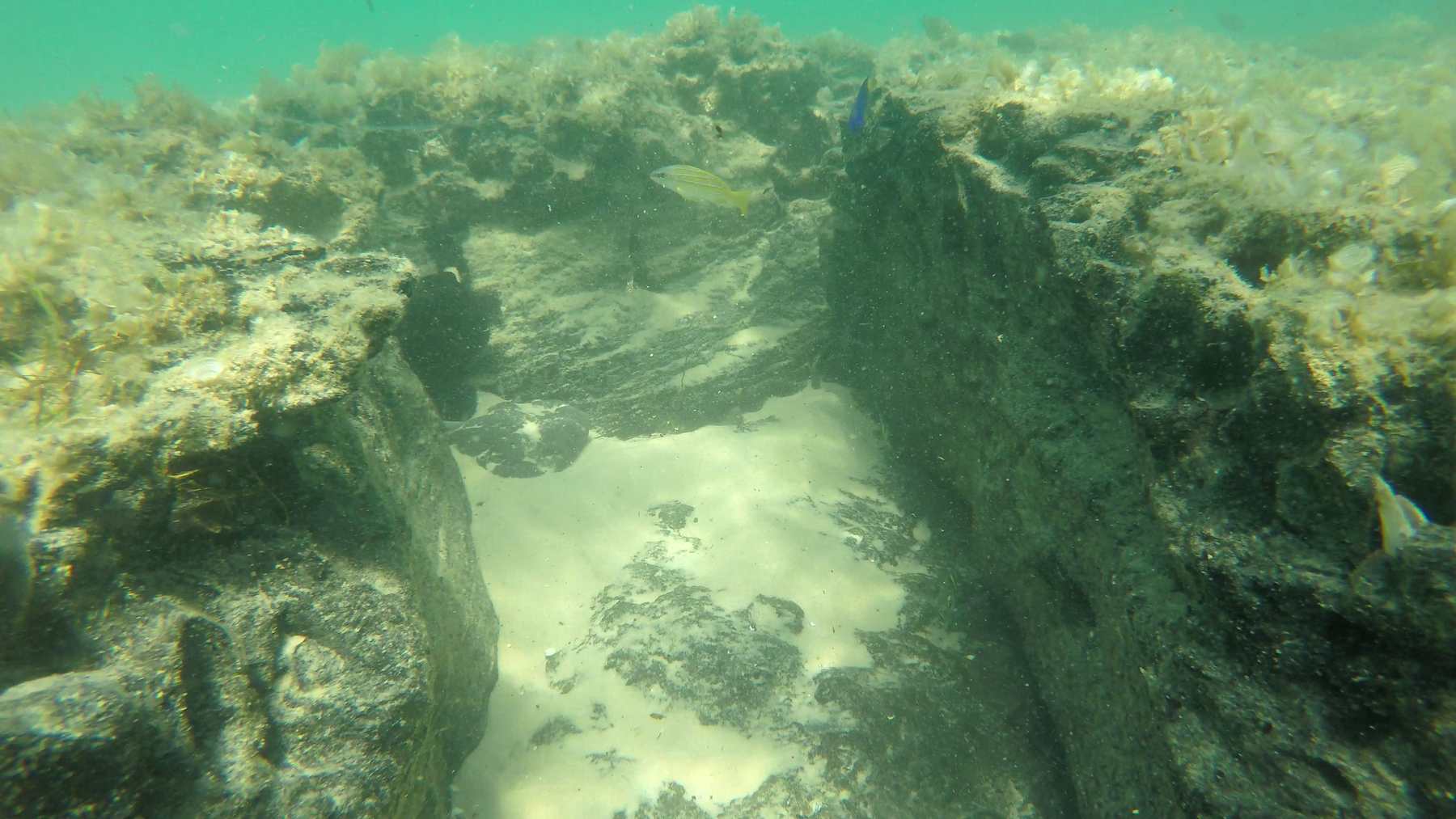
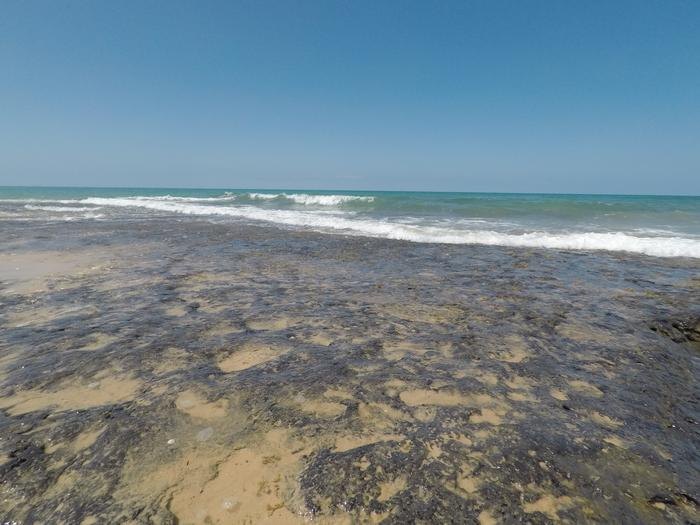
Divers working off Mozambique’s San Sebastian Peninsula in 2023 kept finding fish on a seabed that used to be forest. The dark ledges there are peat reefs, and on each of the three they surveyed they counted 26 to 36 kinds of small fish.
“What was once a forest floor is now a nursery for reef fish. We were surprised by how much life these ancient peat deposits support, and how many species move between them and the coral reefs nearby. This coastline has very little natural hard seabed, mostly shifting sand. When rising seas expose these old peat layers, they create rare, solid habitat where marine life can settle, hide and feed,” said Dr. Mario Lebrato in the release announcing the study.
Lebrato, the lead author, is station manager and chief scientist at the Bazaruto Center for Scientific Studies (BCSS) on Benguerra Island. Other co-authors work at the University of Southampton, the University of Plymouth, Heriot-Watt University, Newcastle University, the University of New England in Maine and Sound Ocean Science in Canada.
Swamps and forests under the sea
“We report the discovery of submerged tropical peat reefs in the shallow coastal waters of the Bazaruto Archipelago, Mozambique; a legacy of ancient coastal forests now transformed into benthic marine habitats,” the team writes in the paper.
The paper spells out how a forest ends up on the seafloor. “During periods of sea-level rise and shoreline advance, former terrestrial peatlands can become submerged, and once wave action removes overlying sediments, ancient peat layers are exposed as semi-hard substrate on the seafloor,” they write. “What was once waterlogged soil in a coastal swamp can thus be transformed into a reef-like platform in the ocean.”
Cape Cod has a version of this. “For instance, blocks of salt-marsh peat in Cape Cod estuaries were found to host abundant algal mats and harbored juvenile American lobsters at densities comparable to those of typical cobble nursery grounds,” the paper notes. In the North Sea, ancient DNA has also pointed to a lost forest beneath the waves.
Peat up to 5,000 years old
Divers took surface grabs and hand-driven cores from three peat reefs in 2023, and 22 samples were sent to the Curt-Engelhorn-Center Archaeometry in Germany for radiocarbon dating.
“Radiocarbon (14C) dating reveals ages spanning ~ 300 to ~ 5000 years BP, indicating mid- to late-Holocene origins as coastal peat swamps and forests subsequently submerged by rising seas,” the authors write. BP means before 1950, the reference year radiocarbon labs use.
Some of the peat was up to 40 percent organic carbon by dry weight, and its chemistry, measured at the University of La Coruña in Spain, points to land plants. In the release’s words, “Chemical analysis confirms it mostly came from coastal land plants and trees.”
No coral, but plenty of fish
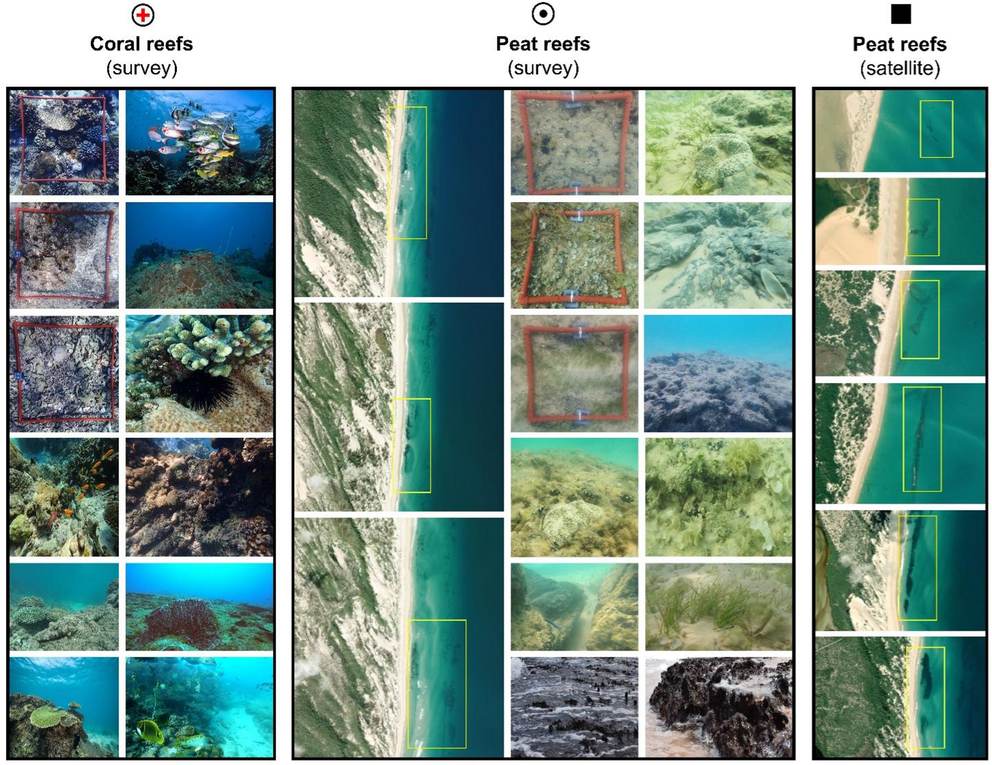
The divers compared the three peat reefs with a coral reef nearby. “Live hard or soft coral was totally absent in peat sites (0%),” the paper says, while the coral reef had about 60 to 70 percent live coral cover.
“Instead, seagrass and seaweeds grow directly on the peat. The crevices and ledges shelter spiny lobsters, oysters, barnacles and juvenile fish, including young snappers and grunts usually linked to coral reefs, likely providing refuge from predators,” the BCSS release explains.
The coral reef held 54 species of small fish, meaning fish under 8 inches (20 centimeters) long. Each peat reef held 26 to 36, with fewer fish overall, and 41 species were found on both.
“Notably, we encountered numerous juvenile fishes on peat reefs, including juveniles of species typically associated with coral reefs (e.g. lutjanids, haemulids, pomacentrids). This suggests a nursery function analogous to that of seagrass beds or mangroves, whereby structurally complex peat reef areas provide shelter and foraging opportunities for the early life stages of reef fishes,” the authors write.
The animals stuck to the bottom were another matter. The surveys found no invertebrate species living on both reef types.
A harder life in shallow water
“The peat reefs also live a harder life,” the release says. They sit only 6.5 to 13 feet (2 to 4 meters) deep, and their water swings between 76.1 and 83.5 degrees Fahrenheit (24.5 and 28.6 degrees Celsius) within a day.
“Intertidal peat reef flats, for example, experience periodic air exposure and high temperature/light conditions at low tide, which few live corals can tolerate,” the paper adds.
“Storms and cyclones regularly bury, uncover and break them apart. Many of them actually disappear due to erosion and sand movements,” according to the release. In the paper’s version, “These peat reefs are not static remnants, but dynamic-transient platforms undergoing episodic exposure and burial under the influence of seasonal swells, tropical cyclones, and tidal extremes.”
The authors call the whole thing a rebirth. “This represents a form of ‘ecosystem rebirth’: the organic foundation of a long-gone peat swamp finds a second life as the backbone of a marine reef community,” they write.
How much carbon is down there
On land, tropical peat swamps can hold 1,000 to 2,000 metric tons of carbon per hectare (about 2.5 acres) below ground, the paper notes. Old peat can also leak, as a study of two dark lakes in the Congo found.
The Bazaruto team does not claim to know the answer. “However, the presence of communities living on this substrate does not, by itself, demonstrate contemporary carbon sequestration by the peat reef system. We therefore do not interpret these habitats as conventional blue-carbon ecosystems equivalent to mangroves, salt marshes, or seagrass meadows,” they write.
The release leaves it as a question: “what is stored there, how stable is it, and what happens if these newly recognised ecosystems are lost, eroded or disturbed?”
Lebrato wants them on coastal maps
“The existence of tropical peat reefs underscores the resilience and adaptive reinvention potential of coastal ecosystems under pressure from sea-level rise and shoreline change. Their contribution to biodiversity, fisheries habitat, and potential legacy-carbon preservation should be recognised in coastal management and conservation strategies, particularly in regions where coral reef health is declining,” Lebrato said.
“The ability to demonstrate the vitality of these habitats as a result of our continuous observation excites me for the prospect of implementing conservation policy that protects similar regions around the world,” he added.
Coral has it worse in the Florida Keys, where a 2023 heat wave killed 98 to 100 percent of wild staghorn and elkhorn coral and staghorn coral nurseries are now banking the survivors’ genes.
“If one habitat type is degraded, for instance by coral bleaching or storm damage, the presence of alternative refugia like peat reefs could help sustain populations of certain non-coral species in the interim,” the paper says. “Similar habitats might exist in other tropical regions with extensive coastal peatlands, including Southeast Asia, the Caribbean, and West Africa, but they remain undocumented in the scientific literature.”
What the study does not show
Three peat reefs and one coral reef is a small sample, and the paper is careful about it. Small fish and big animals didn’t split cleanly by habitat in the statistics. For the big animals, the authors write, the pattern “may reflect limited sampling or within-group variability rather than consistent structural divergence.”
“These dates are interpreted as discrete point-age constraints rather than continuous age-depth profiles,” the methods section says. On the carbon numbers, the results section adds, “These values refer to sampled peat material expressed as percentage dry weight and should not be interpreted as habitat-scale sedimentary organic carbon content or areal carbon stock.” The work was funded through the Resort to Research program that BCSS runs with Kisawa Sanctuary, a sister resort.
The full study was published October 12, 2026, in Scientific Reports.
Elsewhere people build hard ground for sea life by hand, as Britain is doing by dropping concrete reef cubes and scallop shells into the sea to bring back oysters. Off Bazaruto, rising water did the same job with old forest peat.
Photo: Bazaruto Center for Scientific Studies (BCSS) Ocean Observatory