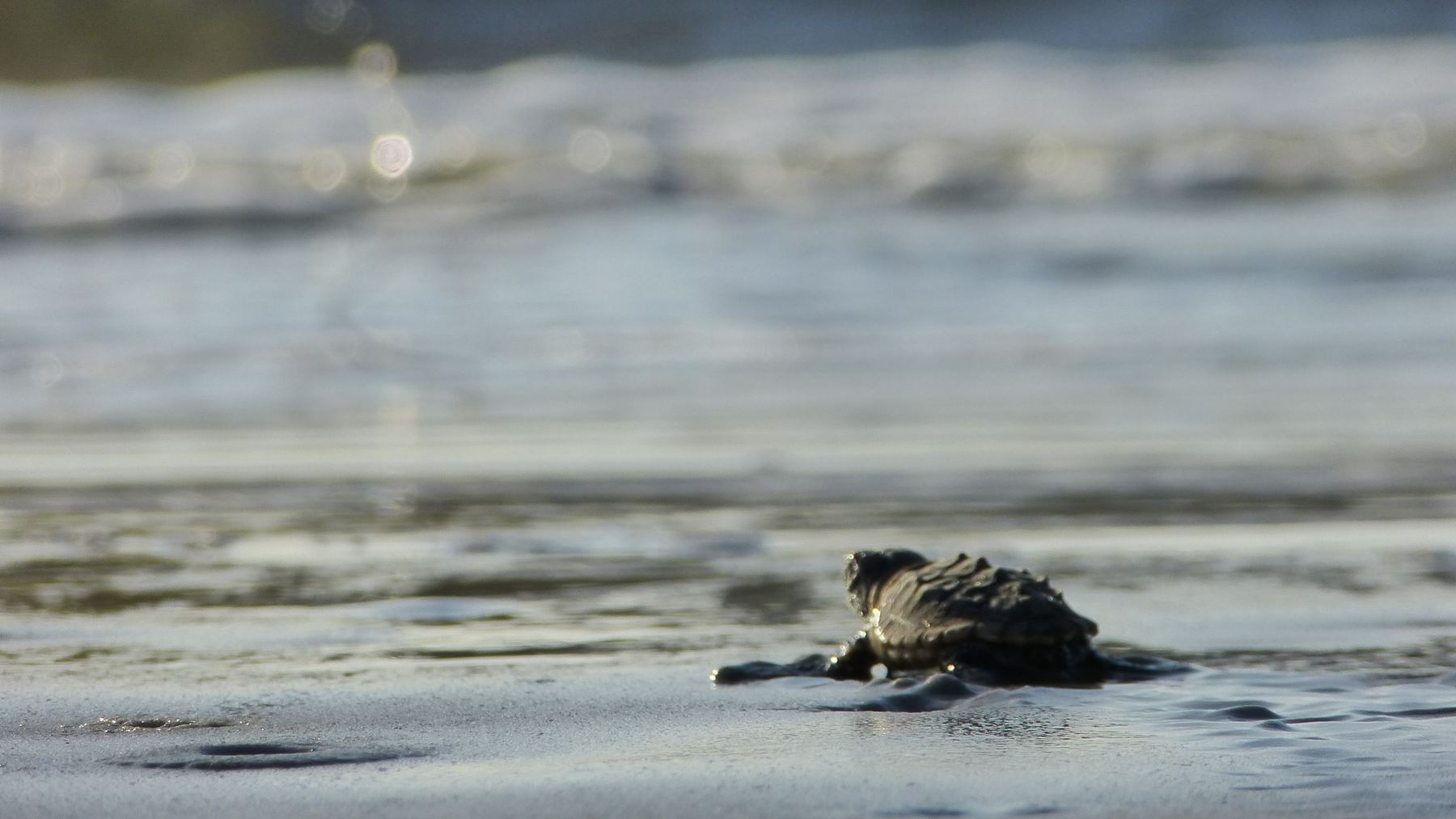
Georgia’s barrier island beaches logged 4,292 sea turtle nests in 2026, according to preliminary counts from the Georgia Department of Natural Resources’ Sea Turtle Conservation Program. Loggerheads (Caretta caretta) dug 4,174 of them, more than the 4,071 loggerhead nests of 2022, which the DNR called the most since comprehensive surveys of all the state’s barrier island beaches began in 1989.
The rest were 7 green turtle nests, 4 Kemp’s ridley nests and 107 that could not be assigned to a species. The loggerhead is listed as threatened under the Endangered Species Act, and it is the only sea turtle that nests regularly on Georgia’s barrier islands, according to the DNR. The low point came in 2004, when the state counted just 358 loggerhead nests.
A record after a bad year
Nobody at the DNR was promising a big season in May. The 2025 total had slid to 1,879 nests, the fewest since 2022, even though population modeling had pointed to a surge, the agency said in its season-opening release.
Mark Dodd, the Georgia Sea Turtle Program Coordinator and a senior wildlife biologist with the DNR, kept his expectations in check. “Just when you think we have it figured out, the turtles go do something different,” he said.
The first nests of 2026 were confirmed on May 5 on St. Catherines and Cumberland islands. “It’s like clockwork,” Dodd said of the turtles’ return around the first of May. The program’s records show the last nest was laid on Blackbeard Island on August 30.
Where the nests were
Cumberland Island had the most, with 1,305 nests, followed by Ossabaw Island with 787, St. Catherines with 481, Blackbeard with 412 and Wassaw with 377, according to the program’s beach-by-beach totals. Tybee Island had 59.
Crews moved 674 nests, about 15.7 percent, to safer spots, the same kind of relocation biologists used when olive ridleys first nested in California. The program also logged 3,676 false crawls, when a turtle comes ashore and goes back to sea without laying eggs.
With a handful of nests still incubating, the program estimates that more than 335,000 eggs were laid and counts 185,531 hatchlings that made it out of their nests so far.
Some 200 people on the beaches every day
The nests are found and protected by the Georgia Sea Turtle Cooperative, a DNR-coordinated network of some 200 volunteers, researchers and agency employees who patrol the beaches daily during nesting season. Working under a DNR permit, they mark, monitor and protect loggerhead nests, plus the few laid by other species.
One egg from each nest, less than 1 percent of an average clutch, goes to the University of Georgia for genetic analysis of how many loggerheads nest in the state and how they are related. The nest is then covered with a screen to keep predators out.
The DNR asks beachfront residents and businesses to turn off, shield or redirect their lights during nesting season, because hatchlings mistake the glow for moonlight and are drawn away from the ocean. They can end up, as in the Florida Keys, in a backyard swimming pool.
Today’s mothers hatched decades ago
Loggerheads do not nest until they are 30 to 35 years old, according to the DNR, so the females nesting this year hatched before the turn of the century. Protections include turtle excluder devices, or TEDs, that let turtles escape shrimp nets, and game wardens enforce their use in commercial shrimping.
DNR cooperators also check the beaches for strandings, dead turtles that wash ashore, which the agency calls “the primary index to at-sea mortality of sea turtles.” Turtles that strand alive can need months of care, like a cold-stunned turtle called Pancake.
The long count is what shows the recovery. “We started out averaging about 850 nests a year and in the last six years we’re just over 3,000 nests a year,” Dodd said in May.
A plateau may be coming
A model developed by the DNR, the University of Georgia and the U.S. Geological Survey suggests the population will plateau at current levels for more than a decade, because few young turtles joined the breeding population in the early 2000s. If protections stay in place through that period, the model suggests loggerheads could then reach numbers not seen since the late 1950s.
The federal recovery plan sets a goal of 2,800 nests a year. Two of the four summers before this one had topped it, the DNR said in May, and the loggerhead population has been growing about 4 percent a year since the early 1990s.
The 2026 figures are preliminary and will be final once the last nests are inventoried. More on the state’s work is on the DNR’s sea turtle recovery page.
Photo: U.S. Fish and Wildlife Service/Becky Skiba