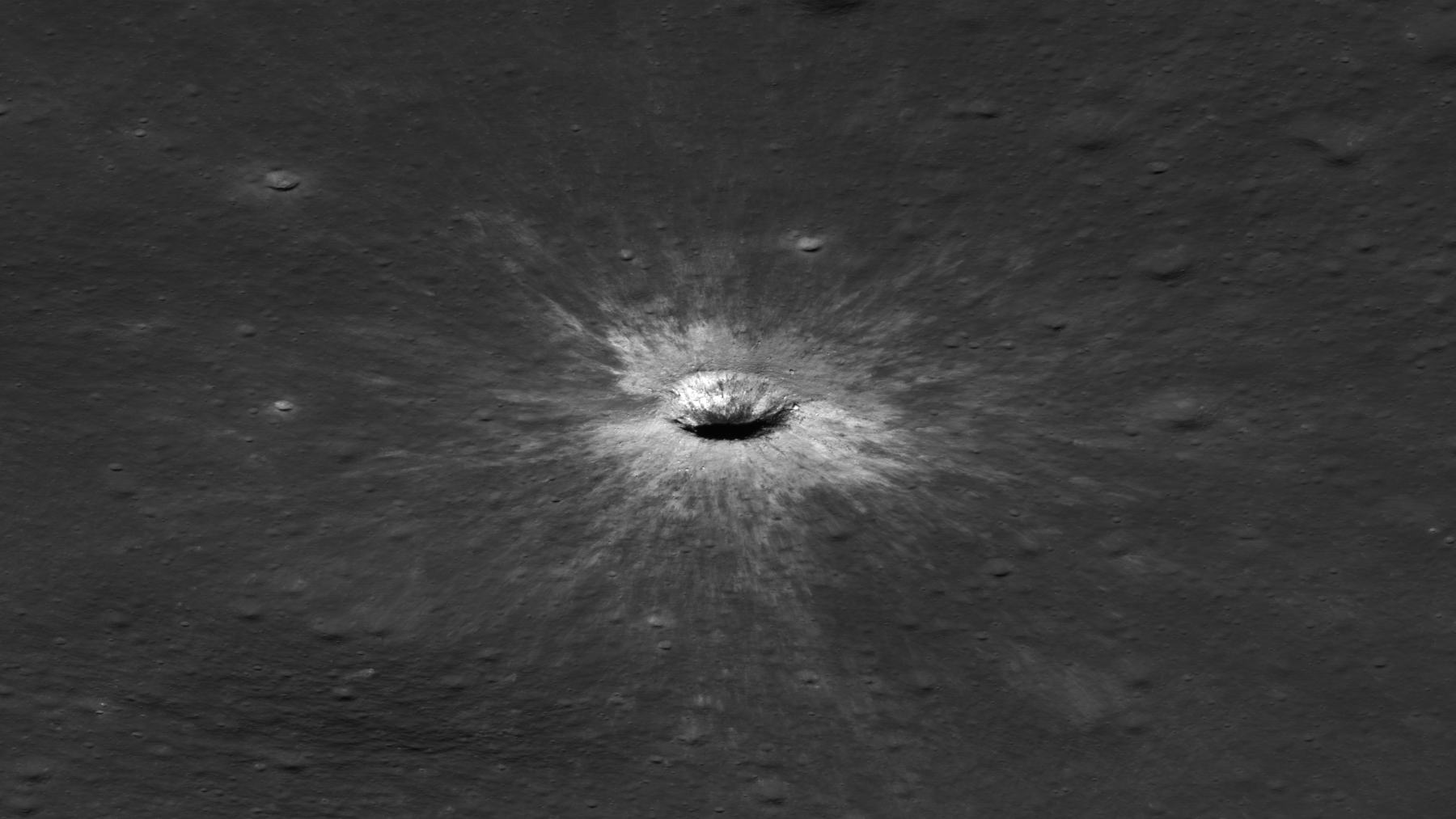
It started as a routine data-quality check on Friday, Oct. 24, 2025, with Robert Wagner scanning a giant map of the Moon on his computer screen, until a bright spot circled by a dark halo caught his eye and turned out to be a new Moon crater about as wide as two football fields are long.
“I just stopped, dropped everything, and started looking into what that spot was,” said Wagner, who processes images from the Lunar Reconnaissance Orbiter Camera for the company Intuitive Machines.
The crater is now officially called McGetchin, after Tom McGetchin, an Apollo-era lunar scientist who once directed Houston’s Lunar and Planetary Institute. NASA says it formed on the Moon’s eastern edge between April 11 and May 22, 2024, after a comet or asteroid fragment about the size of a three- to six-story building hit the ground there, and it measures 728 feet (222 meters) across and 141 feet (43 meters) deep.
Two papers published Sept. 16, 2026, in Science Advances look at the crater and at the ground around it.
The largest new crater found so far
Mark Robinson of Intuitive Machines and his co-authors describe the crater itself in one paper. Tyler Powell, a researcher at the Johns Hopkins University Applied Physics Laboratory, led the second, which looks at the ground around it.
NASA calls McGetchin “the largest, newly formed crater ever found in the solar system.” The LRO team has identified at least 1,000 new impact craters since the orbiter reached the Moon, according to the agency.
“Crater production models indicate that an impact of this magnitude is expected to occur only once every 132 years on the Moon,” the crater paper says. “As such, this event constitutes a statistically rare, effectively once-in-a-lifetime observation.”
How a routine check turned up the crater
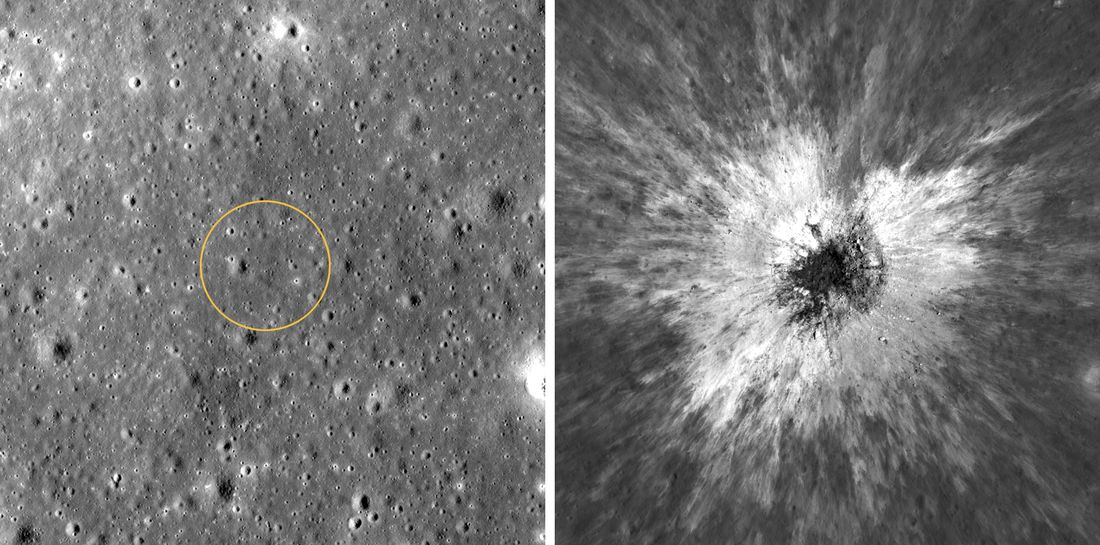
Wagner’s map was built from hundreds of “before” and “after” frames from LRO’s Wide-Angle Camera, whose pixels are about the size of a football field. Software turns everything that stayed the same gray and everything that changed bright or dark, but it also reacts to every little shift in light and shadow, so he goes through the hits by eye.
“It was by far the most obvious impact debris pattern I’ve ever seen in one of these images,” he said of McGetchin, which covered hundreds of pixels.
Nobody caught the strike live, which is why NASA can only place it somewhere between April 11 and May 22, 2024, even though a much smaller rock produced the lunar impact flash a telescope in Northern Ireland recorded.
Debris reached far beyond the rim
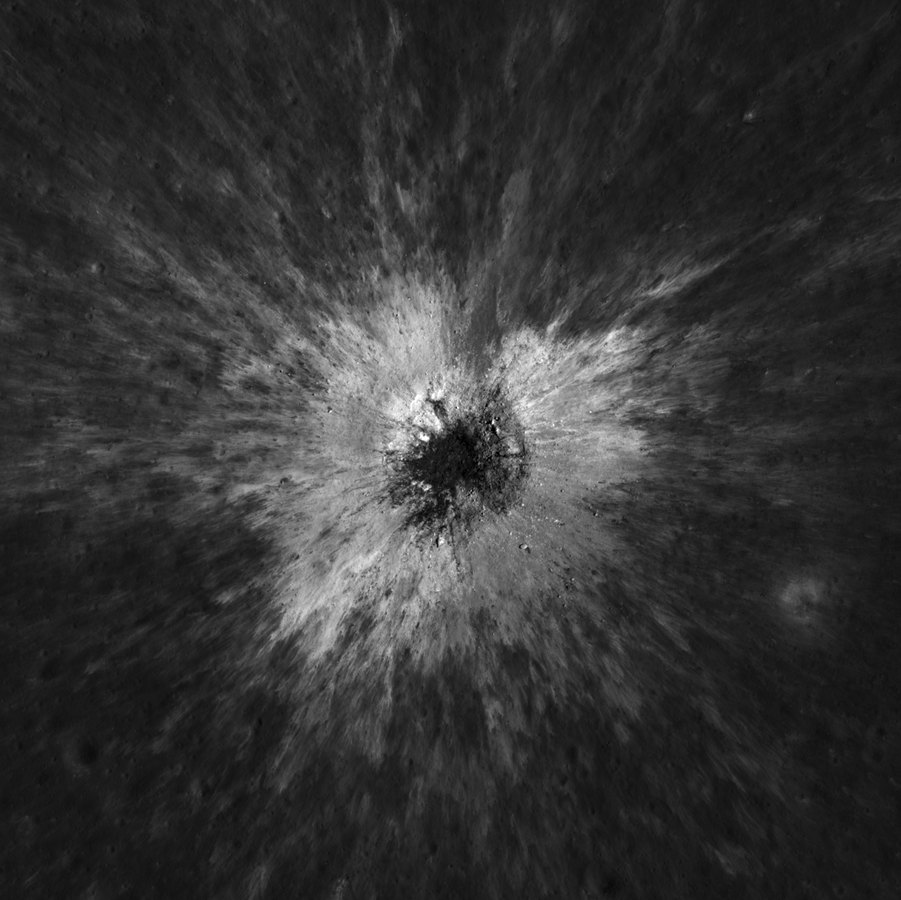
“The distal disturbances can be found more than 1000 crater radii from the new crater and in some cases exhibit a delicate lacey texture,” Robinson and his co-authors write. In plain numbers, faint marks show up more than 62 miles (100 kilometers) away, and in spots as far as about 87 miles (140 kilometers).
“The lace-like texture probably formed as clumps of ejected material separated and spread out over the longer flight times required to reach distal areas,” they write, and when those sparse particles landed they “churned the epiregolith, magnifying their imprint.”
A ridge rising about 2,300 feet (700 meters) above the crater stands 5 miles (8 kilometers) to the west, and the ground behind it was disturbed anyway. The camera team concluded that “the high-speed jetting of material must have been at angles higher than previously thought typical,” above 10 degrees instead of roughly 2.
The camera team’s website says McGetchin “formed on the boundary between mare basalts (volcanic rock) and the ancient anorthositic highland crust,” and that “materials from twenty or more meters below the surface were ejected and emplaced around the outside of the crater.”
A cold spot more than 4 miles wide
Powell’s group pointed Diviner, the LRO instrument that takes the Moon’s temperature, at the site, and their paper reports “an ∼7-kilometer-wide cold spot that is 8 to 9 kelvin cooler than its surroundings” at night, which works out to about 4.3 miles across and roughly 14 to 16 degrees Fahrenheit colder.
According to NASA, the cooling happens because the impact fluffs up the regolith, the blanket of dust and broken rock that covers the Moon, “making it less dense and therefore less able to retain heat.”
“The moon is a very old body, as old as the Earth itself. When you observe the moon from a distance, you see that its surface is pockmarked with large impact craters that formed billions of years ago, and it’s tempting to conclude that the lunar surface has essentially remained unchanged over time,” said David Paige, a UCLA planetary scientist and lead scientist of the Diviner experiment, in a UCLA news release.
“We’re now thinking of impacts as a way to garden the regolith,” Paige said, describing it as “churning the sediments and putting stuff above that’s usually below the surface.”
“We have a lot of detailed statistics for how often a crater of a certain size should form, and we know a crater of this size forms only once in a century,” said Tyler Horvath, a UCLA doctoral student who co-wrote the cold-spot paper. “One of the exciting things about this discovery is that we’re very lucky we have a spacecraft to observe it.”
McGetchin is not alone in this. “We investigate all newly formed craters >20 meters identified to date and find that all craters larger than ∼30 meters produce detectable cold spots, indicating that cold spot formation is a common consequence of fresh lunar impacts,” the Diviner team writes, after checking 21 of them.
Distant impacts matter for a Moon base
Powell, who did part of the work as a doctoral student at UCLA, said in the university’s release that “lunar impacts can modify the surface over distances far beyond the crater itself.” Understanding that, he added, “provides useful context for future lunar exploration, including NASA’s Artemis program.”
NASA notes that the physical changes around the crater “could affect how rover wheels interact with the surface, for instance.”
One engineer has already argued that lunar construction needs its own building code, and Intuitive Machines is one of the companies NASA has hired for Moon deliveries targeted for late 2028.
What the studies leave open
Some basic numbers are still missing, since NASA says estimates of the size and force of the rock that made McGetchin should appear in a future paper. The crater paper also leaves a narrow tongue of debris on the northern rim unexplained, saying “its origin remains enigmatic,” and adds, “We searched for, but did not find, definitive evidence that the bolide impacted at a grazing angle.”
All of this was measured from about 60 miles up, the height from which NASA says the LROC cameras collect their images.
“We see change, but don’t usually know how recently it happened. Here we see a crater that formed two years ago, so we know how it formed and how it is changing. This makes the new crater a very useful calibration point,” Paige said.
The full study was published in Science Advances, alongside the Diviner team’s companion paper in the same journal.
McGetchin died in 1979. A memorial published by the Geological Society of America quotes what he wrote three months earlier: “Shaping your stone means quietly doing your job as well as you can. Your identity will soon be lost to history but your stone, if well shaped and polished, will fit into the structure we call civilization and hold its weight as time sweeps past us and others build upon us.”
Image: NASA Goddard/Intuitive Machines