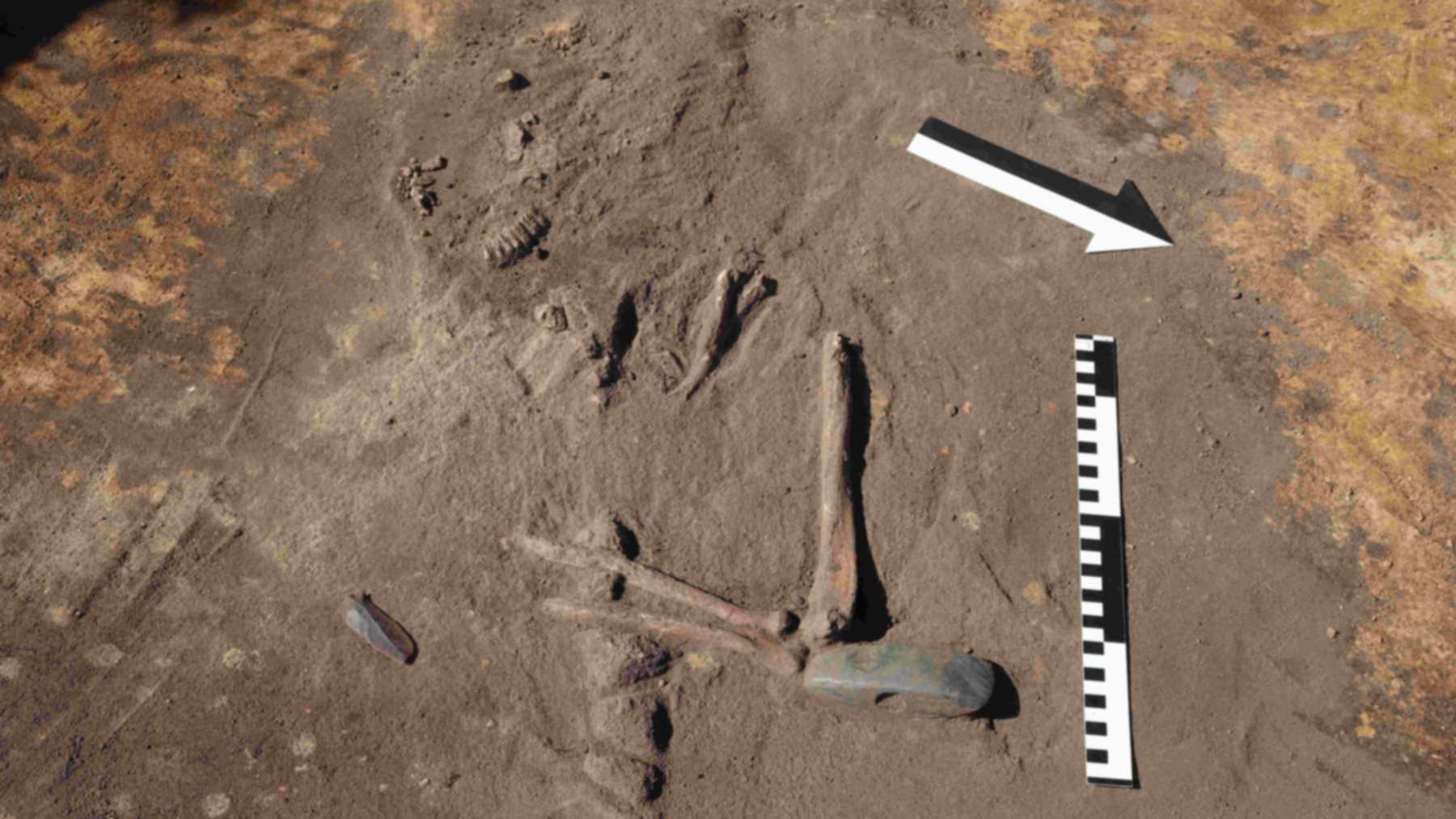
Archaeologists digging a late Roman cemetery outside Wrocław, Poland, had started tidying up the site when a circular outline about 13 feet (4 meters) across showed up in the ground. Underneath it lay a 5,000-year-old grave holding a man’s skeleton, a battle ax, fragments of two other human skulls and a necklace of 42 drilled teeth.
“We were practically already starting to pack up,” said Paweł Dąbrowski, an anthropologist and anatomist at Wrocław Medical University, in a statement the university released on September 2, 2026. “And then we uncovered a round shape in the ground about 4 meters across, resembling the outline of a burial mound. We started digging.”
A Stone Age mound under a Roman cemetery
The site lies near the village of Żórawina, just south of Wrocław in Lower Silesia, and researchers have known it for years as a burial ground from roughly A.D. 350 to 430, the end of the Roman period and the start of the Migration Period.
The excavation was led by Tomasz Gralak, head of the Department of Bronze Age and Early Iron Age Archaeology at the University of Wrocław. Dąbrowski, who works in the Department of Normal Anatomy at Wrocław Medical University and studies ancient human bones, led the anthropology team, and students and volunteers from both universities worked on the dig.
The circle turned out to be the outline of a burial mound, and the objects inside it were far older than anything else excavated at the site, according to the Wrocław Medical University statement.
Forty-two teeth drilled through the root
The teeth appeared first, lying in the central chamber of the mound in a tightly fitted row. “The arrangement of the 42 teeth was precise, and upon further inspection, it turned out that all of them had holes drilled through their roots. They must have formed a kind of necklace,” Dąbrowski said.
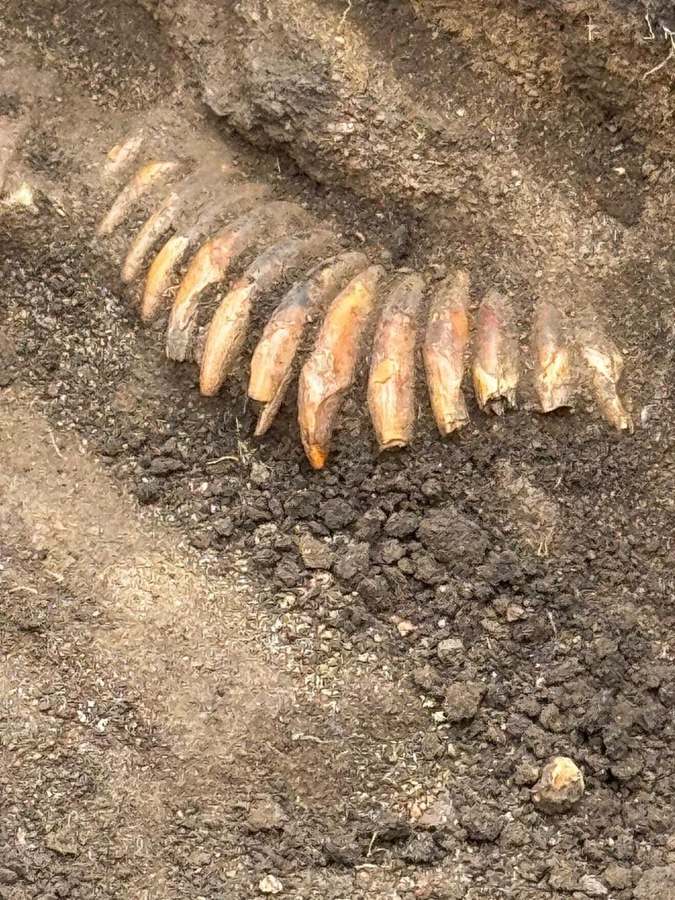
The cord itself rotted away long ago. “It was clear at first glance that there could be no question of chance here,” Dąbrowski said in the statement. “Although the string or cord that connected them has not survived, there is no doubt that it was an ornament made by human hands.”
Based on their features, he suspects the teeth came from members of the dog family, bears and hoofed mammals, and he has not ruled out that some are human, according to the statement. Genetic tests on the teeth are meant to settle which species they belong to.
A man buried with a battle ax and two skulls
Digging deeper, the team reached the nearly complete skeleton of an adult man, who was probably the necklace’s owner. His battle ax still lay under his right elbow. It’s carved from serpentinite, a greenish metamorphic rock, and the grave also gave up amber beads, small bone disks and a flint blade.
Then there are the skulls. Pieces of two more adults’ skulls lay in the same grave, both badly broken, and Dąbrowski and Gralak have floated the idea that they were severed heads, buried with the man as a kind of offering.
So far it’s only an idea. Dąbrowski will search the fragments for cut marks left by a sharp-edged tool, and each set of human bones from the mound will get its own radiocarbon date to see if they really are the same age. The man’s skeleton will also be checked for injuries, strain-related changes and signs of inflammation that could say more about his way of life, activity and health, the statement says.
The ax dates the grave to around 2900 B.C.
The style of the stone ax points to around 2900 B.C., the middle phase of the Neolithic in Poland, according to the university’s statement. That puts the mound more than 3,200 years before the Roman-era graves around it. The researchers think the people buried there may have been linked to the Corded Ware culture, a group known for pottery decorated with impressions of twisted cord.
“Of course, all of these skeletal remains and objects will be examined in detail, but I can already say today that we have come across traces of the presence of people from 5,000 years ago,” Dąbrowski said in the statement, which we translated from Polish.
The human remains will now be radiocarbon dated to check whether they all come from the same period, the statement says.
Warrior, hunter or clan leader
“The ax bore traces of use, its blade is slightly chipped, so it probably served as a combat tool or for hunting,” Dąbrowski said in the statement, in our translation. The household stone axes of the period were smaller, the statement says.
The university’s statement says the large necklace was probably meant to underline the dead man’s special position, and that he may have been a great hunter, a warrior or the patriarch of a clan, a point Gralak has stressed. That kind of status also marks other graves built for a person of high rank.
A second mound a few miles away
At almost the same time, another archaeological team found a similar mound in Iwiny, another village near Wrocław, Dąbrowski said in the statement.
Combined, the two sites could show whether groups linked to the Corded Ware culture, which migrated west from eastern Europe and possibly from as far as the Caspian Sea region, reached what is now Lower Silesia, much as a 5,000-year-old burial mound in Wales has added to the picture of prehistoric Britain.
What the lab work can and cannot settle
A lot of what has been said about this grave is still guesswork, and the researchers say so. Until the radiocarbon results come in, the date hangs on the style of a single ax, and no one has yet checked the skull fragments for cut marks.
The remains are also fragile. Some of the bones were in such poor condition that they were lifted out together with blocks of earth so they would not fall apart, and the material will be X-rayed before it is cleaned, according to the statement.
The ancient DNA work is meant to reveal the biological sex and kinship of the people in the mound, and haplogroup analysis should point to where their ancestors came from, the statement says. Strontium isotopes in the teeth, both human and those in the necklace, may show where each person or animal lived and whether they migrated from other regions.
Wear on the tooth crowns, examined with a scanning electron microscope, should show what kind of food these people ate and how it was prepared, and chemical tests could reveal more about the components of their Neolithic diet.
Wrocław Medical University announced the find in a statement on September 2, 2026, and updated it on September 8.
Dąbrowski expects the first lab results this fall, according to the statement. The detailed anatomical, anthropological and dental work will follow once the dating and part of the lab analyses are done.
Photo: Tomasz Gralak / University of Wrocław