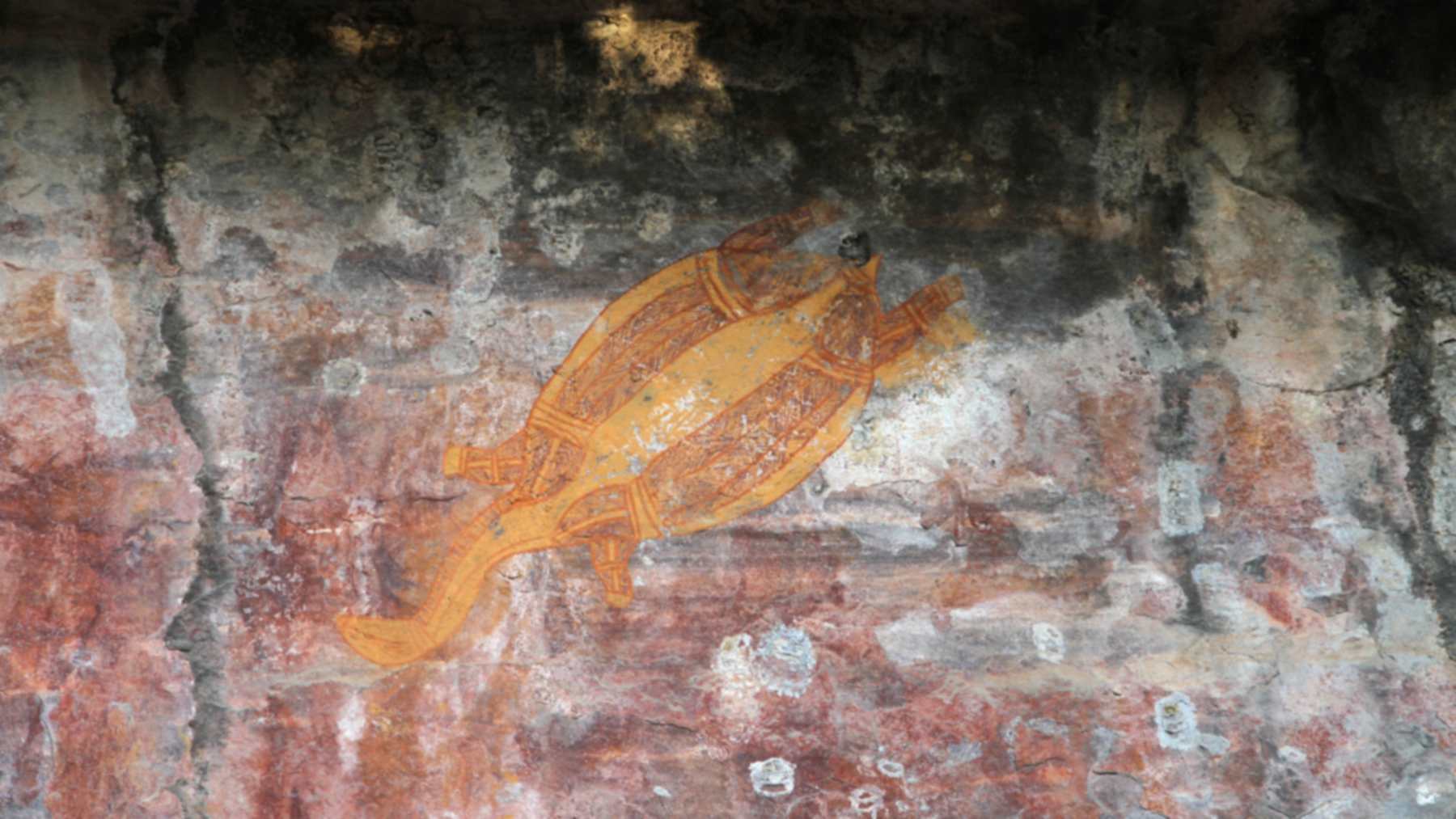
On the ceiling of a rock shelter at Awunbarna, in Australia’s Northern Territory, a white serpent with a crocodile-like head and a tongue poking out between rows of teeth runs about 20 feet (6.1 meters) in a straight line. It is one of 20 Rainbow Serpent rock paintings in one small patch of western Arnhem Land that archaeologists date to the centuries after Europeans arrived, out of just 52 such recent paintings known across the whole region.
The work was led by Taçon, who holds the Chair in Rock Art Research at Griffith University, with Sally K. May of Adelaide University, Andrea Jalandoni of Griffith and Charlie Mungulda, a senior Amurdak Traditional Owner. People have lived in Australia for a very long time, about 60,000 years by one genome study, and Awunbarna, also called Mount Borradaile, “is well known for its rich galleries of rock paintings made over at least the past 15,000 years as well as unique styles and subject matter,” the authors write. To the northwest, in Indonesia, a hand stencil on Muna Island has been dated to 67,800 years.
Twenty serpents in about 10 square miles
“Awunbarna has a particularly large concentration, with 29 Rainbow Serpents at 21 sites,” the paper says, out of 167 known rock art sites. Nine are in the older Yam style, which goes back more than 6,000 years, and 20 are recent.
These beings are snakes with borrowed parts, most often the head of a macropod, the family of kangaroos and wallabies. “They are said to have engaged in great acts of both creation and destruction across western Arnhem Land in many eras of the past and still have saliency today,” the authors write.
Namunidjbuk, to the northeast, has two Rainbow Serpent paintings across 352 sites, and Injalak Hill, near Gunbalanya, has two across 232. The Awunbarna paintings all fall within about 10.4 square miles (27 square kilometers).
“To have 20 post-Contact paintings of Rainbow Serpents in one small area of western Arnhem Land is very unusual, as the other 32 are widely dispersed and there are no other significant clusters in areas smaller than 100 square kilometres,” the authors write.
The newer serpents run twice as long
The nine Yam style serpents average 3.7 feet (1.14 meters), and the 20 recent ones average 7.9 feet (2.4 meters). Back in 1996, Taçon and colleagues had already written that “Yam Rainbow Serpents are generally smaller than Modern, in terms of mean length, mean width and in surface area.”
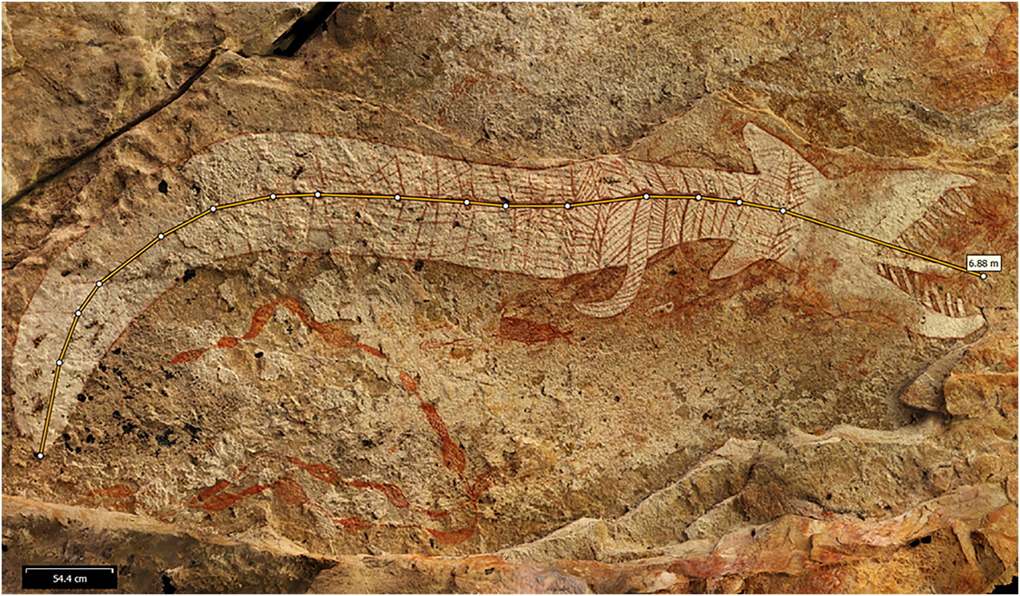
Measured along its curve, the AW5 serpent reaches 22.6 feet (6.88 meters). “It has a fierce crocodile-like head with a tongue sticking out of open jaws between a top row of 10 teeth and a bottom row of eight,” the paper says. “It also has fish fins behind its head and an arm or flipper-like appendage hanging down from its body about one-third of the way towards its tail.”
Still, it is not the region’s biggest. The authors cite a recent Rainbow Serpent elsewhere in western Arnhem Land that is 66 feet (20 meters) long.
Dating paintings without carbon dates
The paper builds its case for the age of the recent serpents from several clues at once.
“We argue that 20 Rainbow Serpent paintings at Awunbarna were made post-Contact (after about 1640AD …) because they are in the most recent Arnhem Land style, they are in the uppermost layers of sites that have superimposed paintings, and seven were made mainly with white pipe clay (kaolin),” the authors write. “White paintings do not last long, usually surviving only a few hundred years and sometimes eroding away in a few decades.”
The colors and infill also line up with a 500-year sequence at Nawarla Gabarnmang, backed by radiocarbon dates, where the changes “accord well with changes at Awunbarna, especially for paintings made at Nawarla Gabarnmang between 1640AD and 1930AD.”
A whale, a giant and a stone serpent
One shelter holds a white whale with a red outline, just over 6.6 by 3.3 feet (2 by 1 meters), placed so it seems to be swallowing a woman. “The painting is most likely to be a portrayal of a humpback whale and is an accurate depiction of this species in many ways,” the authors write, adding that it is the only known rock art whale in Australia that shows baleen.
In November 2020, three humpback whales swam up the East Alligator River, only a few kilometers from the site. “While the painting was made long before, this shows it is possible for the artist to have seen whales nearby,” the paper notes.
Another shelter has a male giant just over 6.9 feet (2.1 meters) long, the largest human figure at Awunbarna. Elsewhere at Awunbarna lie about 407 feet (124 meters) of placed stones shaped like a serpent, spread over roughly 125 by 123 feet (38.2 by 37.5 meters).
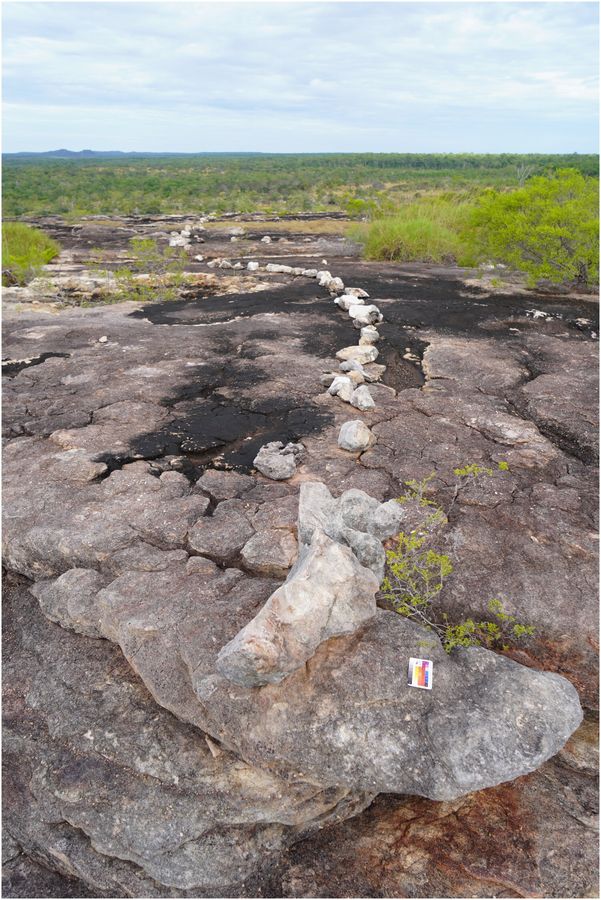
The paper calls it one of only three such stone arrangements known in Australia, the other two in Queensland.
According to Mungulda, the stones marked the ground for Morak, an initiation for young men of about 18 or older that ended in the 1970s. “People say this was very strict, and young men were forced to do some dangerous and painful things,” reads a 2006 account quoted in the paper. Mungulda also told the team that Rainbow Serpent stories were told to young people beneath the big serpent at AW5.
Why the authors think artists painted big
The authors point to the late 1800s, when buffalo shooting spread across Amurdak and neighbouring Country and brought more contact with outsiders and with other clans and language groups. “One of the things this indicates is that there was a conscious choice being made by artists to repeatedly make rock paintings of the region’s most powerful Creation Being during a period of major cultural change brought about by the arrival of Europeans,” they write.
The paper leans on anthropologist Luke Taylor, who wrote in 1988 about bark painting that “Senior artists, as ritually knowledgeable men, are in a position to facilitate social and ritual change through the creation of symbols which show the connections between people that exist over and above clan distinctions.”
It also quotes the late Mawng Elder Lazarus Lamilami, writing in 1974: “Now, when something is caught like a big fish or a goanna, if it is very big or very fat, then they say it’s maraiin.” Mardayin is a major regional ceremony, and the authors argue that big rock paintings “could also be considered Mardayin because of their extra-large size.”
The large size, the authors write, “made them stand out from other paintings on rock shelter panels and therefore they were easier to refer to when Elders imparted cultural knowledge between generations during site visits.”
What the survey cannot show
No Awunbarna serpent has been dated directly, and the size comparison rests on nine older paintings and 20 recent ones at a single place. The link to colonization is the authors’ reading of the pattern, and the data cannot test what any one artist had in mind.
Some details also cut against a simple story, since horses and buffalo were not painted at large scale at Awunbarna, and there are no big crocodile paintings there, even though the area has lots of crocodiles and site clusters to the north and south have many large crocodile paintings.
“No doubt more rock paintings of Rainbow Serpents will be recorded across the region in the future, including at Awunbarna, but it is highly unlikely Awunbarna’s claim to having the most will be challenged,” the authors write.
The full study was published online in August in Australian Archaeology.
Photo: Dave Pape / Wikimedia Commons, CC0