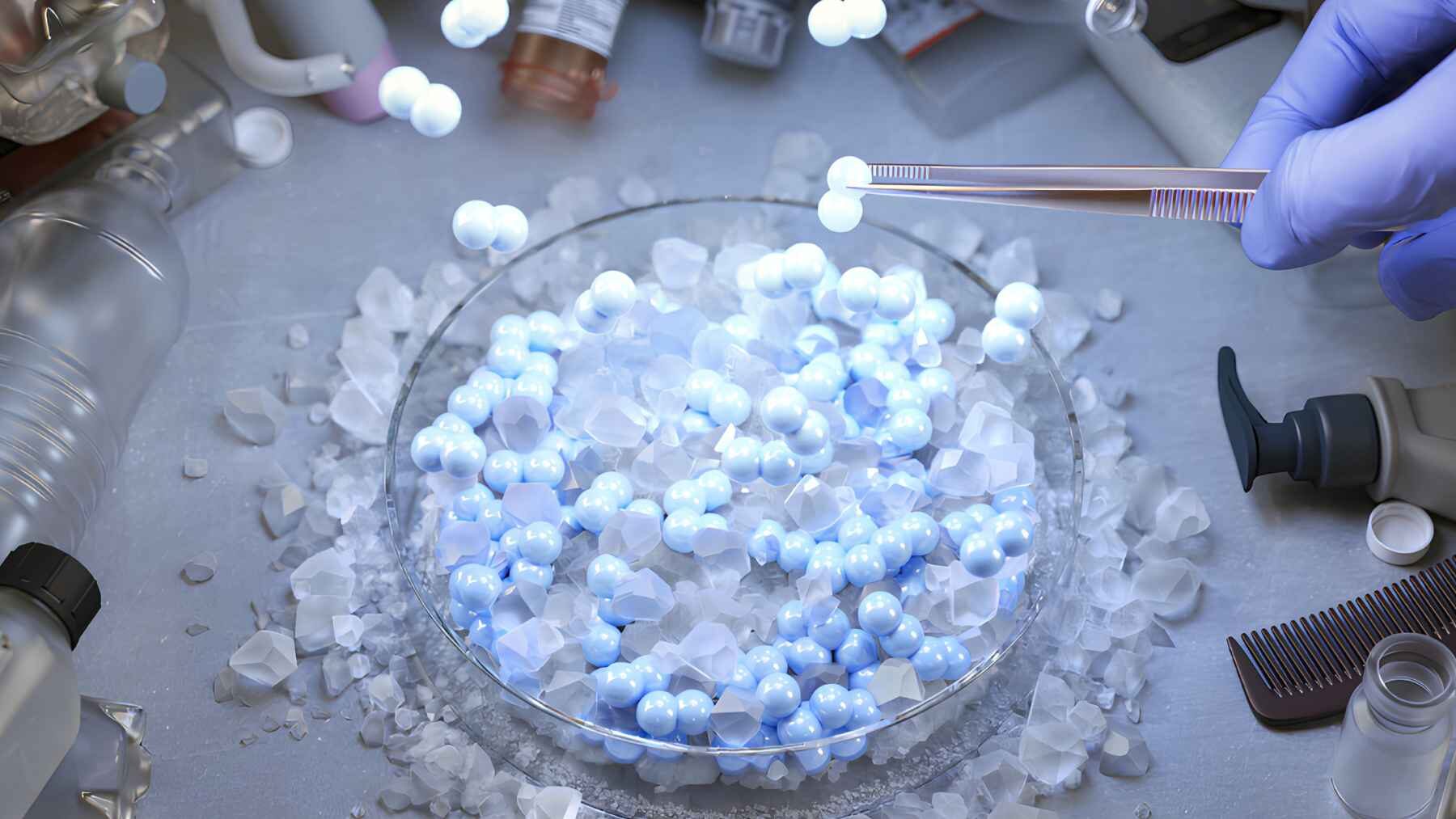
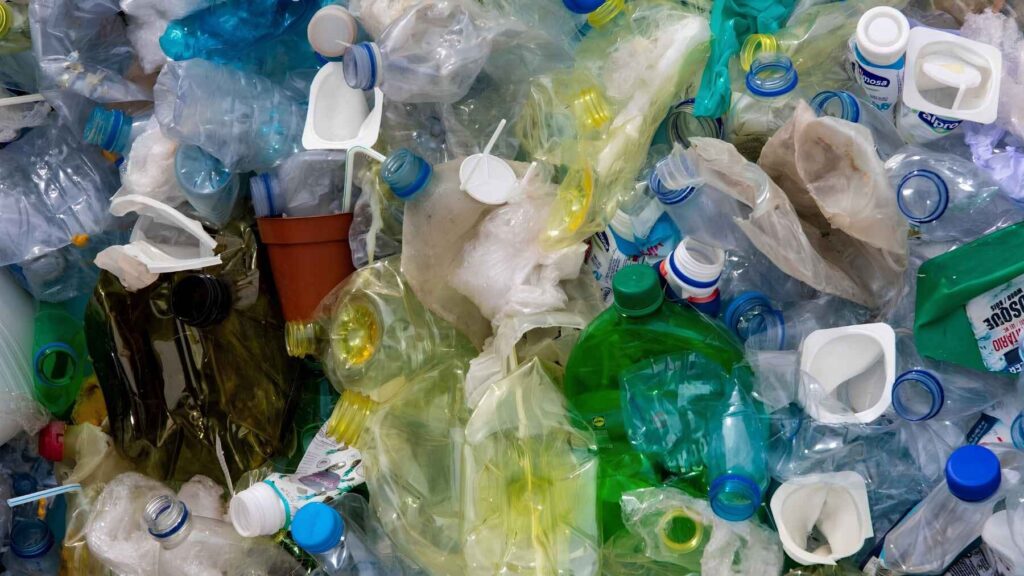
A water bottle, a grocery bag, and a broken car part may look like one pile of plastic, but recycling plants see materials with very different chemistry. A new laboratory process has converted a mixture of three widely used plastics directly into hydrogen gas with a purity above 90%, without separating the waste by type first.
A team co-led by the UCLA Samueli School of Engineering and Ewha Womans University uses heat and an alkaline chemical to break down polyethylene terephthalate, polyethylene, and polypropylene in one reactor. The method also keeps most of the plastic’s carbon in solid or liquid products instead of releasing it as carbon dioxide during the reaction, although its cost and performance at industrial scale still need to be tested.
Why the sorting problem matters
Most recycling systems are designed to handle one kind of plastic at a time. Polyethylene terephthalate, known as PET, is common in drink bottles, while polyethylene is widely used in bags and films and polypropylene appears in food containers and many durable products.
Once those materials are mixed in a bin, separating them can require extra equipment, labor, and money. According to figures cited in the university announcement, only 9% of discarded plastic is recycled, while 79% goes to landfills and 12% is incinerated.
That is why skipping the sorting stage matters. In practical terms, however, this process does not turn old plastic into new plastic. It converts the material into hydrogen and carbon-containing products, so it is better viewed as another route for difficult waste rather than a replacement for reuse or closed-loop recycling.
What alkaline thermal treatment does
The technique is called alkaline thermal treatment. “Alkaline” means chemically basic, the opposite of acidic, and the process uses sodium hydroxide under heat to encourage organic material to release hydrogen.
The researchers adapted the chemistry from an earlier method developed for biomass such as seaweed. In laboratory tests, it worked at atmospheric pressure and at temperatures roughly 540°F to 720°F lower than conventional steam gasification, depending on the comparison point.
First author Jieun Park worked with co-corresponding authors Ah-Hyung “Alissa” Park and Woo-Jae Kim to adapt the process for plastic. “We are solving two urgent global problems at the same time,” Alissa Park said. Still, this is a laboratory result, not a finished commercial plant.
A short oxygen step unlocks stubborn plastics
PET was the easier material because its molecular structure already contains oxygen. Polyethylene and polypropylene were harder to process because they are dominated by stable carbon-hydrogen bonds that do not readily react under alkaline conditions.
The team solved that problem with a brief thermal oxidation pretreatment. The plastics are exposed to moderate heat in air, adding oxygen-containing groups along their polymer chains. Think of those groups as small chemical handles that give the main treatment somewhere to grab.
After that activation step, all three plastics broke down efficiently. Earlier low-temperature approaches, including solar photoreforming and electrochemical conversion, generally worked only with oxygen-containing plastics such as PET. High-temperature gasification can accept mixed waste, but it also releases substantial carbon dioxide.
Carbon becomes a solid instead of smoke
During alkaline thermal treatment, sodium hydroxide captures carbon released from the plastics and converts it into solid sodium carbonate. The researchers found that more than 75% of the original carbon ended up in stable carbonate or liquid organic residues, while less than 13% entered the gas phase.
The sodium carbonate can then be converted into calcium carbonate through a recovery step. In simple terms, the process offers a route for locking carbon into a rock-like material instead of sending it up a smokestack as carbon dioxide.
There is an important distinction, though. Negligible direct carbon dioxide release during the reaction does not automatically make the entire industrial system emission-free. A full climate assessment would also need to count the energy used for heating, the production and recovery of sodium hydroxide, transportation, and the handling of all remaining products.
The next test is outside the laboratory
The researchers say the process must be optimized and its economic viability evaluated before large-scale use. A commercial system would also need to cope with dyes, labels, food residue, additives, and changing mixtures while recovering its chemicals and operating continuously.
That is where promising chemistry often meets the harder reality of waste management. Removing the sorting step could lower one major barrier, but hydrogen yield, energy demand, equipment durability, and the value of the carbonate products will help determine whether the numbers work.
If the method scales successfully, mixed plastic that is difficult to recycle could become a feedstock for high-purity hydrogen rather than being automatically buried or burned. It would not remove the need to reduce disposable plastic, but it could give part of the waste stream a more useful destination.
The full study was published in the Proceedings of the National Academy of Sciences.