“Sarcophagus.” King Harald V opened his speech at the annual dinner for members of Norway’s parliament on Oct. 24, 2024, with that one word. That year’s state budget, he told them, had an item that “could bring to mind Egyptian pyramids and burial chambers.”
“I hope it will be well padded so the stay will be comfortable,” he said, in remarks translated here from Norwegian. “We are going to be there for a while, after all.”
He died on Aug. 28, 2026, at 89. Snøhetta, the Oslo firm that designed his tomb, kept the design under wraps. “Right now we are only showing respect,” Kjetil Trædal Thorsen, the architect and co-founder who led the work, told the Norwegian magazine Arkitektur.
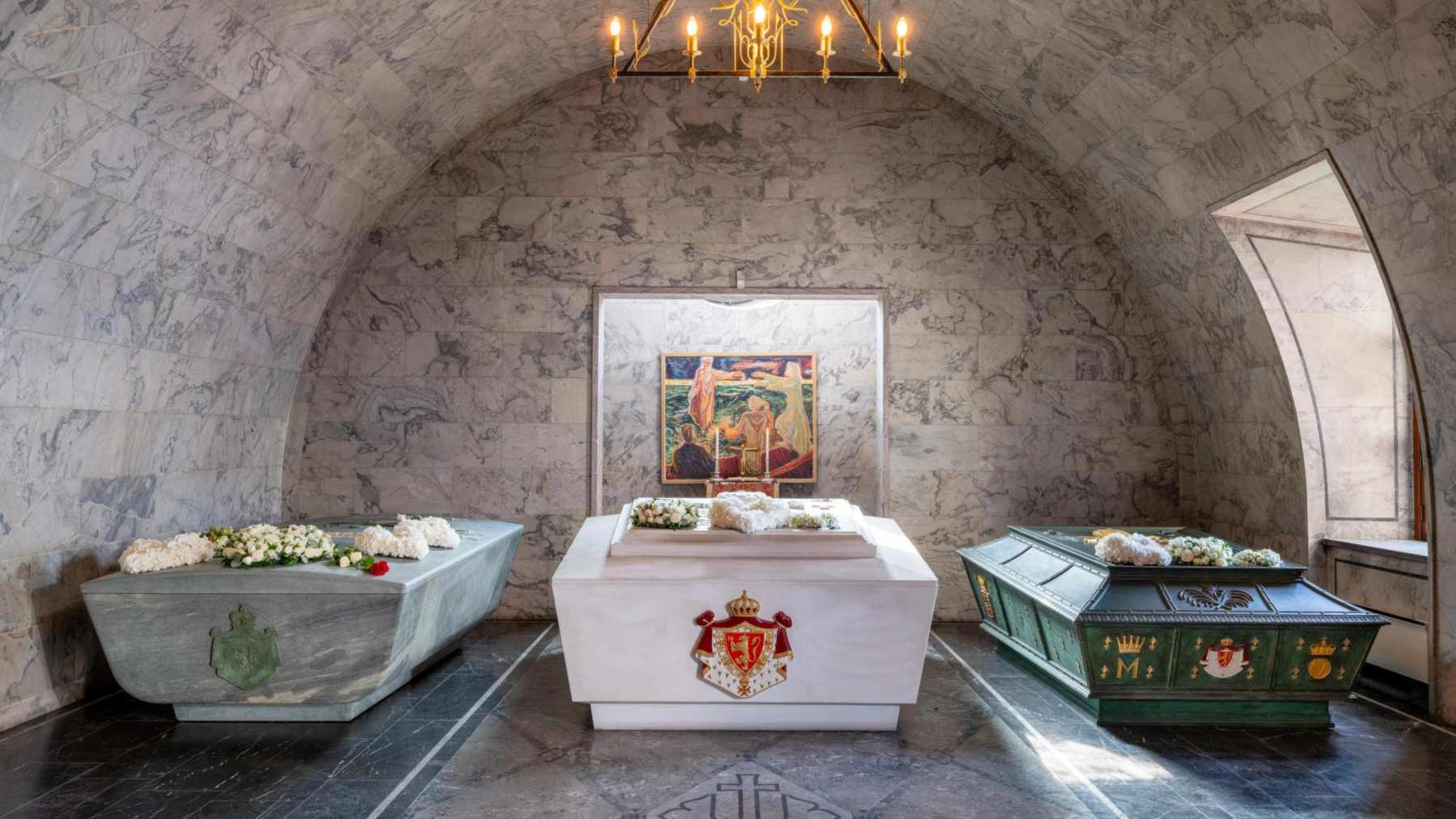
The funeral was held on Sept. 9, and the king’s coffin was taken down into the Royal Mausoleum at Akershus Fortress in Oslo. On Sept. 18 the Royal Court finally showed the sarcophagus: a boat with a rounded hull, cut from green olivine stone. AFP put the price at 20 million Norwegian kroner, about $2.1 million.
A boat, a queen’s hikes and a gem in the crown
The hull is a nod to the king’s love of the sea, the court says, and to the old ship burials in which a boat carried the dead on a last voyage.
The stone was Queen Sonja’s part of the story. She has hiked and skied all over Norway, and the olivine came from Sunnmøre on the west coast, an area she has walked a great deal and knows well. It was quarried at Vassbakkedalen, in Volda.
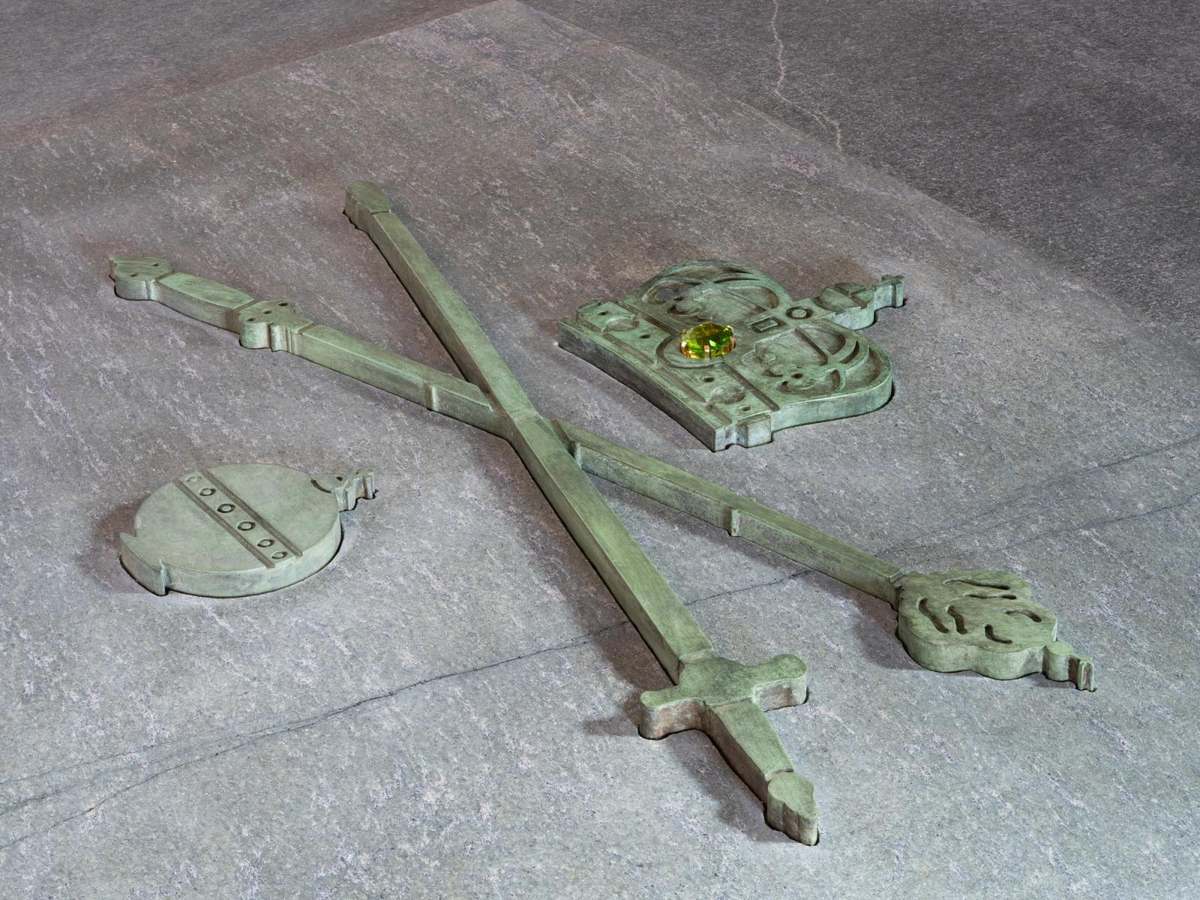
Craftsmen built it from 10 sections of stone. The lid carries bronze versions of the crown, orb, scepter and sword of state, and peridot, the clear green gem form of olivine, sits in the two crowns on the stone. Look closely at Norway’s real royal crown and you will find the same gem on its arches.
The CO2 promise
What made olivine more than a pretty green rock for the designers was chemistry. Snøhetta says the stone “has the ability to absorb and bind CO₂,” and it chose that quality as a symbol of the royal couple’s love of nature and care for future generations.
It stayed a symbol. Neither the firm nor the court has published any estimate of how much carbon dioxide the sarcophagus might take up.
Scientists have been trying to put numbers on olivine for years. When it dissolves in water it can raise alkalinity, the water’s ability to neutralize acid, and that pulls carbon dioxide out of the air. Philip Pogge von Strandmann, a geochemist at Johannes Gutenberg University Mainz, described the appeal in a 2023 university release about a separate study on past climates. “One option might be to boost the chemical weathering of rock,” he said. “To help achieve this, we could plough finely crushed rock into our fields.”
What happened in the lab
The results so far are sobering. Researchers at GEOMAR in Kiel, Germany, left sand that was about 75% olivine in artificial seawater for up to 134 days at roughly room temperature. In their 2022 study, total alkalinity fell instead of rising, and their model indicated that “CO2 uptake is reduced by a factor of 5 due to secondary mineral formation and the buffering capacity of seawater.”
Cold is another problem. Pogge von Strandmann and colleagues mixed crushed olivine from western Norway into watered soil at 4°C, or 39°F, for another 2022 paper. “After >100 days of reaction, the dissolution rate at 4°C was two orders of magnitude lower than at 19°C,” they wrote. In plain terms, about a hundredth of the speed.
They added two warnings. Experiments that mimic natural conditions run “orders of magnitude slower than in normal laboratory experiments.” And grinding the rock finer speeds things up, “but the more CO2 will be emitted by grinding.”
The sarcophagus is none of those things. It is a polished solid block, not a powder, sitting indoors. None of those experiments tested anything like it, and a fair climate balance would also have to subtract the emissions from quarrying, shaping and moving 10 pieces of stone.
Three generations in one room
The decision to make a single sarcophagus for both the king and the queen was taken in 2024, and only Harald rests in it for now, according to the court’s page on the mausoleum. It stands next to two double sarcophagi designed by Arnstein Arneberg, one for his grandparents, King Haakon VII and Queen Maud, and one for his parents, King Olav V and Crown Princess Märtha.
Photo: Øivind Möller Bakken, Det kongelige hoff