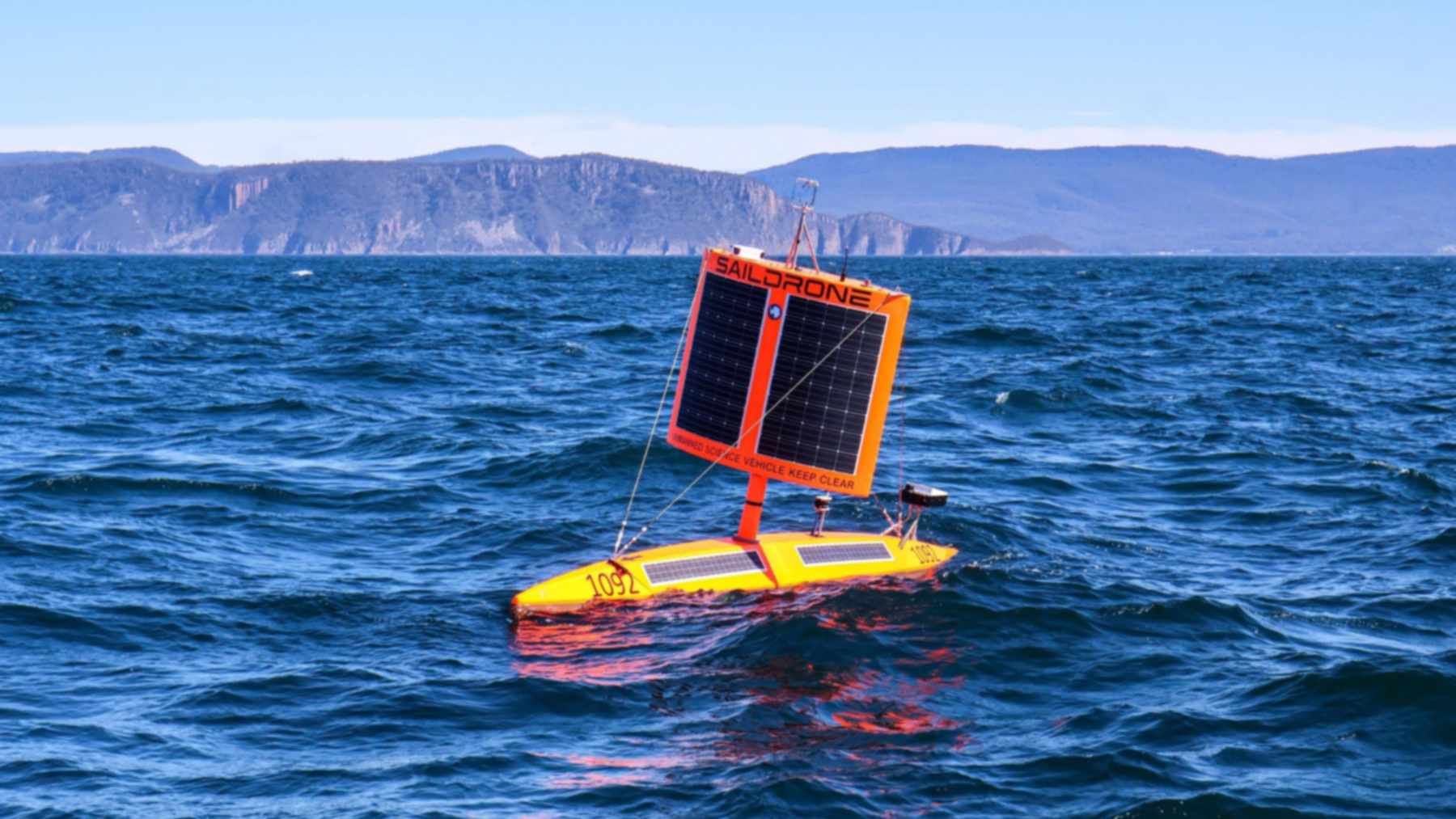
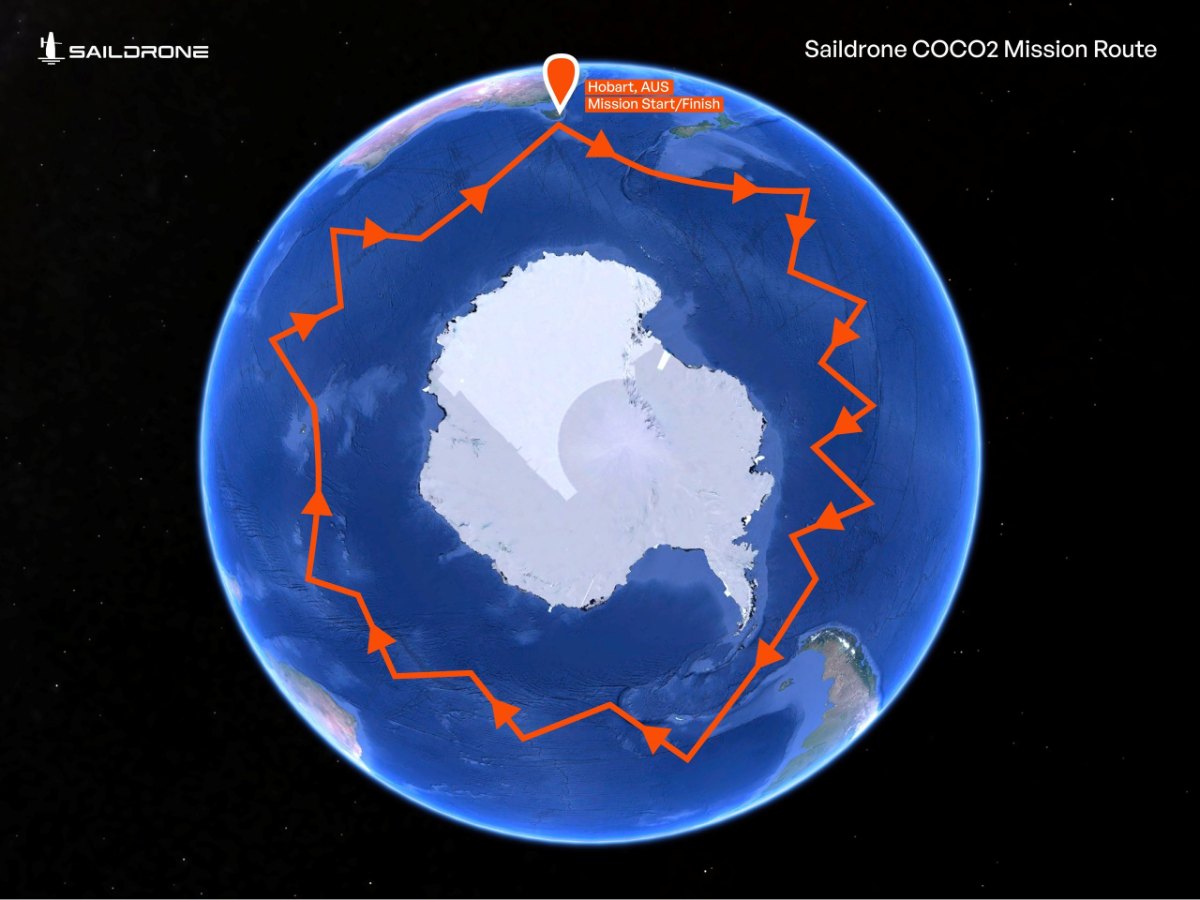
At 3 p.m. on Sept. 20, in Storm Bay off Tasmania, a tow boat let go of a 23-foot sailboat with nobody on board, and Saildrone 1092 turned south, according to the launch account and photos published by the Australian Antarctic Program Partnership. If it does what it was built to do, it will sail around Antarctica and come back to Hobart months from now with a record of where the sea surface was taking in carbon dioxide and where it was giving it off.
It’s the first of four boats that will circle Antarctica for five years, one launched every three months until all are out, according to Columbia University’s account of the project. Without crews, the boats can keep working through the southern winter, Columbia’s account says, when ship-based research in parts of the Southern Ocean “often stops altogether.”
The ocean they’ll measure takes in about 12 percent of the CO2 people emit. That figure isn’t in the announcements. It comes from multiplying two percentages they give.
Much of the effort is American. Columbia’s account says the project is led by researchers at the National Oceanic and Atmospheric Administration’s Pacific Marine Environmental Laboratory and at Columbia, lists the University of Washington among the collaborating institutions and says the philanthropy Schmidt Sciences is paying through its Virtual Institute for the Carbon Cycle. The boats come from Saildrone, which set its boats’ courses from a mission control in Alameda, California, at the time of a 2019 trip around Antarctica, according to a Saildrone article from that year.
Elizabeth Shadwick of Australia’s national science agency, CSIRO, was at the launch with two Saildrone technicians, Haley Holcomb and Jason Westenburg, the partnership’s photos show. “The Southern Ocean is central to the uptake and storage of CO2 from human emissions,” Shadwick said in the partnership’s announcement. The announcement adds that Shadwick called it the first multiyear campaign to send such boats into that ocean specifically for the seasons and regions where ship traffic is limited.
Adrienne Sutton of NOAA co-leads the project with Columbia’s Galen McKinley, Columbia’s account says. In the 2019 article, Sutton called that year’s trip “a preview of the kind of multi-platform, long-term observing system we could envision for the Southern Ocean.”
One ocean takes in about an eighth of human CO2
Columbia’s account says the world’s oceans absorb roughly 30 percent of the carbon dioxide people emit each year. The Australian announcement says the Southern Ocean accounts for 40 percent of what the oceans take up. Forty percent of 30 percent is 12 percent, around an eighth of human emissions. Both inputs are rounded, so the result is rough.
Ships haven’t been enough to measure it, Bronte Tilbrook, a CSIRO biogeochemist, said in the 2019 article. “Over the past 20 years of making ship-based measurements, we’ve learned that there’s a lot more variability in the amount of carbon the Southern Ocean can take up than we’d previously realized,” Tilbrook said. “We need more information to understand the regional changes, and how carbon uptake is changing year to year, but we can’t get that with ships alone.”
Columbia’s account lists what a crewed ship faces there: “drifting icebergs, hurricane-force winds that generate massive waves, and vast distances from shore-based infrastructure.” Sutton called it “one of Earth’s harshest environments and notoriously difficult to observe” in both announcements.
“The Southern Ocean is one of the most difficult places on Earth to operate, and that’s exactly the kind of challenge Saildrone was built for,” Richard Jenkins, the company’s founder and CEO, said in Columbia’s account.
A 23-foot boat at walking pace
The Australian announcement gives the boat’s measurements: 7 meters long, about 23 feet, with a wing 5 meters tall, about 16 feet. It says the boats run on wind and sun, average 1 to 3 knots and can stay out for up to a year without a support vessel.
The new boats will measure CO2 in the seawater and in the air, along with temperature, salinity, wind and other conditions, that announcement says. On the 2019 boat, a NOAA-developed instrument measured the difference between the CO2 in the air and in the surface water, which is used to calculate how much of the gas the surface ocean is absorbing or releasing, according to the 2019 article. That article draws the line between the boats and the robotic floats that also work in those waters: “The saildrone is focused on air-sea interaction at the surface, and the float is focused on sub-surface measurements of the water column.”
The 2019 boat left Bluff, New Zealand, on Jan. 19 and was back on Aug. 3, after 196 days and 11,879 nautical miles, about 13,670 miles, according to Saildrone’s page on that mission. That’s about 70 miles a day, or 2.9 mph, a walking pace. On the way it survived 50-foot waves, 80 mph winds and collisions with giant icebergs, the page says.
The two announcements don’t give the same length for a lap. The Australian one quotes Shadwick saying the boats “are expected to travel around 22,000 kilometres for each deployment,” which is the distance the 2019 boat covered. Columbia’s version of the same quote says “over 24,000 kilometers (13,000 nautical miles),” about 14,900 miles. At the 2019 pace, the first would take the same 196 days and the second about 214, around seven months.
In both versions, Shadwick said the trips will give “unprecedented coverage of regions that we can’t get to with research vessels or commercial ships.”
| 2019 lap | The new project | |
|---|---|---|
| Boats | 1 | 4 |
| Lap length | About 13,670 miles | About 13,670 miles or over 14,900, depending on the announcement |
| Time per lap | 196 days | 196 to about 214 days at the 2019 pace |
| Total time | 196 days | Five years |
“As a USV completes a circumnavigation of Antarctica, it will come back into Hobart where sensors will be replaced and the USV will be redeployed to start another circumnavigation,” Sutton said in the Australian announcement, using the abbreviation for uncrewed surface vehicle. “This pattern will continue for the duration of the five-year project.”
The routes will change as the data comes in
The boats won’t sail preset routes, McKinley said in the Australian announcement. Researchers at Columbia’s Lamont-Doherty Earth Observatory, led by McKinley, will use machine learning and modeling to find the gaps in the data and help decide where the boats should go, Columbia’s account says.
“We will be able to make adjustments over the course of the five-year mission to target data collection in the regions that are most needed to better understand the ocean carbon sink,” McKinley said in both announcements.
Columbia’s account lists South Africa’s Council for Scientific and Industrial Research among the collaborating institutions. Its scientist Sandy Thomalla pointed to the winter in the Australian announcement. “By targeting Southern Ocean CO2 measurements, including over winter, this fleet of sailing USVs will help close one of the most persistent data gaps in global observations,” Thomalla said.
Both announcements say the measurements will feed the Global Carbon Budget, a yearly assessment of human CO2 emissions and how much of them the land and oceans take up. The Australian one says the 2026 edition is due in November. Neither announcement reports any results from the new boat or says when the first data will be published.
Anomaly or not, a question from 2019
In 2019 Sutton was an oceanographer with the carbon group at NOAA’s Pacific Marine Environmental Laboratory, according to the Saildrone article from that year. Robotic floats had been changing the picture of the region in winter.
“The floats are suggesting that the wintertime conditions of CO2 uptake are changing quite a bit more than we understood,” Tilbrook said in that article. “There’s an interesting set of data starting to emerge, showing that the overall Southern Ocean sink is more variable in the winter.”
The floats, Sutton said, had “challenged a lot of our assumptions about the ocean CO2 sink.”
“But have conditions in this region the last few years been an anomaly, or not?” Sutton said then. “Continuous, long-term observing is one way to find out.”