Cement is under our feet, inside our walls, and poured into the roads we drive on every day. Yet it rarely gets the same climate attention as cars, power plants, or the electric bill sitting on the kitchen counter.
A new study suggests that one of construction’s biggest climate problems may have a surprisingly direct fix. Instead of changing what builders use on job sites, researchers say the industry could change the rock used to make Portland cement, the common binder that helps turn sand and gravel into concrete.
The study found that calcium-rich silicate rocks such as basalt and gabbro could cut energy demand by more than 40% and reduce related carbon pollution by more than 80%.
Why cement matters
Portland cement is used in most modern construction, from sidewalks and bridges to schools and apartment blocks. That everyday usefulness is exactly why its climate footprint is so hard to ignore.
The cement industry accounts for about 4.4% of global greenhouse gas emissions, according to the University of California, Santa Barbara. Jeff Prancevic, a geologist at UCSB, led the work with Cody Finke of Brimstone Energy, and he put the problem bluntly when he said cement “barely registers in the public mind.”
That makes the new study unusual. It does not start with a futuristic building material that contractors would need to learn from scratch. It asks a simpler question. What if the same familiar cement could be made from a different source of calcium?
The limestone problem
Today, cement makers usually get calcium from limestone. The process is reliable, well understood, and more than a century old, but limestone brings a built-in climate penalty.
To make a key cement ingredient called quicklime, manufacturers heat limestone to more than 2,700 degrees Fahrenheit. At that temperature, the rock releases carbon dioxide from its own chemistry, producing about 1,000 pounds of carbon dioxide for every U.S. ton of cement before the fuel used for heating is even counted.
That is why cleaning up cement is not as simple as switching to cleaner power. Even if the kiln runs on greener energy, limestone still releases carbon as it is processed. The trouble starts inside the rock itself.
The basalt idea
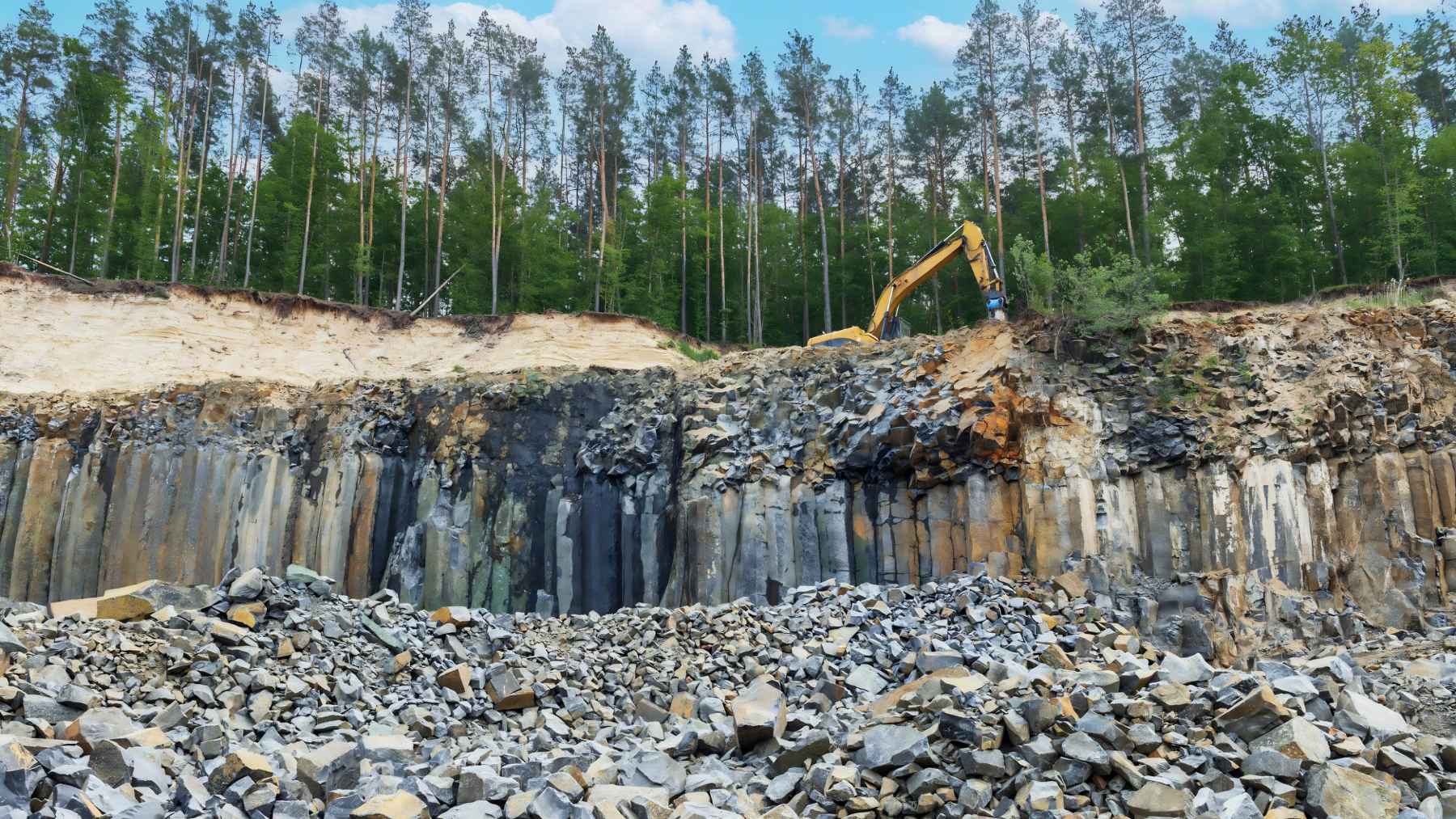
Silicate rocks offer a different path. These rocks, including basalt and gabbro, contain calcium, but they do not store carbon the way limestone does. Effectively, processing them does not release the same burst of carbon dioxide from the raw material.
The research team used existing geological maps to see whether there was enough of these rocks near Earth’s surface to matter. The answer was yes. They found enough supply to support cement production for several hundred thousand years at today’s rates, though the authors are careful not to pretend every deposit would be easy to mine. “Not all of that basalt is easily accessible,” Prancevic said.
That caveat matters. A rock can be abundant and still be expensive, remote, or environmentally difficult to extract. But the size of the resource means the idea is not limited by a rare ingredient.
How deep the cuts go
The study compared the energy and emissions needed to make Portland cement from limestone with the theoretical minimum needed to make it from silicate rocks. The difference was large.
Using natural gas as the energy source, the researchers found that minimum emissions could fall from about 1,220 pounds of carbon dioxide per U.S. ton of cement to roughly 90 to 120 pounds, depending on the exact rock. Even with average grid electricity and today’s non-optimized processes, the approach could cut emissions by more than 25% compared with the standard limestone route.
That does not mean cement plants can flip a switch tomorrow. It means the chemistry gives engineers a better starting point. Less carbon is baked into the raw material, so there is more room for cleaner factories to make a real difference.
More than cement
Basalt brings another interesting twist. It contains iron and aluminum along with calcium, which means a future “rock refinery” could potentially make more than one valuable material from the same feedstock.
The study notes that the calcium and iron ratio in basalt lines up closely with how society uses cement and steel. The same rocks needed for cement would also contain far more aluminum than current global demand, opening the door to new industrial systems with less waste.
This is still an early idea, not a finished factory blueprint. But it changes the way the cement problem looks. Instead of treating cement as a single dirty product, researchers are looking at whether one rock could feed several major industries at once.
The hard part
The biggest barrier may not be the science. It may be the construction industry itself.
Cement is cheap, at roughly $136 per U.S. ton, and builders rely on standards that move slowly for good reason. Roads, bridges, and buildings must last, so even small changes are checked carefully before they are widely accepted. Prancevic said “the construction industry is built around Portland cement,” which explains why alternative cements have struggled to replace the familiar product.
That is why this proposal focuses on making standard Portland cement from a different rock. At the end of the day, what it is trying to do is change the supply chain without forcing contractors to rebuild the way concrete is designed, poured, and maintained.
What comes next
The study is not claiming that basalt-based cement is ready to take over tomorrow. The process still needs more engineering, cost testing, and proof at commercial scale. Experts will also have to weigh mining, transportation, electricity use, and local environmental impacts.
Still, the central idea is hard to miss. A climate problem about as visible as the sidewalk may have a solution hidden in a darker, volcanic-looking rock. That does not make cement emissions disappear overnight, but it gives researchers and industry a practical direction to test.
The main study has been published in Communications Sustainability.