A 12-year-old Connecticut student combined algae with a natural mineral to explore a new way of reducing ocean acidification, and the experiment has now placed her among 10 finalists competing for a $25,000 prize in the 2026 3M Young Scientist Challenge
Raji Doshi, a 12-year-old Connecticut student, has designed a system combining algae with a natural mineral to explore ways of reducing ocean…
· 4 min read

Raji Doshi, a 12-year-old Connecticut student, has designed a system combining algae with a natural mineral to explore ways of reducing ocean acidification. The idea has earned her a place among 10 finalists competing for the 2026 3M Young Scientist Challenge’s $25,000 grand prize.
The Talcott Mountain Academy student is investigating whether biology and chemistry can work together to create less stressful conditions for marine life. It is a research project, not an established ocean treatment, and its most important question goes beyond a prize. How much protection could it provide, and for how long?
How algae and aragonite could work together
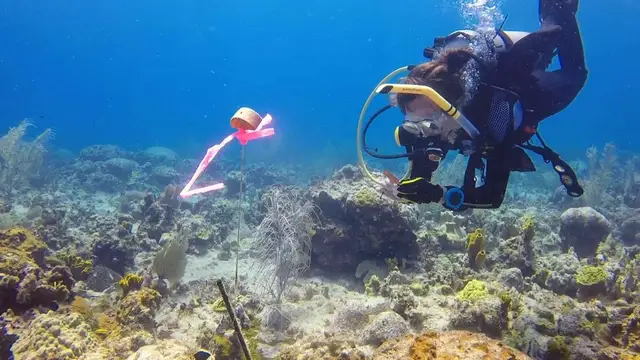
Algae use sunlight to turn dissolved carbon dioxide into new growth through photosynthesis. Taking up that carbon can raise the pH of surrounding water, which is why NOAA researchers have explored seaweed cultivation as a way to reduce local acidification.
Read More: Natural grass acts like a “sponge,” while artificial turf can repel up to 58% of the water
Aragonite plays a different role. It is a form of calcium carbonate, and when it dissolves under suitable conditions, it can increase alkalinity, the water’s ability to neutralize acid. In simple terms, the mineral could provide a chemical cushion.
The proposed partnership therefore has two jobs, drawing down dissolved CO2 and helping buffer acidity. But adding mineral material is not an automatic fix, because its dissolution depends on the surrounding seawater’s chemistry. The starting water conditions matter.
Why a small change in pH matters
According to NOAA, the ocean absorbs about 30% of the carbon dioxide released into the atmosphere. Once dissolved, that gas drives reactions that increase acidity and reduce the supply of carbonate ions, which corals, oysters, and other organisms need to build shells and skeletons.

The ocean is not turning into a vat of acid. Its average surface pH has fallen from about 8.2 to 8.1 since the Industrial Revolution, but remains on the alkaline side of the scale. Because each full step on the pH scale represents a tenfold change in acidity, seemingly small declines can still matter.
For coastal communities, the stakes reach well beyond a chemistry lesson. Shellfish farms and seafood-dependent livelihoods are vulnerable to those changes, linking ocean chemistry to the oysters on a restaurant menu and the people who grow them.
A better pH reading is only the beginning
Raji’s written finalist profile outlines the concept, but does not report measured pH improvements, treatment duration, or the volume of water tested. The summary alone therefore does not establish how effective the system is or whether it can work at larger scales.
Read More: New Orleans is turning discarded bottles into coastal sand, and each crushed glass load can help rebuild a shrinking wetland
What happens when sunlight disappears? Algae continue releasing CO2 through respiration, and separate aquaculture research has described nighttime pH declines linked to that process. A useful assessment would therefore follow water chemistry across day-and-night cycles, rather than rely on a favorable daytime reading.
The key evidence would include comparisons between the combined system, untreated water, algae alone, and aragonite alone under the same conditions. Repeated measurements of pH, alkalinity, dissolved oxygen, and effects on marine organisms would help show whether the approach offers a reliable benefit. A tank is not a coastline.
More than a classroom grade
“I wanted to work on something that mattered, not just something that would earn a grade,” Raji said in her Young Scientist Lab profile. She wrote that entering the competition pushed her to design an experiment, collect data, and put her idea under scrutiny.
The program pairs each finalist with a 3M scientist to help develop the student’s work. Raji’s mentor, Deborah Isabelle, is a product engineering specialist with a background in chemical engineering, according to Young Scientist Lab.
Organizers 3M and Discovery Education announced the finalists on July 6, 2026. Students entered with one- to two-minute videos, and judges assessed their ideas for creativity, scientific knowledge, and communication.
What comes next for the ocean project
NOAA has funded a separate project examining carbon capture and acidification relief at three operational seaweed farms in Florida and Okinawa, Japan. It does not test Raji’s system, but it shows that the search for local protection extends well beyond a school competition.
Even if systems like this eventually help individual coastal sites, they would not remove the need to cut the CO2 emissions driving acidification. Local protection and tackling the source of the problem are different jobs, and success at one does not guarantee the other.
Read More: A metric ton of old mobile phones can hold 100 times more gold than a metric ton of gold ore, yet only 22.3% of the world’s electronic waste is formally collected and recycled
Raji and the other finalists are scheduled to present their projects during the October 12 and 13 final at 3M’s Innovation Center in St. Paul, Minnesota.
The official press release was published on 3M’s newsroom.
Glossary for this story
- NOAA
- The National Oceanic and Atmospheric Administration: the U.S. agency that tracks weather, climate, oceans and fisheries.
Adrian Villellas
Writer at ECOnewsAdrián Villellas is a computer engineer and entrepreneur in the fields of digital marketing and advertising technology. He has led projects in data analysis, sustainable advertising, and solutions for new audiences. He also contributes to scientific initiatives related to astronomy and space observation. He writes for science, technology, and environmental media outlets, where he makes complex topics and innovative advances accessible to a broad audience.
More from Adrian VillellasComments · 0
Rules ›No comments yet. Be the first to share your view.