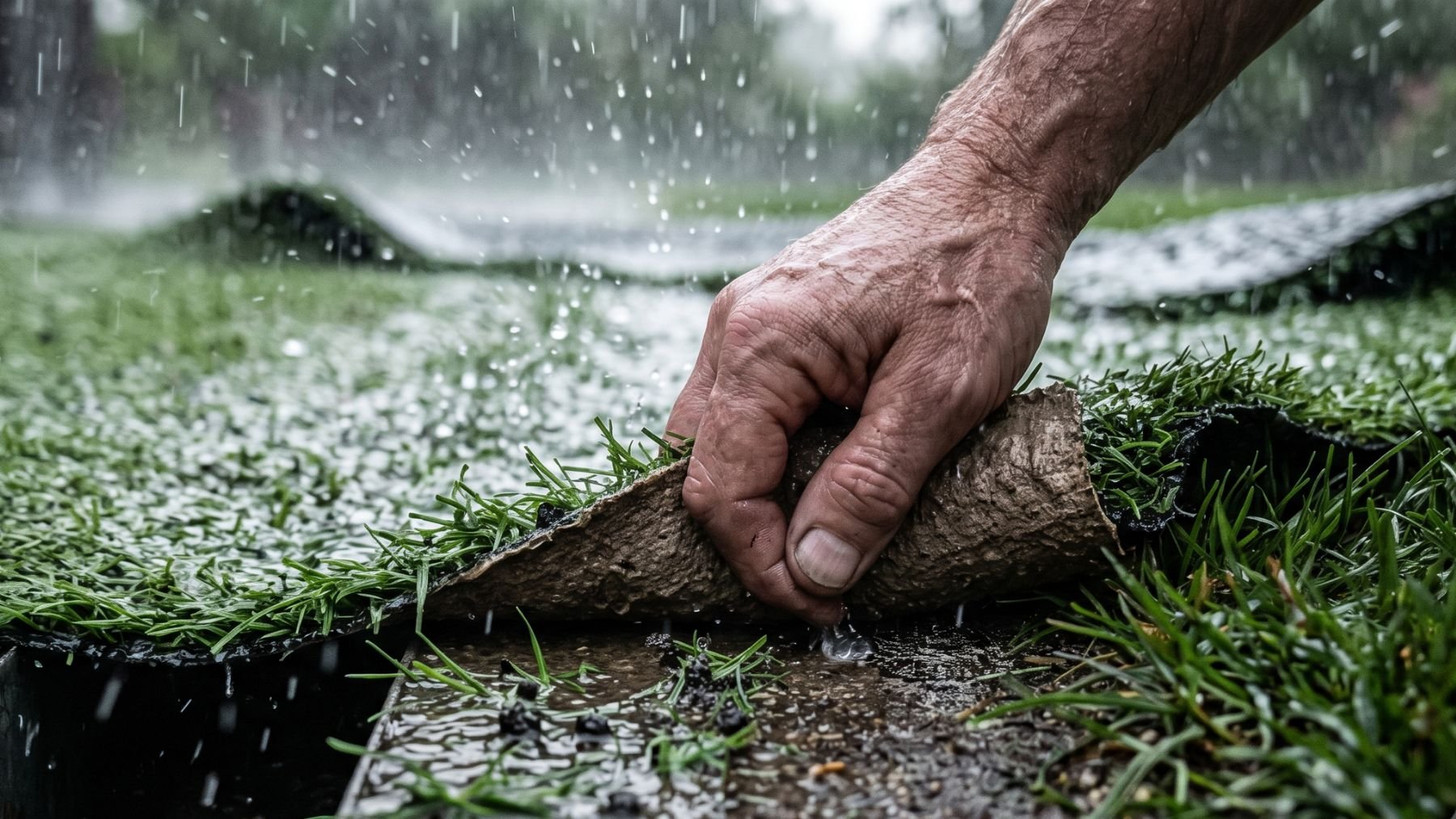
Rain rarely behaves the same way on a living lawn and a plastic one. In a controlled experiment, both artificial surfaces produced significantly more surface runoff than natural grass, while the plush 37-millimeter turf sent between 32.4% and 58.2% of the applied water toward the collection gutter. The living lawn sent almost none across the surface.
The water did not leave alone. In the 2021 peer-reviewed experiment, researchers also recovered loose synthetic blades and plastic thatch from the runoff. It was an early controlled test rather than a verdict on every yard, but when the next downpour hits, where will the water go and what might it carry?
Researchers built three kinds of lawn in a polytunnel
Thomas J. Simpson and Robert A. Francis compared nine small lawn installations inside a polytunnel in Hertfordshire, England. Three boxes held established dwarf perennial ryegrass, three held 22-millimeter short-pile artificial turf, and three held a denser 37-millimeter long-pile product. Each box measured 46 by 33 centimeters, about the footprint of a large doormat.
They applied 750, 1,000, or 1,250 milliliters of water over about 90 seconds, repeating each rainfall treatment across 10 days. Surface runoff was collected within five minutes, while water passing through the substrate was measured after 45 minutes and again roughly 23 hours later. That timing matters because a slower release can ease the sudden rush toward a storm drain.
Living grass behaved like a slow-release sponge
The natural lawn’s surface runoff remained negligible under all three treatments. Researchers estimated that it retained essentially all of the smallest water dose, 60.5% of the middle dose, and 26.4% of the largest, with much of the remainder draining through the soil rather than racing off the top. It bought time.
The short-pile turf sent 4.3% of the smallest dose and 11.5% of the largest into surface runoff. Its estimated retention fell from 59.9% to 14.2%. The long-pile turf was more striking, with 32.4% to 58.2% of the applied water leaving as runoff and retention ranging from 15.7% to 39.4%.
The plushest artificial lawn had the biggest runoff problem
Why did the thicker carpet perform worse? The authors suggested that its taller, denser plastic fibers intercepted rainfall, while the backing and installation layers offered less opportunity for infiltration. In everyday terms, the product that looked most like a lush lawn behaved more like a rain shield, producing the kind of water sheet that slides toward the curb.
The shorter turf had a different tradeoff. Water often moved through its sand-rich base quickly, which can reduce puddling, but it still retained less and released water sooner than living grass. The researchers wrote that “the potential impacts on runoff in particular should be considered” when natural lawns are replaced.
Loose plastic traveled with the runoff
Across the experiment, the team recovered nine synthetic grass blades and two pieces of plastic thatch from the collected water. The thatch pieces measured 22 and 35 millimeters, while one blade was 7 millimeters and the others were at least 33 millimeters long. Most appeared during the first 15 days.
That finding should not be inflated into an annual pollution estimate. The study did not measure the mass of plastic lost from a full yard, and the installations were not walked on by people or pets. Still, rain alone moved visible pieces beyond the turf, and the authors said real-world use could increase shedding, although that needs testing.
What a homeowner can take from the experiment
This was a small controlled study, not a neighborhood flood model. It tested two products from one company, one 40-millimeter living grass height, and temperate conditions, so soil, slope, wear, installation methods, and climate may change the result. Artificial turf may reduce routine irrigation and mowing, while heavily watered and fertilized living lawns carry environmental costs of their own.
Even so, the findings point to a useful design check before the rolls go down. Look at the slope and the nearest drain, then ask whether a planted border, rain garden, gravel trench, berm, or shallow swale can receive the overflow. University of Florida guidance also recommends on-site features such as rain gardens and swales where synthetic turf is used.
The issue has already reached public debate, with Wales’s climate minister saying in June 2023 that a possible ban should be explored. A lawn that never needs a drink may also be a lawn that never holds the rain.
The study was published in Urban Forestry & Urban Greening.