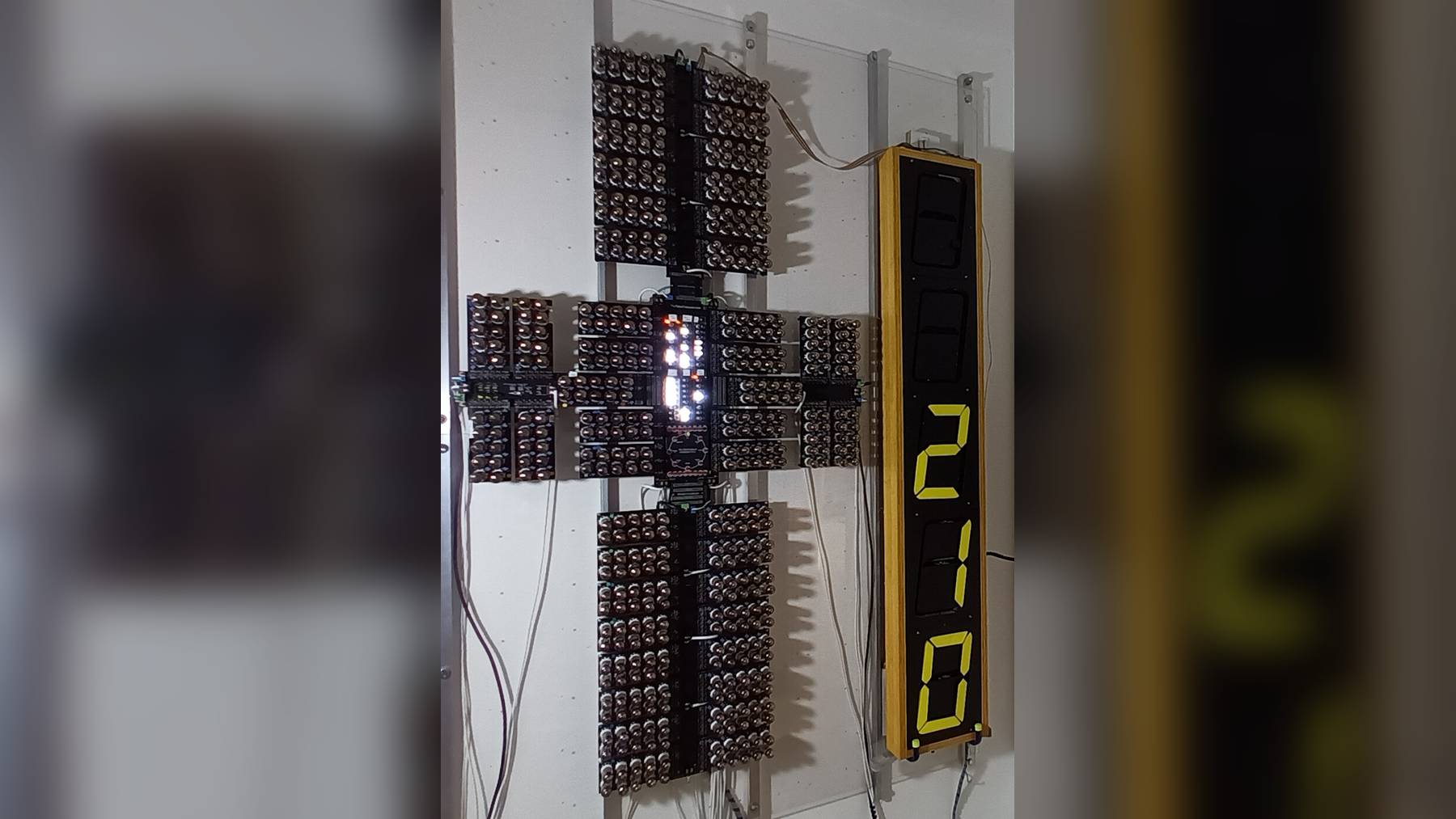
“Building tube computers has become an addiction, this is my third!” Mike writes on The Tube Computer, the site where he keeps notes on his vacuum tube computer. His first one ran on May 28, 2021, sprawled over the dining room table, the chairs and a good part of the floor. This one hangs on a wall of the house.
He sums it up as “a modern 8 bit design, built with recycled 1950s vacuum tubes, that glow and heat the entire room.” There are 460 of them, 6N3P double triodes that, he wrote on Hackaday.io, he found in Eastern Europe a few years ago.
A visit to Bletchley Park
It started with a day out at Bletchley Park. Mike came away thinking about the tube computers that had been rebuilt for museums and the fact that “no new models had been constructed for over 50 years.” Building one sounded ridiculous to him. He did it anyway, curious whether a modern design could deal with the size, the power and “the very real danger of high voltages.”
He got back to tinkering after he retired. “My most important discovery is that building stuff is a great way to learn,” he writes.
The grandchildren gave him a reason. Explaining his earlier machines had meant waving his hands around hot tubes and scribbling drawings, he says. “This time I wanted my grandchildren to be able to actually see it work, with maybe just a bit of hand waving, but absolutely no scribbling.”
Nothing but NOR gates
His first attempts used several types of logic gate. “They all became too intricate,” he admits, so he went back to one rule, keep it simple, and built everything out of NOR gates. “This made it really interesting, as the ALU and binary counters had to be designed with just NOR gates, which was fun!”
Each glass tube holds two triodes sharing one heater, which saves space and power, according to his technical notes. So 460 tubes give him 920 triodes, plugged in 10 tubes to a module, which works out to 46 modules.
The panel they hang on is 190 by 130 centimeters, roughly 6.2 by 4.3 feet. “The total wall load is about 20Kg and fortunately, the wall is made of brick,” he notes, which is about 44 pounds.
IBM’s 700 series, which Mike calls the most successful computer system of the 1950s, combined more than 1,700 tubes with thousands of germanium diodes and could be rented for $12,000 a month, by his account. His machine has about a quarter of the tube count. “The Tube Computer is slightly cheaper,” he deadpans.
Dust, a red glow and a fire extinguisher
Starting it up is slow. The tubes start to glow red, and “after about a minute The Tube Computer has a pleasant homely aroma from the hundreds of double triodes, all quietly burning off their dust.”
Then comes the wait. About 10 minutes for the temperature to settle, he says, a few last adjustments, and a glance at the fire extinguisher. His wife, Judy, bought him a fire extinguisher after an earlier machine “went BANG twice.”
Keeping it running takes work. “It is probably one of the few computers that needs both a small tweeker and a big step ladder!” he writes, adding that “the step ladder keeps me fit!”
The tubes themselves are a gamble. They were made in several grades in many factories across what were then communist countries, rated anywhere from 500 hours for basic domestic ones up to 5,000 for military stock. “Many were used and then stored for over 50 years,” Mike writes, “so life expectancy may be questionable, both for the tubes and for me!”
Reuse with a heater attached
Giving old parts a second job is the green side of the story. The Global E-waste Monitor 2024 counted 62 million metric tons of electronic waste generated worldwide in 2022, and only 22.3% was documented as formally collected and recycled.
Hundreds of heated tubes cost energy, though, and Mike’s pages give no figure for how much electricity the machine draws. Without one, its overall footprint is anyone’s guess.
The airship flight simulator he wrote for the grandchildren, a trip around Brighton, is still waiting on the input and output system. “So no flight sim yet!” he writes.
Photo: The Tube Computer