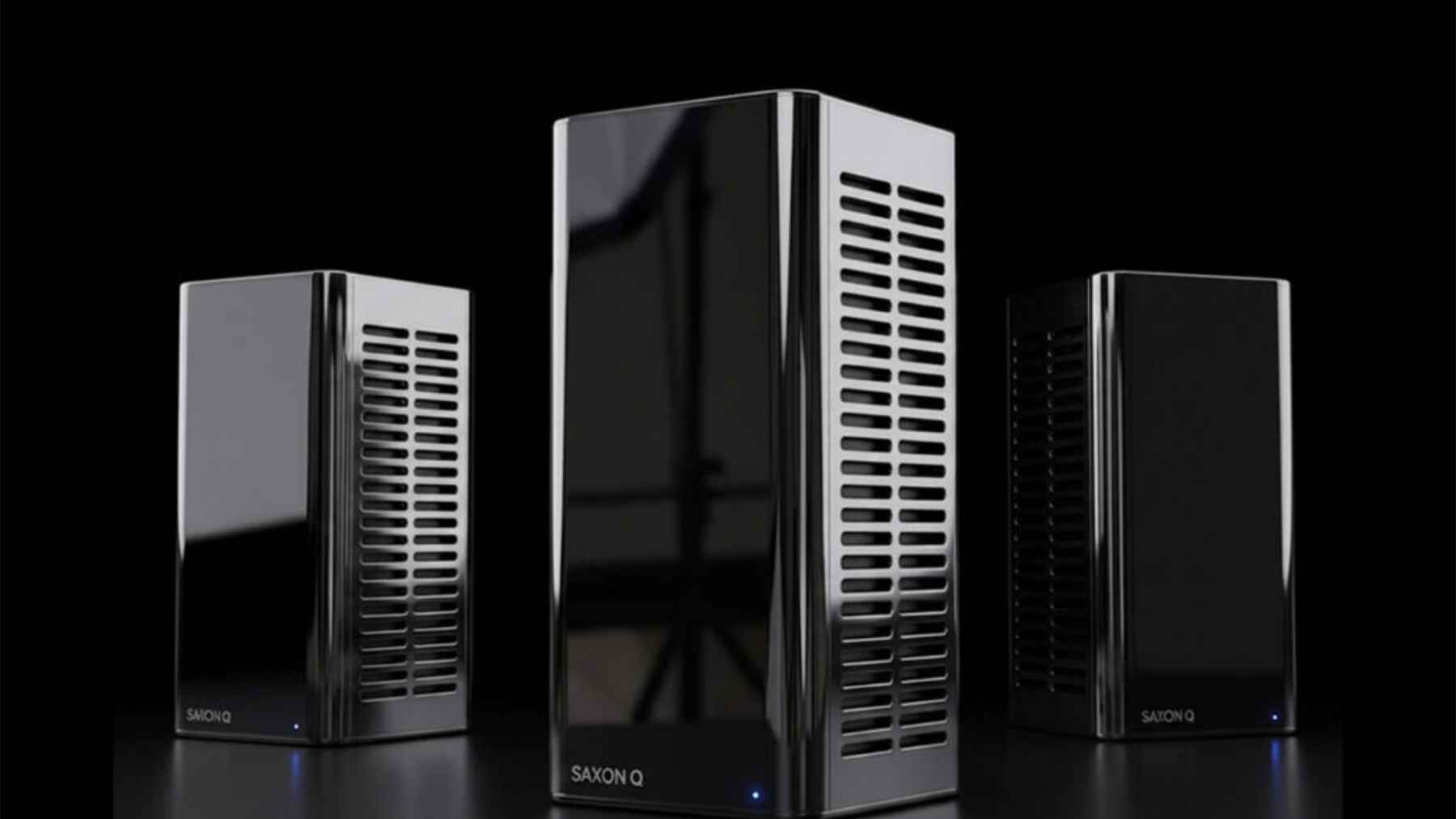
A German startup spun out of Leipzig University has opened orders for two diamond-based quantum computers: the 128-qubit SXQ128 and the 512-qubit SXQ512. SAXON Q says both operate at room temperature, fit inside a standard server rack, and connect to an ordinary electrical supply without cryogenic cooling or vacuum equipment.
That sounds like quantum computing finally stepping out of the laboratory, but one important detail needs explanation: the headline totals describe multicore machines, while the company’s specifications list 8 fully entangled qubits per core in the SXQ128 and 16 per core in the SXQ512.
A quantum computer without the deep freeze
Most superconducting quantum processors depend on elaborate refrigeration, but nitrogen-vacancy systems use defects in diamond whose spin states can be controlled under ambient conditions. In practical terms, this replaces a specialized cryogenic installation with a transportable cabinet that can sit in a normal office or research facility.
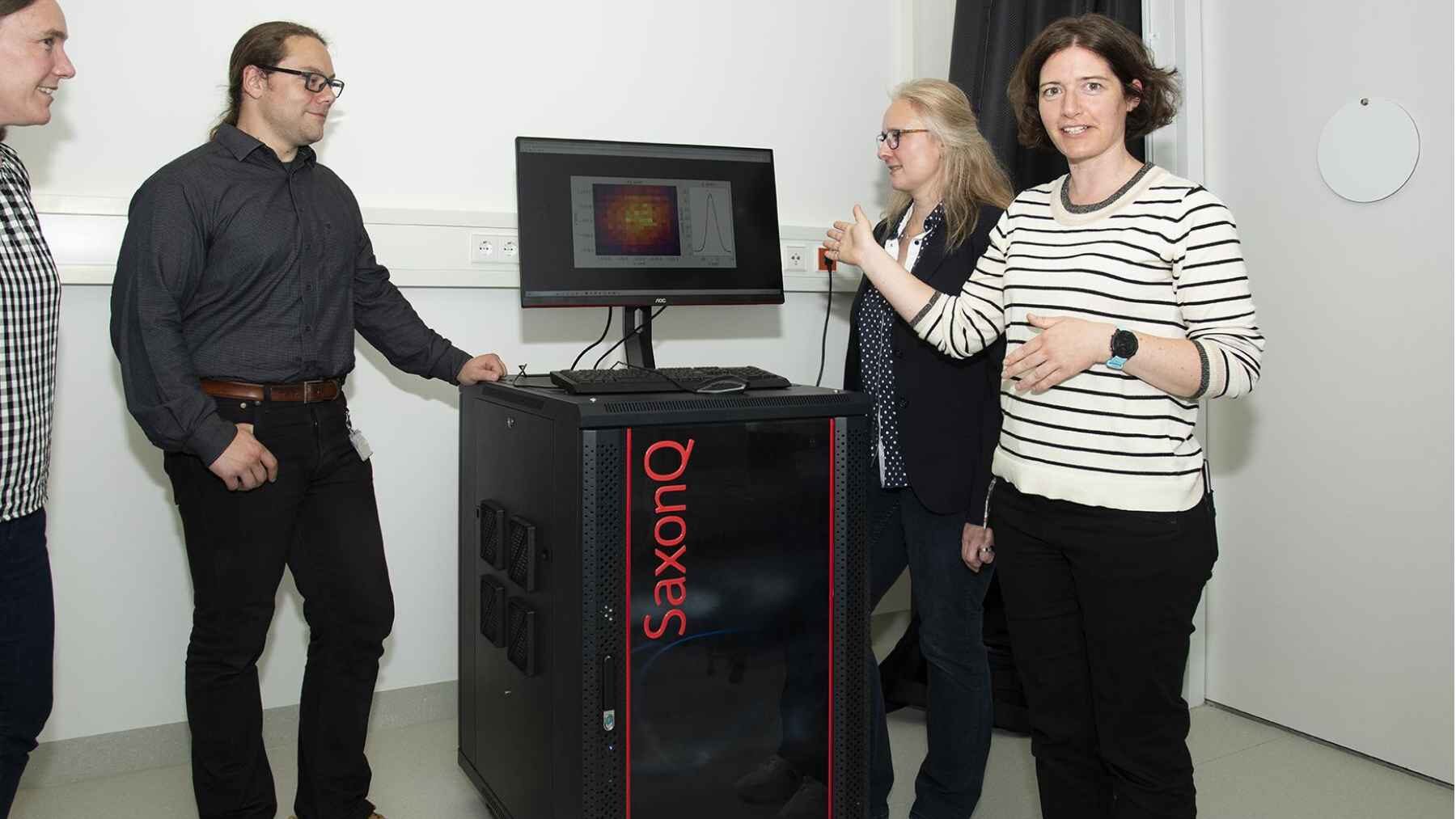
“Portable” does not mean laptop-sized, so think server equipment on wheels rather than something tucked into a backpack. Fraunhofer IWU has operated a four-qubit SAXON Q machine in Dresden since June 2025, and Germany’s DLR Quantum Computing Initiative says it has accepted four-qubit demonstrators based on the same room-temperature approach.
How a flawed diamond becomes a qubit
An NV center forms when a nitrogen atom replaces one carbon atom in the diamond lattice and sits beside an empty atomic site. Its electron spin can store quantum information, while light initializes and reads the state and microwave pulses manipulate it.
This underlying physics is not new. Researchers demonstrated room-temperature entanglement between engineered defect spins in diamond more than a decade ago, while the hard part has been creating many useful centers at precise locations without losing charge stability, coherence, or reliable control.
Why sulfur matters
SAXON Q says its manufacturing advance comes from co-implanting sulfur, which donates electrons and helps keep the NV centers negatively charged. The company reports a conversion yield above 85%, while peer-reviewed work published in 2019 demonstrated up to 75% creation yield using charge-assisted defect engineering with donors including sulfur.
The general mechanism has scientific support, but the newest commercial figures remain company-reported. A 2025 Physical Review Research study found that sulfur can help NV formation, while also warning that competing sulfur-related defects may limit efficiency and that the microscopic process is not fully understood.
Fidelity is only part of the story
SAXON Q reports fidelity as high as 99.92%. Its 2026 whitepaper lists up to 0.9992 for one-qubit gates in its third-generation, dual-core machine, 0.97 for two-qubit gates, and a value above 0.99 for optimized multi-qubit pulses that is labeled as simulated.
Those distinctions matter because a computer can perform excellent one-qubit operations and still struggle with the entangling gates needed for deeper algorithms. The next useful disclosure would be model-specific benchmarking across every core, not only a best-case percentage.
What 128 qubits really means
The SXQ128 divides its total across cores with eight fully entangled qubits each, while the SXQ512 uses cores with 16. These cores can work in parallel, allowing several jobs or pieces of a decomposed problem to run at the same time.
That architecture can be valuable for workloads that split naturally into smaller tasks, but it is not equivalent to a single register containing 128 or 512 mutually entangled qubits. SAXON Q’s own whitepaper notes that circuit cutting requires classical recombination, adds overhead, and does not scale well for problems that demand extensive entanglement.
The environmental promise
Removing deep refrigeration could reduce one of quantum computing’s largest infrastructure burdens. A peer-reviewed energy model found that cooling can consume far more power than quantum computation itself in cryogenic systems, and that operating temperature can shift energy requirements by orders of magnitude.
Still, a wall plug is not proof of a smaller carbon footprint, and although SAXON Q says its systems deliver six to ten times better energy performance than GPU-based approaches, its announcement does not publish a workload-by-workload methodology. A credible environmental comparison will need total system power, runtime, error rates, fabrication impacts, and useful results per kilowatt-hour.
What has actually run
The smaller platform has moved beyond a laboratory prototype, with a four-qubit system operating at Fraunhofer IWU. At Hannover Messe 2025, SAXON Q and control-hardware company Quantum Machines also demonstrated a hydrogen-molecule energy calculation and basic image recognition on a mobile room-temperature machine.
The new scale is at a different stage, with the SXQ128 available to order for delivery within three months and SXQ512 deliveries scheduled to begin in the second quarter of 2027. That makes this a commercial launch and engineering roadmap rather than a peer-reviewed benchmark package for every announced capability.
The milestone that matters next
The real test will be transparent, independently reproducible performance. Researchers will need full-core data on two-qubit fidelity, connectivity, calibration time, throughput, and energy consumed per completed workload before the new machines can be compared fairly with superconducting, ion-trap, neutral-atom, or photonic systems.
For now, the strongest verified advance is simpler but still significant. Diamond-based quantum hardware has operated at room temperature in real research facilities, and SAXON Q is trying to scale that deployable design far beyond four qubits without bringing the deep freeze back into the room.
The official announcement was published on SAXON Q’s website.