A rare circular Maya structure has emerged from the forest floor in northeastern Petén, Guatemala, and archaeologists say it could open a new window into a poorly understood moment in Maya history. The building, called Okox, means “mushroom” in q’eqchi’ and was built roughly 2,000 years ago, between 100 BCE and 150 CE.
The discovery matters because Okox was found in unusually good condition, with no evidence of looting. That is not a small detail in a region where many ancient structures have been disturbed. Not every Maya story starts with a towering pyramid, and this one may be powerful precisely because it comes from a smaller, more residential settlement.
A hidden building called Okox
Okox was found at the archaeological site of El Tigre, a settlement in northern Guatemala that sits 8.7 miles from Nakbé and about 10 miles from Naachtún. The work was carried out by the Lechugal Norte-El Tigre Archaeological Project, with researchers from Guatemala, France, Mexico, and Canada.
The structure is modest in size, but not in meaning. Its circular platform stands 7.2 ft. high and 16.4 ft. across, while the attached rectangular section measures 16.4 ft. long, 13.1 ft. wide, and 6.2 ft. high. Together, the two parts stretch about 33 ft. in length.
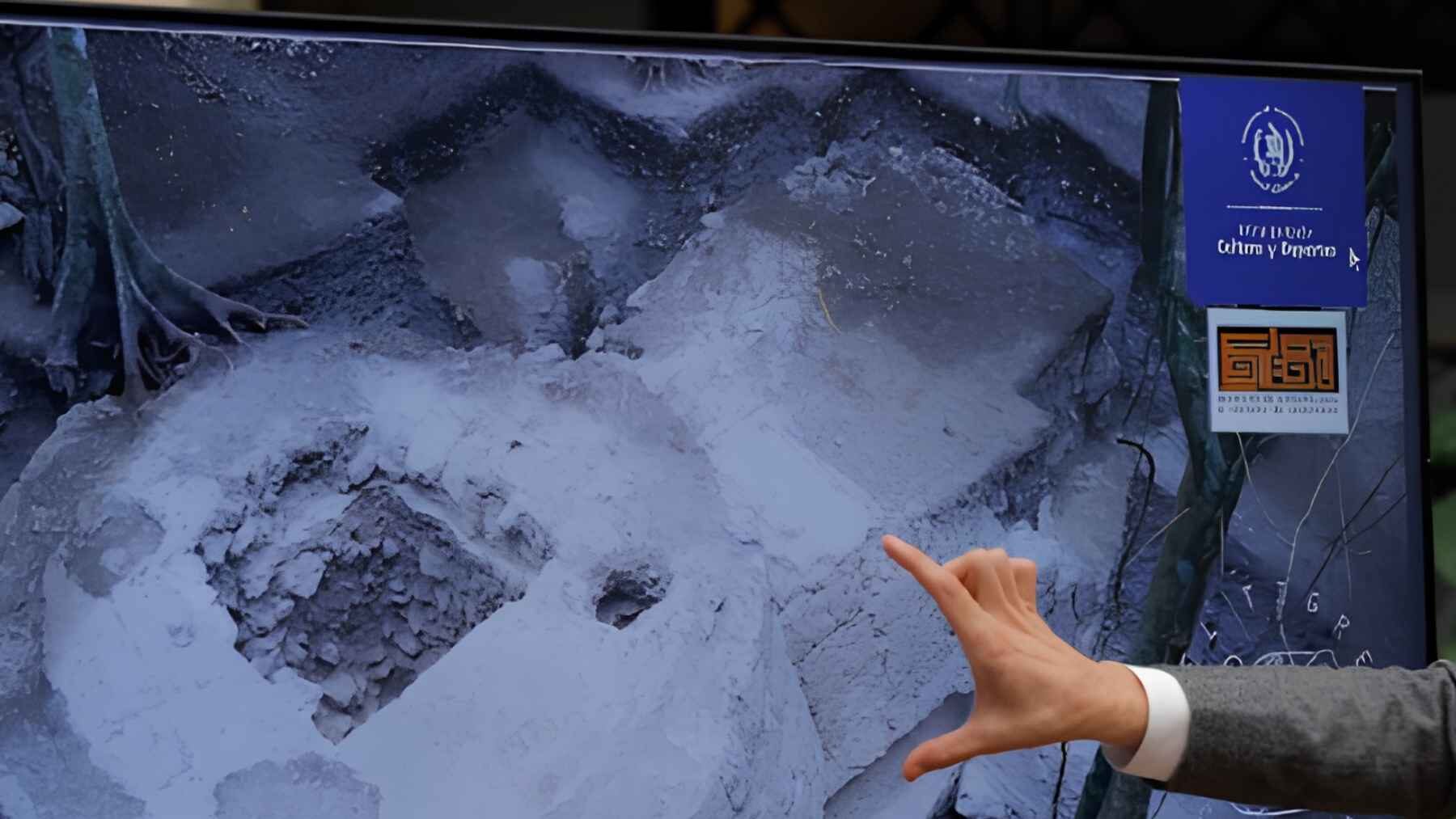
A stairway about 5 ft. wide led into the building, and the limestone blocks used in its construction measured 2.6 ft. by 1 ft. by 0.8 ft. Archaeologists also found decorative molding around the structure and traces of red paint on preserved stucco. A quiet building, yes, but not a careless one.
Why this find matters
The biggest clue may be where Okox sits in time. El Tigre contains two acropolises only 164 ft. apart, one associated with the Preclassic period and the other with the Classic period. That makes the site especially useful for studying the transition around 150 CE, a complicated shift in Maya politics, religion, and settlement patterns.
El Tigre does not appear to have been the seat of an independent dynasty. Researchers note that it lacks several features often seen in major Maya power centers, including an E Group, a triadic complex, a ball court, and stelae. Essentially, that suggests a different kind of place, possibly an administrative, tax, economic, or market center.
That makes the discovery feel more human. Several thousand people may have lived there, not necessarily under the shadow of a famous royal capital, but in a busy community with its own rituals, status symbols, and local authority. How much power did such places hold? Okox may help answer that.
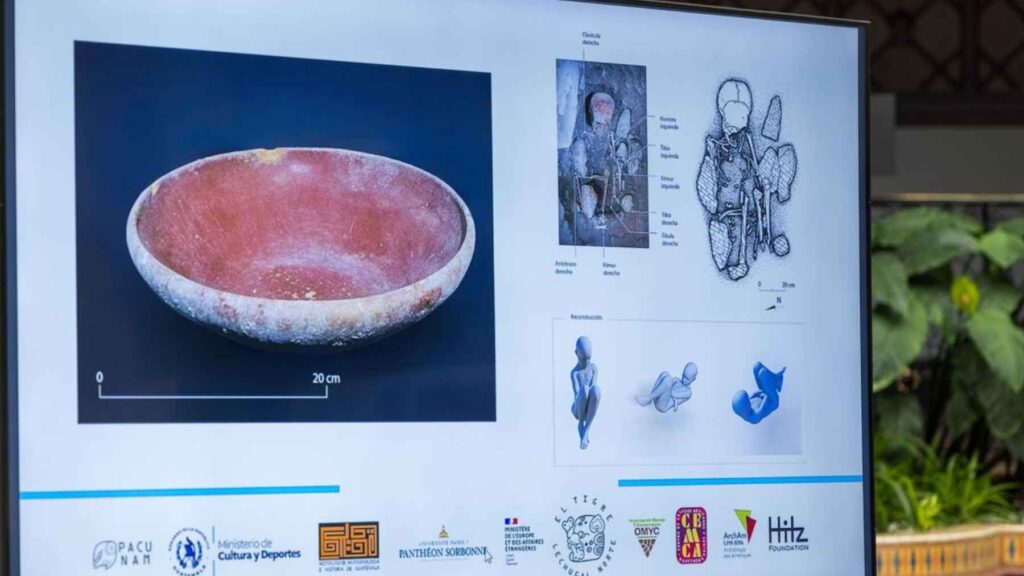
An official presentation highlights ceramic artifacts, burial documentation, and digital reconstructions from the Okox circular Maya structure discovered at El Tigre in Guatemala’s Petén region.
Burials beneath the platform
The excavations revealed several burials associated with the structure. Infants were placed in the fill beneath or near the building, including a baby younger than 3 months, another child about 7 to 9 months old, and a child about 7 to 9 years old near the access stairway. Researchers have described these burials cautiously, suggesting they may have functioned as offerings linked to the construction.
At the center, archaeologists found the burial of a man between 30 and 40 years old. He had been placed in a seated position, wrapped as a bundle, beneath a large vessel. Nearby was a stingray spine awl, an object associated with Maya bloodletting rituals and high religious or political status.
That does not mean every answer is already clear. For the most part, the burials raise careful questions rather than easy conclusions. Were the children related to the man? Were they chosen for family, ritual, or political reasons? Ancient DNA and other tests may help, but the humid environment of Petén can make genetic preservation difficult.
A possible sky connection
Because Okox dates to a period before writing became widespread in the region, archaeologists cannot simply read an inscription and explain what the building meant. Instead, they have to work with architecture, orientation, artifacts, and burial placement. That is slower, and it leaves room for uncertainty.
Some details suggest the builders may have cared deeply about direction. The structure has projecting moldings toward the west, north, and east, and the infant burials found so far were placed roughly to the north and west. Researchers have also noted lines drawn on the structure and on the later floor that covered it.
Those lines may correspond to the position of the sunset near the end of April, a time linked in the region to burning milpas before a new agricultural cycle. It is an intriguing idea, especially for a farming society watching the seasons closely, but the researchers themselves warn that the interpretation remains speculative. Sometimes a line can carry symbolic meaning. Sometimes it can also be practical.
A ritual ending
During the Terminal Preclassic period, Okox was partially dismantled and buried under fill, then covered by a new floor. Researchers believe this may have been a ritual or symbolic act, rather than a simple effort to reuse building materials.
That final treatment is one reason the structure survived so well. Unlike circular structures at sites such as El Achiotal and Uaxactún, Okox was not built over again after it was buried. Once the people of El Tigre sealed this sector, they appear to have left it alone.
There is a modern warning here, too. LiDAR work in the broader region has shown a much denser ancient occupation than traditional surveys once suggested, but it has also exposed the scale of looting in parts of the Maya Biosphere Reserve. The past is still there, but it is not always safe.
What comes next
The next phase will focus on laboratory work. Researchers plan radiocarbon dating, ancient DNA testing, and isotopic analysis to learn more about the people buried around Okox, including where they came from, what they ate, and what kind of lives they may have lived.
The team also plans to keep studying the building’s architectural context. Was Okox part of a larger ritual group, or did it stand apart inside the settlement? That detail could change how experts understand religious life in communities that were complex, populated, and socially layered, but not as monumental as the best-known Maya cities.
For now, Okox is less a solved mystery than a rare preserved question.
The official statement was published on Ministerio de Cultura y Deportes de Guatemala.